

JPMorgan Chase & Co. reported its highest quarterly net interest income ever and raised its guidance for the year as the biggest U.S. bank reaps rewards from the Federal Reserve’s interest rate hikes.
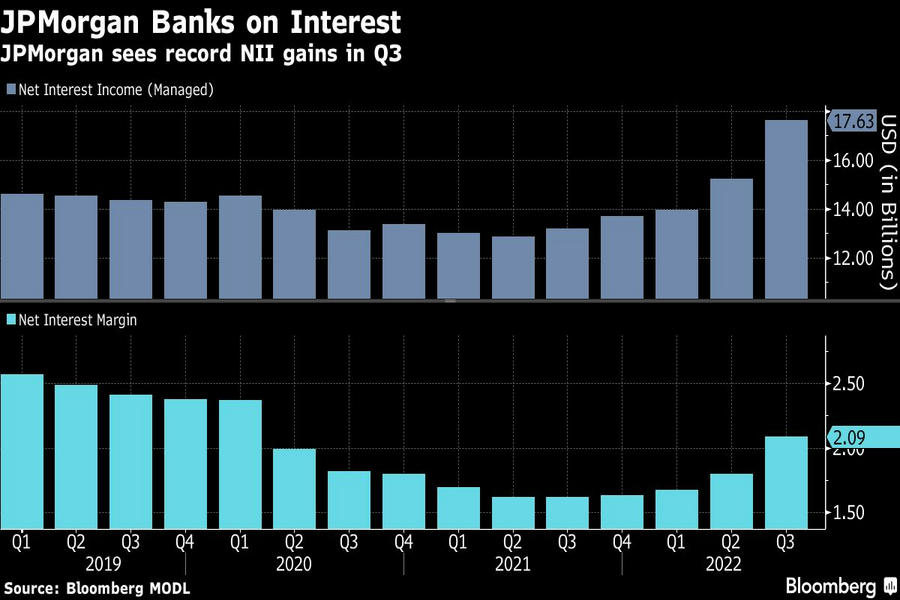
The firm generated $17.6 billion in third quarter net interest income, the money it earns on loans minus what it pays out for deposits. Expenses also came in lower than analysts expected, driving a profit beat.
“In the U.S., consumers continue to spend with solid balance sheets, job openings are plentiful and businesses remain healthy,” Chief Executive Officer Jamie Dimon said in a statement Friday. “However, there are significant headwinds immediately in front of us,” the CEO said, citing high inflation leading to higher global interest rates, quantitative tightening, the war in Ukraine, and “the fragile state of oil supply and prices.”
Investors are scouring Friday’s results for four of the biggest U.S. banks for clues on how consumers and companies are faring as interest rates rise and recession threats mount. Wells Fargo & Co., Citigroup Inc. and Morgan Stanley also report third-quarter results Friday, with Bank of America Corp. and Goldman Sachs Group Inc. up next week.
At a conference Thursday, Dimon said he doesn’t think the U.S. can avoid a recession as the Federal Reserve raises interest rates to choke off inflation. The CEO said his “gut” tells him that the central bank’s benchmark rate will probably have to rise higher than the 4% to 4.5% level many economists are predicting, as price pressures persist. Core inflation, excluding food and energy, jumped to a 40-year high of 6.6% in September from a year earlier, data released Thursday showed.
Shares of JPMorgan, which are down 28% this year, rose 4.4% at 9:39 a.m. in New York. The gain of 12% since Wednesday represents the strongest three-day streak since November 2020.
Results were marred by a $959 million net investment securities loss, which “reflected higher net losses on sales of U.S. Treasuries and mortgage-backed securities,” the New York-based company said in the statement.
JPMorgan raised its guidance for this year’s net interest income excluding its markets business, saying it now expects about $61.5 billion. The firm said in July it would pull in at least $58 billion from that source.
JPMorgan temporarily suspended share buybacks in July in order to quickly meet higher capital requirements while maintaining flexibility to navigate a changing economic environment. The move came at a cost to investors: In the year preceding the pause, the firm had averaged about $2.2 billion of buybacks a quarter. Dimon said in the statement Friday that the firm hopes to resume buybacks early next year.
JPMorgan’s noninterest expenses rose 12% to $19.2 billion, slightly lower than what analysts were expecting. The firm’s spending has been a key focus for investors this year after executives predicted an 8.6% increase from 2021. Costs are up 7% for the first nine months of the year.
Investment-banking fees fell 47%, less than analysts expected. JPMorgan President Daniel Pinto said last month that revenue from the business could fall by half as clients spooked by economic uncertainty stay on the sidelines. Trading revenue rose slightly, with a 22% jump in fixed income offset by an 11% drop in equities. Pinto said last month that markets revenue could increase 5% in the third quarter from a year earlier.
The firm set aside $1.5 billion for potentially soured loans, more than the $1.2 billion analysts expected. That’s a stark contrast from a year ago, when the firm’s earnings were boosted by reserve releases after predicted losses tied to the Covid-19 pandemic never materialized.

The Pennsylvania-based recordkeeper is 'playing Switzerland' as data on 16 million savers will help plan advisors reach 401(k) participants at rollovers and retirement

A BCG report finds private credit and hedge funds driving CIB growth while AI reshapes bank operating economics through 2030.

Janney opens a Houston office with four advisors from Raymond James as Rockefeller deepens its Naples, Florida wealth management footprint.

Bernstein Private Wealth experts says childless adults hold significant wealth yet rarely have a plan.

Shorter waits for failed SIE and Series 7 candidates take effect Jan. 19, speeding the path to registration.
Knighthead Life entered the market with a competitive MYGA. A strong launch earned advisor confidence and paved the way for FIAs.
As AI makes financial information more accessible than ever, Lana Hock explains why human judgment, trust, and empathy remain the qualities clients value most in a financial advisor

