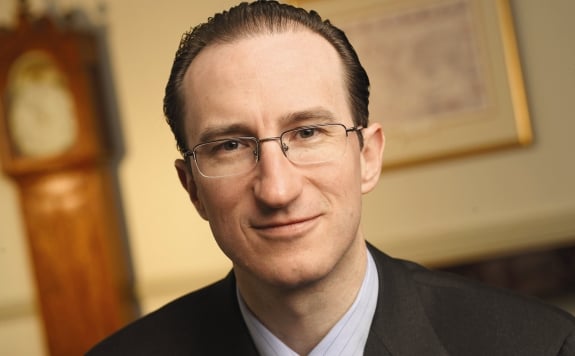
Bill Miller's decision to relinquish the reigns of Legg Mason Capital Management Value Trust in April is unlikely to herald big changes in how the $2.8 billion fund is being run today, according to the fund's incoming lead manager, Sam Peters.
“The core bedrock of a valuation-driven concentrated portfolio is still in place,” said Sam Peters, who has been co-managing Legg Mason Capital Management Value Trust (LMVTX) with Mr. Miller for the past 12 months. “And how long I hold positions will be measured in years, not in quarters or months.”
Mr. Peters, 42, who also co-manages the $1 billion Legg Mason Capital Management Special Investment Fund (LMNSX) joined Legg Mason Capital Management in 2005. Before that, he spent seven years at
Fidelity Investments as an analyst and money manager specializing the financial, health care and technology sectors.
“I knew it was possible I could be taking over the [Value Trust] fund this soon,” Mr. Peters said of the announcement on Thursday. “We told investors that we would give them a heads-up. But I was ready to go if it happened on Day One or if it happened two years from now.”
MILLER'S RECORD
Mr. Miller, 61, has managed the Value Trust fund since it was launched in 1982, when Mr. Peters was just 12.
Over that 30-year period, Mr. Miller set a celebrated 15-year record through 2005 for consecutively outperforming the S&P 500. More recently, however, the fund has lagged the index in four of the last five years, and through Nov. 17 was down 7%, compared with a 1.5% decline for the index.
With the exception of 2009, when the fund's 40.6% gain beat the S&P 500's 26.5% gain, it has lingered in the 98th and 99th percentiles of Morningstar Inc.'s large-cap-blend category since 2006.
The fund's assets, which peaked in 2005 at around $12 billion, have since declined by 77% to $2.8 billion.
Mr. Miller will remain as chairman of the $8.7 billion asset management arm of Legg Mason Inc., but according to Mr. Peters, the transition of management of the Value Trust fund has already begun.
“Investors can look at the fund starting now to see how I'm going to be managing it,” he said. “I've been working with Bill for six years now, and a big part of my job is continuity, but you can't come in [as a new lead manager] and be someone else.”
According to the most recent public filings at the end of September, the historically low-turnover portfolio has upped its trading activity.
The filing showed reduced exposure to financial sector giants
Bank of America Corp. (BAC),
Citigroup Inc. (C) and The
Goldman Sachs Group Inc. (GS), as well as Eastman Kodak Co. (EK) and Hewlett-Packard Co. (HPQ).
The fund also added exposure to financial sector firms
BlackRock Inc. (BLK) and
PNC Financial Services Group Inc. (PNC).
The portfolio's largest position is Apple Inc. (AAPL) at 3.5%.
RELATED ITEM The fund firms advisers are most loyal to »
For a fund that had just 4% turnover in 2009 and has a 20% annual average turnover rate, the most recent filing represents significant activity, according to Russel Kinnel, director of research at Morningstar.
“We don't know if this is a one-time changeover to stocks Sam Peters likes, but it does seem like they're dumping some of the lower performers,” he said.
Considering Mr. Miller's age and long tenure with the fund, Mr. Kinnel said the management change is “not terribly surprising.”
However, he added, “what's more surprising is the dramatic rise and fall of a fund that had such an amazing record and then pretty much squandered it in the past few years.”
Morningstar has awarded the fund just one star, and under its new forward-looking analysts' ratings system, the fund is rated as neutral, a rating that Mr. Kinnel does not expect to see immediately adjusted under the management change.
“For investors, this is as good a time as any to take another look at this fund,” he said. “I don't think [the portfolio manager change] makes the fund significantly more attractive, but it wasn't very attractive to begin with.”
Todd Rosenbluth, a mutual fund analyst at S&P Capital IQ, a unit of Standard & Poor's, warned that a management change of this magnitude could add risk to the fund — at least temporarily.
“It has been a bumpy last few years for the fund, and [Mr. Peters] is coming in at a time that might help to turn it around,” he said. “But investors need to continue to review what happens here and look at it almost like a new fund.”
“If you bought the fund for the excellent long-term track record, the change should give you some pause,” Mr. Rosenbluth added. “A management change typically adds some risk, although a planned succession like this is less risky.”