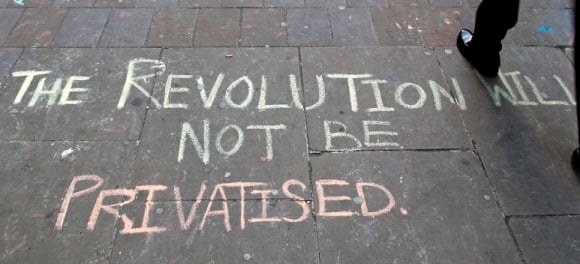
In perhaps the ultimate example of irony, the Occupy Wall Street movement now has its own stock index.
Created by Minyanville Media Inc. columnist Michael Comeau, the tidy collection of eight stocks is designed to represent the kinds of corporate villains that have sent so many protestors into the streets.
“We're not making any calls one way or the other; we just want to see what happens” with the stocks in the index, Mr. Comeau said.
The list of companies was compiled by Mr. Comeau and his colleagues following research of the protests that included interviews with protestors, and the reading of blogs and other news reports on the subject.
The complete index includes BP PLC (BP), General Electric Co. (GE), The
Goldman Sachs Group Inc. (GS), JPMorgan Chase & Co. (JPM), Lockheed Martin Corp. (LMT), News Corp. (NWSA), SLM Corp. (SLM) and Wal-Mart Stores Inc. (WMT).
Each company was added to the index for a reason related to what Mr. Comeau learned from the protestors.
“JPMorgan and
Goldman Sachs were the biggest targets because they created mortgage-backed securities that were designed to fail,” he said.
General Electric, he explained, is considered a corporate tax dodger.
Wal-Mart is on the list because it has long been opposed to organized labor, which joined the movement shortly after it began.
News Corp., which owns and operates Fox News, was included “because we saw a lot of anti-Fox signs.”
“They're really not buying the whole fair-and-balanced stuff,” Mr. Comeau added.
When asked why he thought the protestors have not also included the bailed-out American automakers General Motors and Chrysler Corp. as targets, Mr. Comeau said, “Those companies are in Detroit and they employ blue-collar workers.”
“It's easier to visualize an auto industry worker in trouble,” he added. “But nobody really cares if a bunch of bankers lose their jobs.”
Mr. Comeau, who said he developed the index not as a statement of his own but to reflect the sentiment that he is observing, acknowledged the absence of a centralized theme among the protestors.
“The whole thing is an expression of the fact that people see uncertainty about the future and they don't see any solutions,” he said. “Everybody is showing up with whatever causes they're angry about.”
As far as why such an eclectic list of issues is being protested in lower Manhattan, Mr. Comeau surmised: “Occupy Wall Street is an easy and memorable name, but it is almost a branding failure because most of the financial companies moved out of that area a long time ago.”
Of the stocks making up the OWS index, News Corp. has performed the best so far this year, up 15.12% from the start of the year, and
Goldman Sachs has done the worst, down 38.36%.
That compares with a 3.15% drop in the S&P 500 over the same period.