
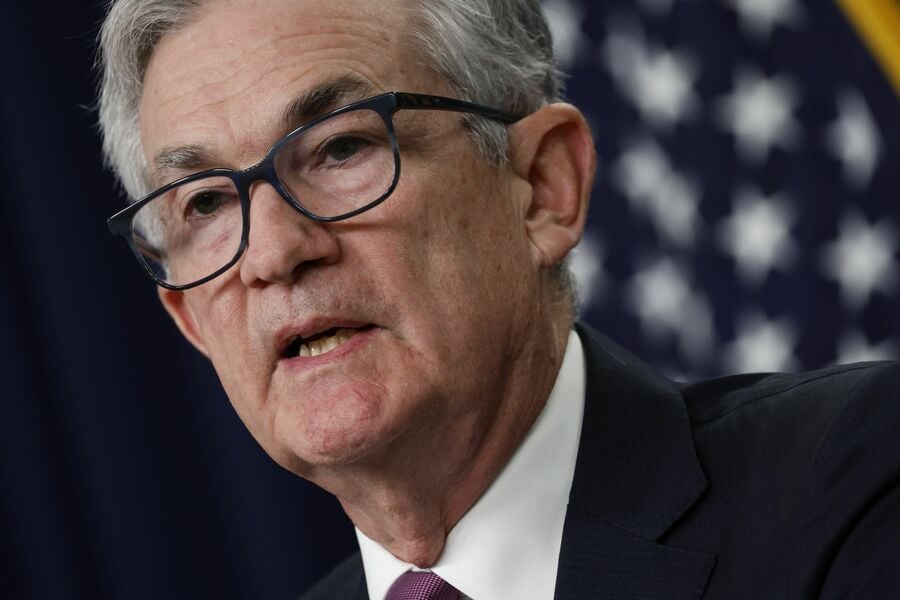
Federal Reserve Chair Jerome Powell said the economic impact of new tariffs is likely to be significantly larger than expected, and the central bank must make sure that doesn’t lead to a growing inflation problem.
“While uncertainty remains elevated, it is now becoming clear that the tariff increases will be significantly larger than expected,” Powell said Friday at the Society for Advancing Business Editing and Writing annual conference. “The same is likely to be true of the economic effects, which will include higher inflation and slower growth.”
Despite that view, in a question-and-answer session following his speech, Powell emphasized the central bank doesn’t need to hurry to adjust interest rates as policymakers wait for more clarity on the administration’s policies and their impact.
His remarks follow President Donald Trump’s announcement of sweeping new tariffs on imports from across the globe, which has already begun provoking retaliatory responses from foreign governments.
Powell’s tone was more cautious than his March 19 press conference when he said the inflationary impact of tariffs was expected to be transitory.
“While tariffs are highly likely to generate at least a temporary rise in inflation, it is also possible that the effects could be more persistent,” Powell said Friday.
He then stressed that Fed action will be focused on arresting any rise in public perceptions that inflation was slipping from the Fed’s control.
“Our obligation is to keep longer-term inflation expectations well anchored and to make certain that a one-time increase in the price level does not become an ongoing inflation problem,” he said. “We are well positioned to wait for greater clarity before considering any adjustments to our policy stance.”
During Powell’s remarks, a selloff in stocks deepened, bonds surged and oil hit a four-year low extending losses that were already being driven by China’s decision to step up its the fight against Trump’s tariffs.
In his Q&A, Powell expressed confidence the current high level of uncertainty driven by the new administration’s policies would fade.
“If you fast forward a year from now, the uncertainty should be much lower,” he said. “The actual effects of the policies should then be pretty manifest and clear.”
Tariffs announced by the Trump administration Wednesday will complicate the Fed’s task to maintain stable prices and maximum employment. Powell acknowledged conditions were pointing to a scenario in which those mandates would be in conflict, but added, “That’s not what we’re seeing right now.”
Fed officials will next gather May 6-7 in Washington.
Shortly before Powell’s speech, Trump said on Truth Social that it is a “PERFECT” time for Powell to cut interest rates. “He is always ‘late,”’ Trump posted. “CUT INTEREST RATES, JEROME, AND STOP PLAYING POLITICS!”
Stocks have tumbled by about 11% this year, measured by the S&P 500 Index, and yields on government 10-year notes had fallen below 4%, as of Friday morning, on the near-term risks to growth.
Powell spoke after the release of the March jobs report which showed non-farm payrolls rose by 228,000 last month. The unemployment rate ticked up to 4.2%. Some analysts are discounting the importance of the report in light of the tariff news.
Reading current data, Powell said the economy “is still in a good place.”
Bloomberg Economics has estimated the tariffs Trump announced so far could take the average effective tariff rate in the US to around 22%, from 2.3% in 2024.
Forecasters are raising their recession probability estimates, and futures contracts on the benchmark lending rate show investors betting on as many as four cuts in the policy rate this year.
Tariffs — essentially a tax on imports — could raise prices on a variety of consumer goods and services and squeeze margins at businesses trying to hold the line on price.
Inflation has been above the 2% target since 2021, and a continued miss could test public confidence in the price goal.
A tariff-induced spike in prices that produced second-round effects with further increases in inflation — and public expectations of higher prices over the medium term — would cause officials to hold back on cutting the rate and raise the possibility of an increase.
If the tariffs result in a one-time price shock with negative effects on growth and hiring, then Fed officials might consider the need for a cut, albeit with some delay as they wait for more data.

The financial advice industry has been facing inquiries into its cash sweep programs for years now.

Investor money allegedly went to strip clubs, exotic cars, and landscaping

Procyon adds $415 million in assets under management in New Jersey while Savant picks up a $213 million Southern California planning firm

With a growing number of real estate-rich Baby Boomers aging into retirement, some advisors may be failing to consider all the options available for those clients' assets.

Cornerstone Advisors study reveals compliance bottlenecks stall campaigns weeks after customer opportunities close.
As AI makes financial information more accessible than ever, Lana Hock explains why human judgment, trust, and empathy remain the qualities clients value most in a financial advisor
Northern Trust’s Ken Lassner shows advisors how to convert volatility into after-tax portfolio gains

