

Nick Hofer carved out his financial planning niche by going after clients that most of the industry isn’t interested in or doesn’t completely understand.
To be a client of Boston Family Advisors, you not only need to have at least $50 million mostly tied up in illiquid investments like private equity and venture capital, you also need to have a thirst for getting to the next level of success.
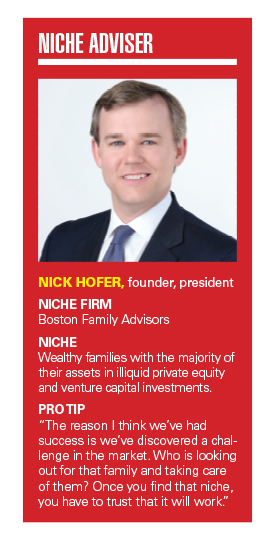
“If someone came to us who just sold their business for $10 million and now wants to go sit on a beach and retire, that’s not a client for us,” said Hofer, who founded Boston Family Advisors in 2018 after spending 20 years working with private banking clients at Boston Private.
Hofer said his experience in private banking exposed him to “where I saw the greatest need — folks in the VC or PE world with high amounts of carried interest or those people funded by one of those groups.”
Hofer works with 30 families that combine for more than $1 billion worth in total balance-sheet assets, about 60% of which is illiquid.
While his target market of households with between $50 million and $300 million of total net worth is clearly high net worth, Hofer said the illiquidity factor makes them less appealing to advisers looking to charge fees based on assets they can manage.
“I was working with a lot of VC and PE professionals while at Boston Private and we continued to come up against helping them in terms of finances when their investments are all tied up in illiquid assets, but when those assets become liquid there are 30 or 40 companies that say they want to work with them,” he said. “By waiting for a liquidity event, you are behind, because there is lots of estate planning and investment planning that can be done ahead of time. But for most of these folks, being rich on paper doesn’t necessarily appeal to people in our industry.”
Hofer described his niche as households just below traditional family office levels, where clients might pay annual fees of between $750,000 and $1.5 million.
“You’ve got that section of the market that’s too small to start their own family office, yet too big and with needs too unique to go to a typical advisory firm,” he said.
Because the household balance sheet assets are mostly illiquid, Hofer said an asset-based fee wouldn't work, especially since his model sometimes includes working with outside asset managers and advisers.
“If you have PE or VC or are an entrepreneur funded by them, you do not have to bring your assets over if you don’t want to,” he said. “This is where the financial planning industry really needs to take a hard look at their model. If you already have an adviser and really like that person, but need a bunch of other things, you shouldn’t have to get rid of your adviser. There’s room for collaboration.”
Hofer said that he acts as a manager of managers for 30% of his clients, while his firm manages the assets of half his clients, and the remaining 20% use a hybrid approach.
With such a varied service model, Hofer said establishing fees is often “more art than science, because it’s based on total balance-sheet assets as well as the scope and complexity of the services required, and the time it takes.
Arguing that most generic fee models based on clients' assets result in some clients overpaying and some underpaying for the services they receive, Hofer said determining the fees is unique to each client.
“I want to make sure you pay not a cent more than you have to and coming up with the right fee is probably the most arduous part of our work,” he said.
The annual fees, which range from $50,000 to $250,000 per household, are reevaluated every two years and are always presented in dollar terms, as opposed to as a percentage of assets that might otherwise be an easier sell to clients.
“Being transparent has its downside,” Hofer said. “Because we don’t quote in basis points, there is sometimes a little bit of sticker shock.”
With such a narrow target market, the business includes very little marketing, relying almost exclusively on referrals from clients.
That system has worked so far. Prior to the pandemic, Hofer said he had 10 clients, but by the end of 2020 he was working with 25 families.
His advice for anyone carving out a niche is to fine-tune it and stick to it.
“I have guided prospective clients elsewhere, and it’s not necessarily about the size of client assets, it’s also a mindset,” he said. “Our clients are always asking themselves what’s next. Those are the folks we’re looking for so we can introduce them into our ecosystem.”

Chicago-based Mesirow Fiduciary Solutions adds flexPATH's plan-level outsourced fiduciary book, boosting its retirement market reach to $164 billion.

Also, Raymond James's employee advisor channel adds breakaways from Wells Fargo and Stifel, while UBS welcomes an ex-Morgan Stanley duo in Indiana.

It promised guaranteed principal and 10% monthly returns. The SEC says it invested nothing.

Ten years after entering the fee-based annuity market, MassMutual Ascend says nearly half its lifetime sales came in the past two years alone – but barriers remain among fee-only advisors.

Amplify, WealthReach, Zeplyn and Zocks have unveiled partnerships aimed at automating portfolio management, content creation, account opening, and client communication.
Northern Trust’s Ken Lassner shows advisors how to convert volatility into after-tax portfolio gains
Dan Biagini of American Equity says the steady decline of pensions, longer lifespans and a reset in interest rates are rewriting how advisors build retirement income

