
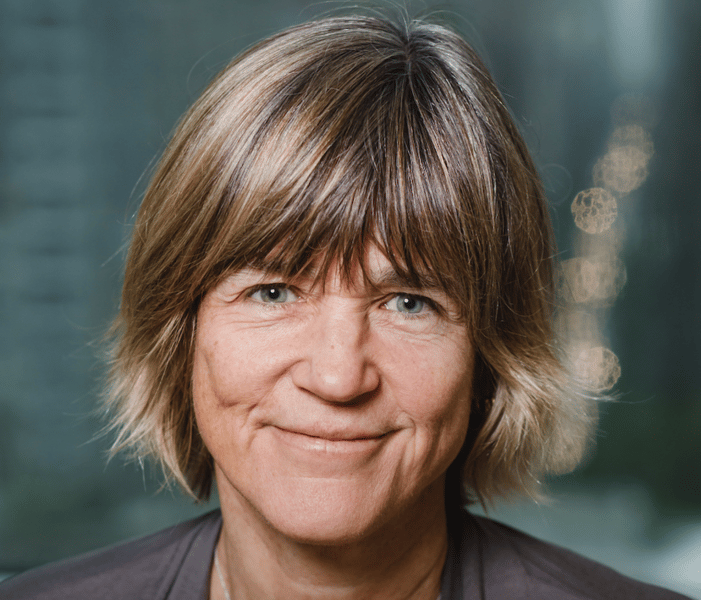
American businesses will continue to address environmental, social and governance concerns of their own operations no matter who becomes the next U.S. president, said Professor Tensie Whelan, director of the New York University Stern School of Business Center for Sustainable Business.
“Companies have continued to make substantial commitments to climate change targets, despite the Trump administration's climate denialism,” said Whelan in answers to questions from readers of InvestmentNews' ESG Clarity that were posted on Twitter on Friday.
Management of ESG issues is “mission critical” for businesses and will continue to be whether President Donald Trump or Democratic nominee Joe Biden secures the White House in November, she said.
Her center has created a methodology to help companies recognize how they are making money on their sustainability investments. The goal is for CFOs and investors to use its Return on Sustainability Investment (ROSI) tools to develop metrics that allow companies to better integrate, track, and report on corporate financial performance that comes from embedding ESG into business practices.
Whelan previously was president of the Rainforest Alliance and executive director of the New York League of Conservation Voters. She joined the Stern School of Business five years ago.
Can you define or describe what makes a business' practices sustainable or not?
Tensie Whelan: Sustainability is a journey—no one is there yet! But, sustainability should be core to business strategy (rather than siloed), focused on material ESG issues, set meaningful, time-bound targets, report externally, and align internal systems and incentives.
What do sustainable best practices look like? Any examples?
TW: Best practice is different depending on industry. Some key elements: focus on material ESG issues, use third party standards (SASB/GRI) to report on progress, robust stakeholder engagement, sustainability is part of the business strategy, board level engagement
What can businesses do ensure sustainable practices within supply chains?
TW: First, assess supplier sustainability thru surveys and inspections. Second, focus on high risk (environmental and social) suppliers with requirements to meet your standards or third party certification. Provide incentives for improvements. Should be a partnership not a transaction.
Do investors give up yield when investing in green bonds?
TW: Generally, the yield on green bonds is equivalent to conventional bonds, though can be lower due to high demand and low supply. Preliminary data during COVID-19 points toward more resiliency for green bonds. For corporate issuers, a reduction in cost of capital is possible.
Will the upcoming U.S. elections impact whether businesses continue to embrace sustainability?
TW: Companies have continued to make substantial commitments to climate change targets, despite the Trump Administration's climate denialism. Business will continue tackling ESG issues as their management is mission critical.
When will ESG funds become more common on 401(k) plan menus?
TW: Current scarcity is due to ESG funds having short track records and thus fiduciaries don't feel comfortable including them. Some past funds focused solely on negative screens and did not always perform well. Performance has become at par or better than other funds.
What improvements would you like to see on business' sustainable data?
TW: Lots! Consistent metrics focused on material ESG issues. Full value chain. Reporting to one standard. Performance vs process oriented. Integrated reporting on the financial impact of ESG efforts. Third party assurance of the reporting.
Can sustainability strategies drive higher profitability?
TW: Yes, our ROSI (Return on Sustainability Investment) research demonstrates significant returns. An auto company had a $285 million benefit from waste reduction strategies. An apparel company had $34 million in improved productivity/retention due to their sustainability approach.
Are there particular third party certifications that consumers should look for if they want to support sustainable businesses?
TW: There are third party certifications for most consumer products that have multi-stakeholder developed standards and auditing. Credible ones are members of ISEAL, such as Fair Trade, Rainforest Alliance, FSC (Forest Stewardship Council).
Also, @Bcorporation is a great new business model and more big brands such as Dannon and Athleta are signing on. This certification supports companies managing to the triple bottom line.
How does society benefit from corporations focusing on sustainability?
TW: Potentially, companies produce value for all stakeholders, including workers, customers and the environment, rather than just extracting value for senior leadership and shareholders, and help solve societal problems like climate change.
Will the economic impact of COVID-19 have an impact, positive or negative, on Americans’ willingness to buy/invest green?
TW: Our research (Sustainable Market Share Index) finds that sustainability-marketed products are responsible for 55% of growth in the last five years in food/personal care. Demand continues to grow during the pandemic. Most demographics are buying, not only millennials.
Why has Europe embraced ESG and responsible investing more thoroughly than in the U.S. and do you anticipate we'll catch up at some point?
TW: The US has $1/$4 under some type of ESG filter or engagement. Major asset managers (BlackRock, Goldman Sachs, State Street) and banks and funds are building ESG practices. Europe is ahead of us due to historical governmental and citizen support of sustainability.
What benefits can a firm expect if it does the work to embed sustainability into its practices?
TW: A wide range from operational efficiencies from reduced resource use, to increased employee productivity and retention, to innovation in products, processes or services, to reduced risk, \such as from climate change, human rights abuses, etc.
Can't speak to a professor and not ask about books! Do you recommend any particular books for someone looking to get better informed on ESG strategies?
TW: Embedded Sustainability by Chris Lazlo - old but great; Doughnut Economics; THE NEW GRAND STRATEGY: Restoring America’s Prosperity, Security and Sustainability in the 21st Century; The Big Pivot; and Green Giants.

Carmel-based Elements Group joins the employee advisor channel as Raymond James extends its run of wirehouse and bank recruits

Former Hightower CEO Bob Oros takes a seat at the board of Praxis Solutions as Nuveen taps a private credit distribution lead and FinServ Foundation adds advisory board members
Majority owner Azimut follows Kennedy Lewis with a matching $250 million offer as the $71 billion hybrid RIA platform weighs its financing

As ChatGPT, Claude and Muse push into personal finance, the Osaic president says there's "no way" she'd give an "unregulated AI tool" her bank account info.

It was part of a dispute over a client seeking access to his account.
A continuity plan is one of the most important risk tools an advisor has, and the right successor is easier to find among peers
Advisors are broadening the conversation beyond savings to help clients prepare for the realities of longer lives

