
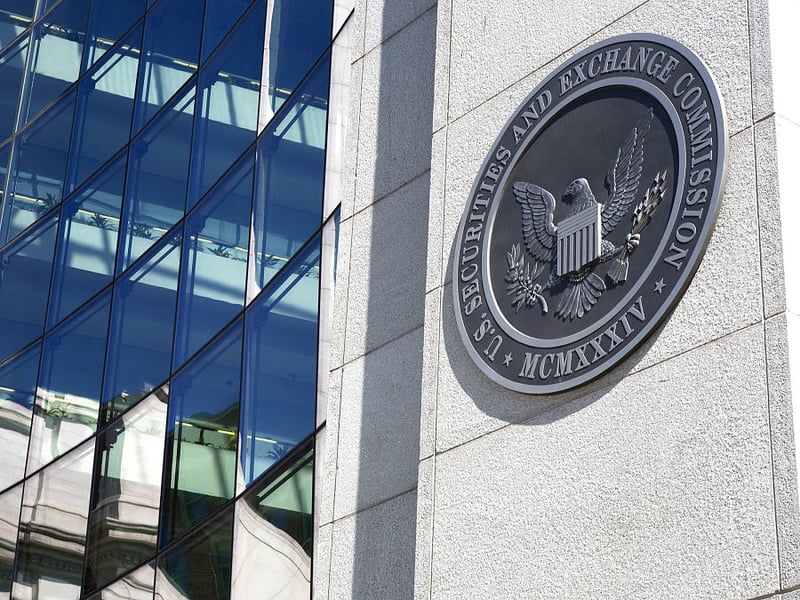
Some compliance experts are wondering whether federal loans meant to sustain small businesses during the COVID-19 pandemic would trigger a disclosure requirement for any registered investment advisory firms that receives one.
Small companies can apply for loans through the Paycheck Protection Program, which was established by the Coronavirus Aid, Relief and Economic Security Act. For the moment, the popularity of the program has depleted its funding capacity. Lawmakers are deadlocked on how to replenish it.
Nonetheless, if an advisory firm landed one of the loans, it raises the question of whether it must disclose that on its Securities and Exchange Commission registration document.
An item on Form ADV Part 2 states that if an RIA has custody of client assets or solicits prepayment of more than $1,200 in fees, it must “disclose any financial condition that is reasonably likely to impair your ability to meet contractual commitments to clients.”
With the coronavirus laying waste to the U.S. economy, most small businesses are under stress. The lending program is meant to provide them with money to cover payroll and other expenses to stay afloat. If the loans are used in that way, they're forgivable.
Chris DiTata, vice president and general counsel at RIA in a Box, a compliance software and consulting firm, would like the SEC to clarify whether a PPP loan is a disclosable event.
“Until there’s further SEC guidance, it still has to be viewed as an evolving regulatory topic,” DiTata said. “Firms should consider whether disclosure is warranted on a case-by-case basis at this juncture.”
An SEC spokesperson declined to comment.
Gail Berstein, general counsel at the Investment Adviser Association, said an RIA’s taking a PPP loan and being unable to meet a contractual commitment to clients “are two different questions.” If firms weren’t teetering financially before the coronavirus outbreak, they should be able to take PPP assistance without notifying the SEC.
“We don’t think applying for the Paycheck Protection Program necessarily triggers the Part 2 disclosure,” Bernstein said. “The question on the ADV is going to be more fact-specific. What kind of situation are you in?”
Amy Lynch, president of FrontLine Compliance, agreed that firms have to make their own assessment of their financial condition to determine whether an ADV statement is required.
“It needs to be a facts-and-circumstances decision,” Lynch said. “If it really is propping up the advisory firm [in a way] that’s not directly related to the COVID-19 situation, that may need disclosure.”
Form U4 disclosure not required
The Financial Industry Regulatory Authority Inc. has said that broker-dealers do not need to disclose PPP loans on their Form U4. That document requires a broker to indicate loan forgiveness as a compromise with a creditor.
“Because a PPP loan contemplates forgiveness of some or all of the loan as part of the original terms of the loan, such forgiveness will not involve a new agreement by the creditor, but will be an event consistent with the loan’s original terms,” the broker-dealer self-regulator says in a frequently-asked-questions posting on its website. “In those circumstances, the forgiveness of a PPP loan will not be a 'compromise with creditors' for purposes of Form U4.”

InvestmentNews reported in 2017 that the IRS was scrutinizing the tax shelter land deals, called syndication conservation easements.

Advisors gain a second workflow for 401(k) guidance as the fintech expands beyond bulk rebalancing, backed by new policy research on advice access.

New data shows most people do not have enough saved to cover costs and are not fully utilizing their accounts.

Firms announce new recruits this week, with teams overseeing hundreds of millions in client assets switching affiliations.

It’s the 12th deal for Stratos since SEI's investment and follows 11 acquisitions worth $4.8B in 2025.
Northern Trust’s Ken Lassner shows advisors how to convert volatility into after-tax portfolio gains
Dan Biagini of American Equity says the steady decline of pensions, longer lifespans and a reset in interest rates are rewriting how advisors build retirement income

