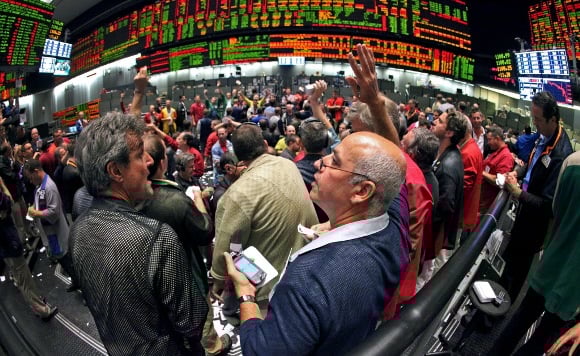
U.S. stocks rose, extending the first weekly gain since July for the Standard & Poor’s 500 Index, amid optimism the economy will recover and after Hurricane Irene failed to shut financial markets.
The S&P 500 rose 2.8 percent to 1,209.89 at 4 p.m. in New York, according to preliminary closing data. The benchmark gauge of American equities climbed 4.7 percent last week, the biggest increase in almost two months, as
Federal Reserve Chairman Ben S. Bernanke indicated the economy isn’t weak enough to warrant immediate stimulus.
“I still do not buy into the
recession,” Jeffrey Saut, chief investment strategist at
Raymond James & Associates in St. Petersburg, Florida, said in a telephone interview. His firm manages $278 billion. “There’s no way the U.S. is going into a
recession. Pessimism can’t get much worse than it’s been. Is growth going to be slow? Yes. But if we avoid a
recession, stocks are pretty attractive.”
The S&P 500 had fallen as much as 18 percent from a three- year high on April 29 amid concern about a global economic slowdown. Gauges of financial, industrial and energy shares, which are most-tied to the economy, led the declines in the index, slumping at least 22 percent over that period.
Equities climbed today after Americans’ spending increased more than economists forecast while incomes grew at the projected pace. Benchmark gauges also rose as two Greek banks, EFG Eurobank Ergasias SA and Alpha Bank SA, discussed merging. Equities in Greece rallied the most in more than 20 years.
Home Sales
Stocks rose even after a report showed that the number of contracts to purchase previously owned U.S. homes fell in July for the first time in three months, a sign that lower prices and borrowing costs aren’t luring in buyers.
Investors are paying less for equities than they have during every
recession since Ronald Reagan was president amid growing concern that the economy is on the edge of another
recession. The S&P 500 lost 13 percent in the past five weeks, sending its price-earnings ratio down to 12.9. That’s 3.5 percent less than the average multiple during the 10 contractions since 1949 and a level last reached in 1982, according to data compiled by Bloomberg.
Stocks dropped and then rebounded on Aug. 26 after Bernanke’s speech in Jackson Hole, Wyoming, in which he said the central bank still has tools to stimulate the economy without signaling he will use them. He echoed comments from dissenting members of the Federal Open Market Committee who said data aren’t pointing to a
recession.
“Some positive thinking here has some value -- to at least making investors think twice before they dump stocks,” Madelynn Matlock, who helps oversee $14.8 billion at Huntington Asset Advisors in Cincinnati, said in a telephone interview. “Central bankers don’t think there’s any really immediate screaming problem to deal with and have taken that more positively. Plus, there’s the fact that valuation is a whole lot better than it was a couple of months ago. In addition, the absence of any bad news in Europe is good news.”