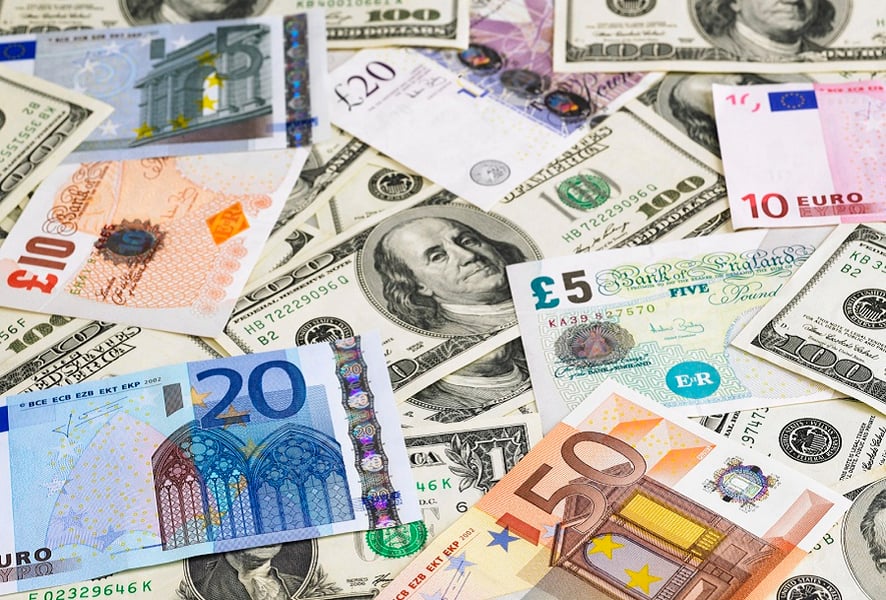
One of the highlights in the first half of 2015 will involve currency valuations across global markets and how the developed economies' efforts to control the value of their currency affect markets.
The U.S. dollar is known as the world's safe-haven currency. Whenever a crisis hits an emerging market, governments and citizens alike turn to the dollar as a safe store of value. We know that in many markets, the underground economy trades in dollars regardless of whatever local currency the aboveground economy runs on.
This safe-haven status is achieved not only because the United States has one of the largest economies but because, despite its expansion and contractions, the U.S. economy is relatively stable. Our trade rules are well-established. In many countries, the currency value is “pegged” to the value of the dollar.
(More: The surging dollar could crush unhedged global mutual funds)
Remember that the value of a country's currency is really just a mechanism whereby the supply and demand for that currency are equalized. There are many factors affecting both the supply and demand, including the rate of economic growth, the level of interest rates between countries, how inflation is affecting prices, how much trade occurs between countries and how diverse is the basket of goods traded.
DIVERGENCES
Just before the Christmas holiday, the federal government announced that third-quarter economic growth in the U.S. came in at 5% annualized. Consider that fact in contrast to the contracting economies of Europe, Japan and China.
As a result of this divergence, the
Federal Reserve eliminated its quantitative easing program and has begun to talk about increasing short-term interest rates. The bond market is anticipating this, as we can see from the increase in two-year Treasury notes. The yield closed at 0.59% on March 25, compared with 0.40% at the beginning of last year, a 48% increase. Clearly the bond market is aware that the Fed's policy is going to change.
However, if you look at the interest rate on a 30-year Treasury bond, you get a very different picture. The long bond closed at 2.5% on March 25, after beginning last year near 3.9%, a decline of 36%. In fact, yields on the long bonds of the ECB, the U.S. and Japan all fell over the last year, and the bonds provided better price returns than their respective stock markets.
(More: Wisdom Tree leverages dollar volatility to attract investor dollars)
So what's up? The Fed has indicated that with unemployment approaching 5%, most recently posted at 5.2%, and the economy nearing its expected growth rate, interest rates needn't be pegged at zero. However, the central bank notes caution in that growth is volatile, labor participation is still weaker than hoped for and inflation is non-existent. The ECB and Japan's central bank have a similar deflationary problem but they have very weak economic growth and higher unemployment. In fact, they have taken actions recently to either suggest they are going to engage in special quantitative easing or announced specific programs.
Longer maturity interest rates suggest the central banks are losing the war on deflation and provide a cautionary note.
We have also seen a divergence among the performance of these economies, their labor markets and, therefore, their central bank policies. These differences have resulted in a pretty dramatic change in the value of their currencies relative to the U.S. dollar.
The dollar index has moved from near 80 in midsummer to over 97 on March 25. This 21.3% move over nine months is significant because currency values among the more established economies normally don't move that much in such a short period of time. The value of the euro has declined from a high of 1.38 to the dollar last year down to its present level of 1.09, a 21% decline. At the same time, the Japanese yen has gone from last year's low of 102 to near 120 yen to the dollar.
OIL AND THE YIELD CURVE
Because oil trades in dollars, the currency battle and the resulting rise in the U.S. dollar have caused the value of oil to decline. Couple the currency issue with the increase in supply from OPEC, at a time when demand is waning because foreign economies are weak, and you have the making of the 50% drop in oil prices from last year's high.
The fact that U.S. oil production is up is no surprise. It is the increase in supply from OPEC and the currency chase that have exacerbated the move in oil prices.
In the wake of the
recession of 2008-2009, economic growth in the developed parts of the world was tepid for much longer than anticipated. It is likely that the secular trends affecting developed countries, such as slow population growth and an aging work force, made the effects of the
recession worse and more intractable.
As governments and their central banks wrestled with what to do, they expanded their powers by using never-before-executed policies like quantitative easing. However, the secular forces have been difficult to overcome and that is why we see rising short-term but falling long-term interest rates in the U.S. and elsewhere.
(More: From stocks to bonds, the strong dollar hits global markets)
Falling oil prices will be a boon to consumers in the U.S. but will create further difficulty for those economies whose currencies decline relative to the dollar. Emerging markets in particular will have to be carefully monitored, especially those that are highly levered and have meager foreign currency reserves.
Those emerging economies whose fate is tied to natural resource prices will also struggle. Russia has already declined into a recession and had to use a substantial portion of its reserves.
It's going to be an interesting year.
Brian Andrew is president and chief investment officer at Cleary Gull Inc.