

Jim McDonald is using all of his four decades of experience in financial markets to navigate the global pandemic’s impact for wealthy and institutional customers at Northern Trust Corp. His main message: Be bullish on U.S. stocks.
The huge policy response from American authorities and prospects for even more fiscal measures have left McDonald favoring the U.S. over others. The chief investment strategist at Northern Trust, which manages about $1.2 trillion, says this earnings season won’t offer much to investors. What’s more important is understanding how the economy will get back on its feet as restrictions ease, he says. And for that, clues can be found as lockdowns in Europe end.
“This earnings season is not going to get us there,” McDonald said. “There will not be enough information to have confidence in what the 2021 earnings number should be.”
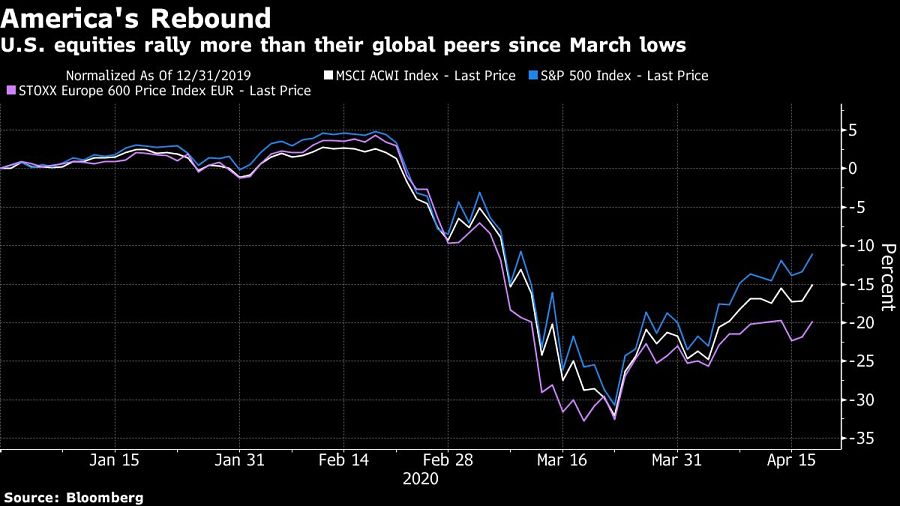
However, “the U.S. has had the most cohesive, immediate and sizable policy response, and that is what has underpinned our favoring of U.S. equities,” he said.
The S&P 500 is up 28% since the March low and the rally in technology giants has ensured the Nasdaq 100 is no longer down for 2020. Still, many companies will take the high degree of uncertainty as a chance to say that they aren’t able to give guidance, McDonald said. He’s betting the fiscal boost will be large enough to offset the demand destruction from the virus.
“We think there will be sufficient willingness to spend, but if we get a negative surprise -- if the coronavirus reaccelerates globally significantly -- that would be a problem,” he cautioned.
Germany is among the first nations in Europe taking cautious steps toward normalcy, loosening some restrictions on public life from Monday. Its success may help inform decisions in other jurisdictions that are still deliberating on how and when to ease lockdowns.
“Everyone will have an outlook but the reality is the economy is very dependent on the path of the coronavirus and the success in opening it back up,” said McDonald, who began his career in 1981 at accounting giant Arthur Andersen. “So that’s why looking at the success of countries like Germany, like Austria, like Spain and then increasingly the U.S., will be helpful to determine what the outlook in 2021 will actually be.”

The campaign spans broadcast TV and streaming, as the brokerage faces slowing client net flows and an $8.1 billion advisor team that left to launch an RIA this month.

A Michigan Democrat's proposal to lower the retirement age adds a new variable to claiming strategies for clients in manual trades.

The US accounted for nearly half of all new millionaires worldwide last year, but insurance specialists warn wealth growth is outpacing planning.

Merrill and Wells Fargo Advisors also made additions to expand their presence in Florida and Michigan.

Beemo's agents will draft client proposals and surface custodial data from Schwab for Choreo's 120-plus advisors across 21 states
As AI makes financial information more accessible than ever, Lana Hock explains why human judgment, trust, and empathy remain the qualities clients value most in a financial advisor
Northern Trust’s Ken Lassner shows advisors how to convert volatility into after-tax portfolio gains

