
The recession question continues to loom large over any outlook for the U.S. economy, even if the financial markets appear to be shrugging off the risk of an economic slowdown.
“If we get a recession, this would be the most widely expected recession ever, and with that comes a different kind of investor behavior,” said Niladri Mukherjee, senior managing director and chief investment officer of the wealth management division at TIAA.
Citing the market's rebound from the March sell-off triggered by the regional bank failures, as well as the fact the S&P 500 Index has entered bull market territory, Mukherjee believes investors are generally prepared to accept a mild recession.
“Right now, the balance of risk is negative for the equity markets,” he said. “If we have the beginnings of a shallow recession in the fourth quarter of this year or the first quarter of next year, people will follow the usual playbook; the Fed will cut rates, markets will stabilize, and investors will likely ride it out and just look forward to the back half of 2024.”
Eric Beiley, executive managing director of wealth management at Steward Partners Global Advisory, is also watching the relative strength of the equity markets as he lays out a forecast for the second half of the year.
“It’s a narrow bull market being fueled by a handful of giant tech companies that we are all watching in amazement, but if you look at the broad breadth of the market, the Dow still in bear territory,” he said. “I think you have to be careful because there’s still a lot of headwinds and a lot of things you have to be concerned about as far as where the economy is going.”
Beiley believes a recession is “absolutely still on the table.
“I think a lot of economists were early in forecasting a recession,” he said. “I do think we’ll hit a recession. It might be mild, and it might be later this year or into next year.”
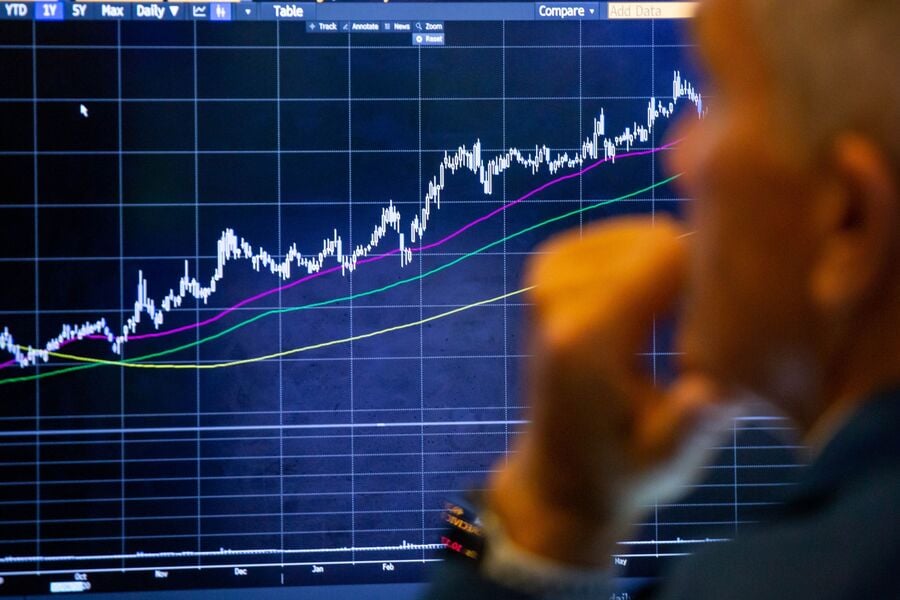
The S&P 500 has gained more than 20% from its October 2022 low, including a gain of more than 15% so far this year. The market run got more fuel in early June when the Federal Reserve left interest rates unchanged and indicated a winding down of its 15-month tightening cycle.
Despite the recent surge in performance, most market watchers expect stocks to finish the year flat or down from current levels.
“The market is trying to reconcile two very different scenarios: one where the U.S. economy remains fairly strong and the Fed doesn’t cut rates, and one where the Fed has to cut by several percentage points,” said Arif Husain, head of international fixed income and chief investment officer at T. Rowe Price.
“The Fed and other central banks in developed markets will lower rates eventually, but the timing is tricky,” he said. “Rates are likely to remain higher for longer.”

Total US retirement holdings jumped 7.9% in the second quarter, with 401(k) balances and IRA contributions both climbing despite lingering economic unease

Megadeals are surging in 2026, but small and mid-market transaction volume remains well below historical norms.

From a $1.5 billion California production pledge to possible cable channel sales and a CNN oversight board, the terms of a potential deal are taking shape.

Major AI models failed to correctly answer financial questions in 57% of cases, new research shows, raising serious questions about consumer reliance on AI tools.

A new report from the National Seniors Policy Center details how a US sovereign default could unfold - and who would be hurt first.
As AI makes financial information more accessible than ever, Lana Hock explains why human judgment, trust, and empathy remain the qualities clients value most in a financial advisor
Northern Trust’s Ken Lassner shows advisors how to convert volatility into after-tax portfolio gains

