
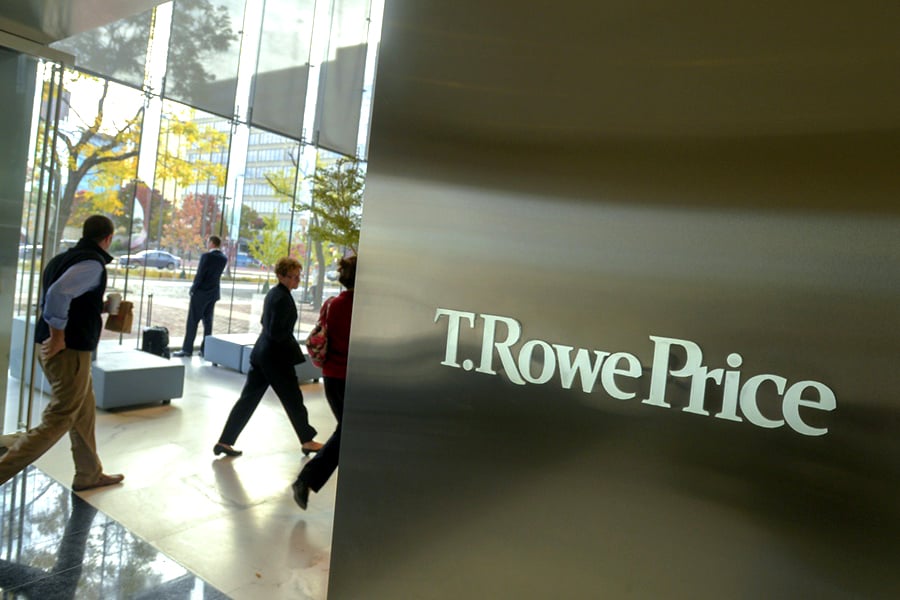
T. Rowe Price is the latest asset manager to jump into the semitransparent active ETF market with four funds expected to launch later this year.
The $1 trillion Baltimore-based asset manager follows American Century, Legg Mason and Fidelity Investments into the arena of offering actively-managed portfolios that trade throughout the day like a stock and exchange-traded fund, but only disclose holdings on a trailing quarterly basis like a mutual fund.
This marks the first move into the ETF space for T. Rowe, which traces the regulatory approval process for the new active ETFs back to 2013, according to Tim Coyne, the asset manager’s head of ETFs.
“This is very exciting and it’s a natural extension for T. Rowe because it’s about providing access to these four strategies for ETF investors,” he said. “This is phase one. We’re looking to develop a more comprehensive ETF product line.”
The first four ETFs will include Blue Chip Growth, Dividend Growth, Equity Income and Growth Stock, all of which are modeled after well-established mutual fund strategies at T. Rowe.
“They are using existing, highly popular and strong performing active strategies with a total of more than $170 billion in assets,” said Todd Rosenbluth, director of mutual fund and ETF research at CFRA.
“While some investors will stay loyal to the mutual fund, either by inertia or they don’t want to incur capital gains or other reasons, other investors will be interested in the new products,” he added.
There are multiple models to provide ETF market makers enough information to price the underlying active portfolios without exposing the underlying holdings. T. Rowe is using a proxy basket for pricing, but also disseminating each fund’s net asset value every 15 seconds throughout the trading day.
In terms of selling licensing agreements to other asset managers looking to get into the semitransparent ETF space, Coyne said there is nothing to announce yet, but he also didn’t rule it out.
“We have had conversations with other asset managers, and we continue to develop that,” he said. “There could be more to share on that, but as of now we have not entered into any licensing agreements.”

CFP, CFA and CPA holders could gain accredited investor status as regulators weigh wider private market access for advisory clients

DeepVest, Vanilla and Libretto roll out tools to help financial advisors launch firms, close estate plans and sharpen planning skills

“People aren't effectively using their wealth in retirement,” said David Blanchett of Prudential.

Second-generation NFL ref Shawn Hochuli co-founded IWM Partners in Irvine, California, a wealth management practice with more than $500M in client assets

U.S. seniors lose $28.3 billion annually as a result of financial exploitation, according to a 2023 AARP study.
As AI makes financial information more accessible than ever, Lana Hock explains why human judgment, trust, and empathy remain the qualities clients value most in a financial advisor
Northern Trust’s Ken Lassner shows advisors how to convert volatility into after-tax portfolio gains

