
 The narrative goes something like this: Inflation will finally break out in 2020 as a global growth rebound gains momentum and recessionary fears are vanquished. Central bankers will do nothing to snuff it out this time after being blamed for too-hasty rate increases in 2018, even if it means bearing witness to a run-up in consumer prices.
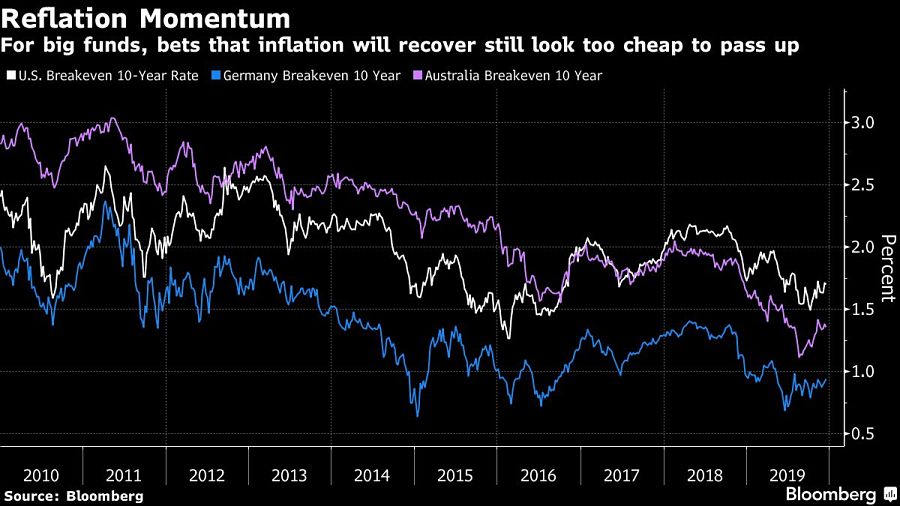
The bond market's gauge of inflation expectations over the decade, U.S. 10-year break-evens, on Friday reached 1.75%, the highest since July, before giving up some of that ground. The nominal benchmark Treasury yield rose as high as 1.95%, then slipped to around 1.89%. The boost in rates was spurred by dovish monetary bet and news that the U.S. and China have reached agreement on the first stage of trade deal stirred optimism about the growth outlook.
As data signal global manufacturing is emerging from a trough, Ms. Browne has gravitated toward TIPS with two- and 10-year maturities in recent months. These securities "are pretty bearishly priced for almost recession-like conditions," she said.
"One risk for 2020 is that we might have disruptive inflation of some kind," said Tim Graf, head of macro strategy at State Street, who favors TIPS. "Markets are not adequately prepared for it because we've been so used to low inflation."
[Recommended video: Schwab's Andrew Salesky: Advanced digital onboarding coming for advisers in 2020]
The nonchalance in Mr. Bloom's audience and many of their peers makes sense when you look at how inflation has undershot Fed targets through the course of the decade-long expansion. Based on the central bank's preferred gauge, inflation has averaged just 1.5% a year since the end of the last recession, compared with its target of 2%. So it's easy to disregard the inflationistas.
JPMorgan Chase & Co., which is touting reflation trades for 2020, isn't going all-out on inflation bets. Strategists at the bank see muted price pressures in developed economies and consumer price indexes only "inching higher" in the second half of the year on faster growth and tight labor markets.
"Typical reflation trades won't work as well next year because central banks are on hold," said John Normand, who is head of cross-asset strategy at JPMorgan. "Targets need to be tamer."
The narrative goes something like this: Inflation will finally break out in 2020 as a global growth rebound gains momentum and recessionary fears are vanquished. Central bankers will do nothing to snuff it out this time after being blamed for too-hasty rate increases in 2018, even if it means bearing witness to a run-up in consumer prices.
The bond market's gauge of inflation expectations over the decade, U.S. 10-year break-evens, on Friday reached 1.75%, the highest since July, before giving up some of that ground. The nominal benchmark Treasury yield rose as high as 1.95%, then slipped to around 1.89%. The boost in rates was spurred by dovish monetary bet and news that the U.S. and China have reached agreement on the first stage of trade deal stirred optimism about the growth outlook.
As data signal global manufacturing is emerging from a trough, Ms. Browne has gravitated toward TIPS with two- and 10-year maturities in recent months. These securities "are pretty bearishly priced for almost recession-like conditions," she said.
"One risk for 2020 is that we might have disruptive inflation of some kind," said Tim Graf, head of macro strategy at State Street, who favors TIPS. "Markets are not adequately prepared for it because we've been so used to low inflation."
[Recommended video: Schwab's Andrew Salesky: Advanced digital onboarding coming for advisers in 2020]
The nonchalance in Mr. Bloom's audience and many of their peers makes sense when you look at how inflation has undershot Fed targets through the course of the decade-long expansion. Based on the central bank's preferred gauge, inflation has averaged just 1.5% a year since the end of the last recession, compared with its target of 2%. So it's easy to disregard the inflationistas.
JPMorgan Chase & Co., which is touting reflation trades for 2020, isn't going all-out on inflation bets. Strategists at the bank see muted price pressures in developed economies and consumer price indexes only "inching higher" in the second half of the year on faster growth and tight labor markets.
"Typical reflation trades won't work as well next year because central banks are on hold," said John Normand, who is head of cross-asset strategy at JPMorgan. "Targets need to be tamer."

Nearly half of private firms forgo 401(k) plans even as new data ties them to higher stock option uptake among employees.

New research finds just 12% of wealth management firms have reached AI leader status, and it isn't spending that separates them

Affinity fraud refers to investment scams that prey upon members of identifiable groups, such as religious or ethnic communities.

Self-serve access to Strategic Advice Manager promises onboarding in days, as RIAs weigh how deep to take AI adoption.

Elios Financial Group joins Carson Wealth as the Omaha RIA adds to a record year of industry dealmaking.
Northern Trust’s Ken Lassner shows advisors how to convert volatility into after-tax portfolio gains
Dan Biagini of American Equity says the steady decline of pensions, longer lifespans and a reset in interest rates are rewriting how advisors build retirement income

