
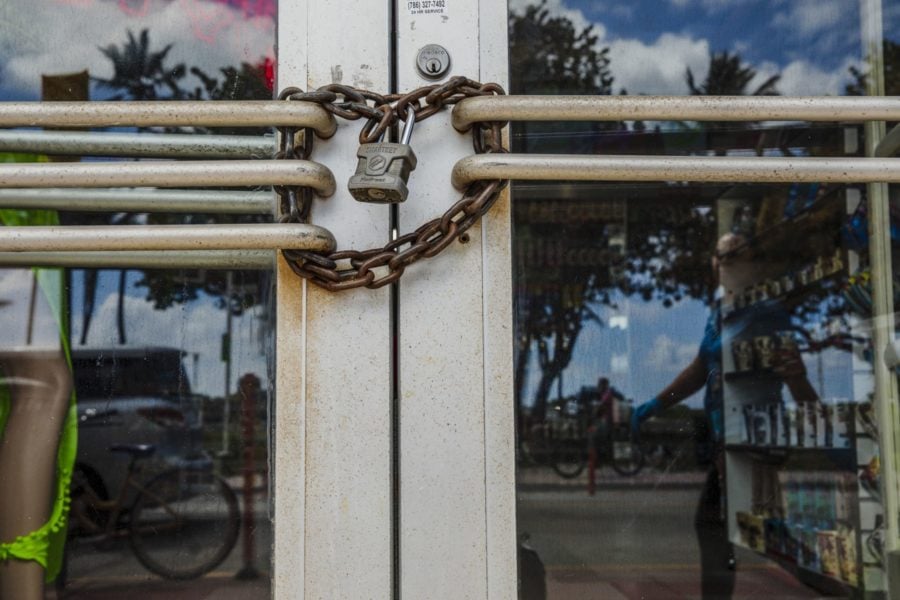
Florida, a state chock full of registered reps and financial advisers, may be facing the end of its boom times and staring at the likelihood of a recession.
That call, made last week by Wells Fargo Securities' economics group, comes as no surprise as businesses across the United States lay of millions of workers due to the fallout of the country's attempt to slow down the COVID-19 virus.
Florida is a bellwether for the brokerage and investment advice industries. According to the Financial Industry Regulatory Authority Inc., in 2018 the Sunshine State was behind only California and Texas in the number of branches of securities firms, with 10,441.
"Florida’s economy has gone from full throttle to a sudden stop in less than a month, something that is truly without modern era precedent," wrote Wells Fargo Securities senior economist Mark Vitner in a research note. "Layoffs have skyrocketed, as restaurants, hotels and amusement attractions have shut down and spring break tourists have either stayed put in their home states or returned home."
"With shutdowns and stay-at-home orders commonplace throughout the country and Florida, job growth is certain to fall hard over the next few months," Vitner wrote. "Florida’s economy tends to bounce back from recessions fairly quickly as long as real estate has not gotten grossly overbuilt in the state — which it has not."
"We are looking for this recession to be incredibly sharp but fairly short, with a recovery taking hold by the end of the year," he added.
Advisers in Florida, of course, focus on winning the business of wealthy retirees, not the waiters and waitresses and other hourly workers who have lost their jobs as restaurants and amusement parks close. But those retirees are also some of the most vulnerable to the coronavirus.
"Florida, particularly south Florida, has a large concentration of retirees from the northeast — the snowbirds," said Brian Kovack, president of Kovack Securities Inc., an independent broker-dealer based in Fort Lauderdale, Fla. "They potentially face a high concentration having the virus."
"A lot of businesses cater to those people," Kovack said. "It’s going to be pretty devastating for the service industries in Florida. South Florida is based on tourism, and that’s dead."
"Hotels and all the businesses associated with them that are affected by seasonal flows of tourism will be pretty hard hit," said Robert Anderson, a veteran adviser registered with Harbor Financial Services and based in Vero Beach, Fla. "That brings a ton of money into this state."
"There's no cars on the road and very little activity going on. People are basically sequestered to their homes," said Frank Congemi, another veteran adviser registered with Securities America Inc. and based in Deerfield Beach, Fla. "We are still doing transactions, but people are strangely silent. They are focusing on home."

The financial advice industry has been facing inquiries into its cash sweep programs for years now.

Investor money allegedly went to strip clubs, exotic cars, and landscaping

Procyon adds $415 million in assets under management in New Jersey while Savant picks up a $213 million Southern California planning firm

With a growing number of real estate-rich Baby Boomers aging into retirement, some advisors may be failing to consider all the options available for those clients' assets.

Cornerstone Advisors study reveals compliance bottlenecks stall campaigns weeks after customer opportunities close.
As AI makes financial information more accessible than ever, Lana Hock explains why human judgment, trust, and empathy remain the qualities clients value most in a financial advisor
Northern Trust’s Ken Lassner shows advisors how to convert volatility into after-tax portfolio gains

