

Just as major investment firms like Blackstone and KKR & Co. are priming the pump to sell more alternative investment products through financial advice firms to retail investors, one of the most noted self-help gurus of the past 30 years, Tony Robbins, has returned to the financial advice industry pitching a new book that promotes alternative investments.
What’s with the timing? Undoubtedly, the terrible year for both stocks and bonds in 2022 has created a marketing environment for the messengers of alternative investments: The portfolios of mass affluent investors would have been insulated from the shocks of 2022 if a chunk, say 10 percent to 20 percent, had been invested in assets not correlated to the stock market, like real estate, private equity, or private loans, rather than just stocks and bonds.
“I had the privilege of interviewing 13 of the masters of the universe in private equity investing, firms that have gotten 20 percent, some 30 percent, compounded [returns] for decades,” Robbins said in an interview in February with InvestmentNews. “To the average person, that sounds absurd. I wanted to bring that to the general population.”
He noted that Congress is considering new rules and legislation for mom-and-pop investors to make it easier to invest in vehicles like private equity for the mass affluent or those investors with less than $1 million in assets.
Meanwhile, the broad alternative investment industry is trying to shrug off a bad year for sales in 2023, particularly for one of the most popular kinds of alternative investments, non-traded real estate investment trusts.
Sales of non-traded REITs to retail investors totaled about $5 billion last year, while that same group of investors pulled about $18 billion from REITs through a process called redemptions, said Kevin Gannon, chairman and CEO of Robert A. Stanger & Co.
He expects a similar year for REITs this year, which means that retail investors may be looking to roll money out of REITs into different asset classes, including private equity.
“There’s more concern right now about real estate pricing directionally – which way is it actually going – than there has been in a long time,” Gannon said. “The [net asset values] of the so-called NAV REITs have come down but probably not enough as the real estate market indicates.”
“This translates into lower fundraising and higher redemptions by clients,” he said. “Is the REIT’s value right? Everyone on the planet has that concern right now.”
Given that uncertainty around real estate and REITs, a slew of alternative asset managers are rolling out new products to get in front of financial advisors. That’s not only Blackstone and KKR, but others including StepStone Group, Ares, BlackRock, and JPMorgan, according to Stanger, which tracks fund flows into illiquid alternative investments.
Many of the new offerings – 14 of 23 were launched last year – tracked by Stanger are either private funds, known as Reg D offerings, which may be sold only to accredited wealthy investors – or closed-end funds. They include private equity, private REITs, private business development companies, and private infrastructure deals.
KKR, for example, launched three such funds last year: the KKR FS Income Trust; a BDC, KKR Infrastructure Conglomerate; and KKR Private Equity Conglomerate.
The new funds appear to be gaining traction with financial advisors and clients. In January, Blackstone said a new fund for wealthy clients that focuses on private equity, Blackstone Private Equity Strategies Fund, had raised $1.3 billion, a staggering amount for a new fund.
“With this latest push by alternative managers, what the industry is seeing is the large, institutional quality managers moving into the retail market, because that’s where the assets are,” said one senior industry executive who spoke privately to InvestmentNews. “The positive for advisors is the really good firms taking institutional quality products to high-net-worth clients. In the past, that was part of the marketing pitch, but I’m not so certain that was accurate.”
“These funds are designed to make investors money, and it’s working,” the executive said. “It’s easier for high-net-worth investors to get access to private markets. But you can argue all day whether they are too expensive. As for REITs, real estate has always been an up-and-down market. It will take time, but they will eventually come back.”
Some broker-dealers have said recently that they’re pulling back from sales of alternatives, which at times may lack liquidity and can be volatile and more expensive than plain vanilla mutual funds and exchange-traded funds.
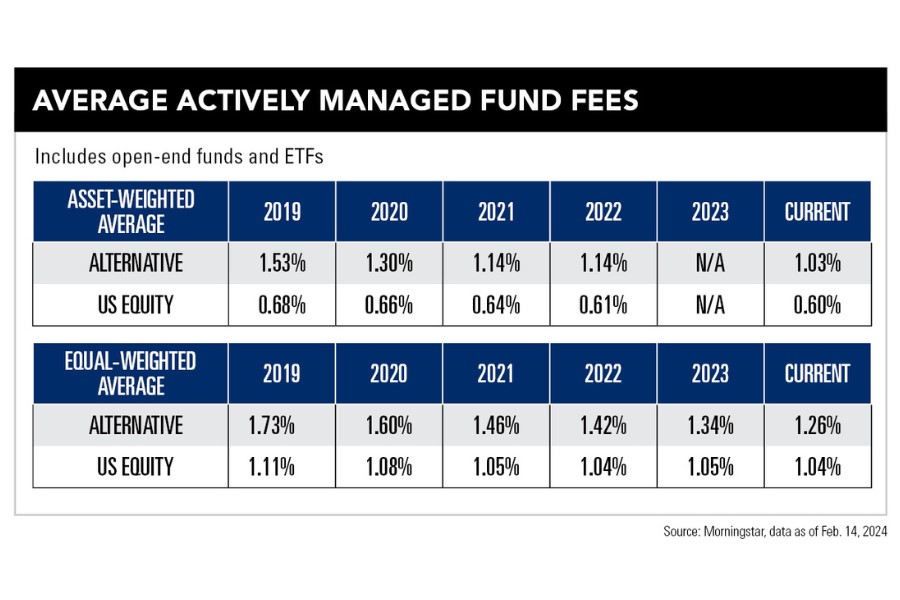
According to fund tracker Morningstar, alternative funds are more expensive than US stock mutual funds, including open-ended funds and ETFs, although fees on alternative funds have been coming down since 2019 (see chart). As measured by an asset-weighted average, alternative funds on average currently charge a fee of 1.03 percent, while US equity funds charge 0.6 percent.
High fund expenses erode investors’ long-term returns.
Tony Robbins’ new book will clearly draw attention to alternative investments like private equity. But some financial advisors are likely to duck his pitch.
“Historical returns for private equity are not useful for investors allocating today,” Josh Brown, CEO of Ritholtz Wealth Management, noted in a recent post on LinkedIn regarding Robbins’ latest book. “Valuations have converged with public markets and competition is up 1,000-fold. Retail investors will not get access to top-tier PE funds, and top-tier PE funds are the performance drivers of the asset class.”

Iowa's Greenwood Wealth Partners exits D.M. Kelly as UBS and Ameriprise win Merrill Lynch recruits in California and Florida

Less than 1% of pool funds went to actual trading, CFTC says

Plus, SEIA builds a governed data foundation for its in-house AI and Snappy Kraken debuts a read-only marketing coworker for advisors.

He owes $364 million but pays $100 a month

Broadridge, Wedbush and Alaris Acquisitions have also filled senior wealth management roles with hires from J.P. Morgan, Osaic and SageView.
As AI makes financial information more accessible than ever, Lana Hock explains why human judgment, trust, and empathy remain the qualities clients value most in a financial advisor
Northern Trust’s Ken Lassner shows advisors how to convert volatility into after-tax portfolio gains

