
With Russia’s stock market closed, U.S. exchange-traded funds are signaling the scale of the rout facing the nation’s equity market.
The VanEck Russia ETF (RSX) and the iShares MSCI Russia Capped ETF (ERUS) plunged 26% and 20%, respectively, in U.S. trading early Monday. Millions have poured into the funds in the past week, some of which was likely create-to-lend activity in which new shares are created for short sellers to borrow and bet against.
The Bank of Russia halted trading in Moscow on Monday, one of several measures unleashed in a bid to shield the nation’s economy from sweeping sanctions. That has turned the two ETFs, which primarily track Russian energy stocks, into useful price-discovery tools for traders seeking to navigate the geopolitical turmoil caused by Russia’s invasion of Ukraine.
“The ETF has proven itself time and time again, especially around geopolitical events when liquidity is difficult to access,” said Athanasios Psarofagis, a Bloomberg Intelligence ETF analyst who noted that the ETFs predicted moves last week in Russia’s markets. “ETFs are suppose to be index trackers, but when that process breaks down, they take on the role of price-discovery vehicles — and it’s impressive how accurate they have been.”
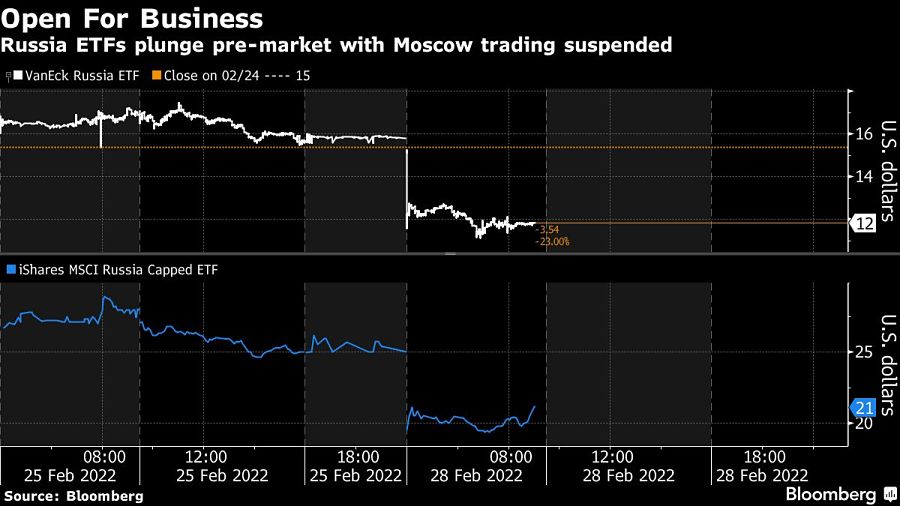
RSX and ERUS have plunged more than 40% in 2022 as geopolitical risks built, ranking them as the two worst-performing non-leveraged U.S.-listed ETFs so far this year, according to data compiled by Bloomberg. The losses have accelerated in the past week in the face of mounting sanctions, with the U.S. banning transactions with Russia’s central bank, the Russian National Wealth Fund and the Ministry of Finance.
The drop for the Russia-tracking ETFs is reminiscent of March 2020, when fixed-income funds continued to trade even as cash markets effectively froze amid pandemic-fueled turmoil.

See which platforms and providers earned 5-Star recognition this year

Meanwhile, a multigenerational Cambridge team has hopped to LPL in Michigan, and Cetera's run of Commonwealth recruitment continues in New Jersey.

TIAA survey finds 53% of Americans worry about running out of money, as AI and medical advances scramble retirement income planning.

Two wirehouse veterans choose advisor-owned model as independents target ultra-high-net-worth clients beyond portfolio management.

Guardian's Nancy DeRusso tells InvestmentNews how advisors can help close the 'longevity gap'.
As AI makes financial information more accessible than ever, Lana Hock explains why human judgment, trust, and empathy remain the qualities clients value most in a financial advisor
Northern Trust’s Ken Lassner shows advisors how to convert volatility into after-tax portfolio gains

