
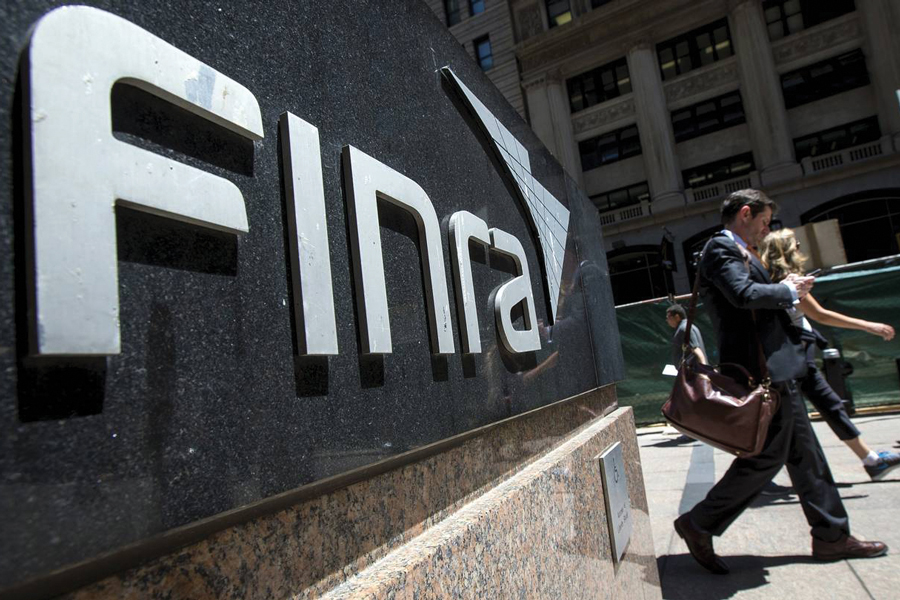
Finra is starting the New Year with more latitude to rein in rogue brokerages.
A new Financial Industry Regulatory Authority Inc. rule went into effect Jan. 1 that enables the broker-dealer self-regulator to impose additional capital obligations and other conditions on brokerages that employ a high number of registered reps with significant disciplinary histories.
Under the rule, Finra can require a “restricted firm” to deposit cash or qualified securities in segregated, restricted accounts that are controlled by Finra. The money could be used to fund arbitration awards and for other purposes.
“Finra believes that the direct financial impact of a restricted deposit is likely to change such member firms’ behavior—and therefore protect investors,” Finra said in a regulatory notice.
The rule was approved last summer by the Securities and Exchange Commission.
Finra will make an annual determination of which brokerages pose heightened investor-protection risks. The criteria includes the number of firm-level and individual-level regulatory disclosures.
“The multi-step process includes numerous features designed to narrowly focus the new obligations on the firms most of concern,” the regulatory notice states.
Finra has been under pressure for years to crack down on firms that hire a high number of brokers who have violated the self-regulator’s rules. In April 2018, it issued guidance on heightened supervision.
The new rule will help Finra identify potential problem brokerages before they harm investors, said Marlon Paz, a partner at Latham & Watkins.
“It is not just addressing misbehavior in the capital markets through enforcement, but it’s addressing misbehavior through prevention,” said Paz, a former counsel in the SEC’s Division of Trading and Markets. Finra “is not just continuing to play whack-a-mole. It’s about smart investor protection.”
The rule allows a firm to avoid the “restricted” category by voluntarily reducing its workforce, explaining why it doesn’t deserve the designation or proposing an alternative punishment.
It’s not clear how many firms will be designated as restricted. As the rule was being developed, Finra indicated the number likely would be small.
But Paz is concerned that small firms will make up most of the restricted roster and said that the amount of time to work with Finra “to get out of the penalty box” may not be sufficient for firms with limited resources.
“I hope Finra remains vigilant that the onus [of the new rule] is not borne by smaller firms that continue to struggle to compete,” Paz said.

According to a federal charges Bradley Heppner, 60, received more than $150 million in payments through funneling money from GWG Holdings to a shell company.

Also, CAPTRUST adds a $300 million planning team from Sanctuary in its home market of Raleigh, and Sequoia Financial Group buys a Boulder family office.

New nonvoting shares would let the Meta CEO cover eyed Proposition 40 tax without losing control, in exchange for an eight-year residency pledge

New research exposes a wide gap in how affluent parents and their adult children understand and prepare for the transfer of family wealth.

A new AIC report finds a 13.2% median annualized return over 10 years, outpacing public equities, real estate, and fixed income.
Knighthead Life entered the market with a competitive MYGA. A strong launch earned advisor confidence and paved the way for FIAs.
As AI makes financial information more accessible than ever, Lana Hock explains why human judgment, trust, and empathy remain the qualities clients value most in a financial advisor

