
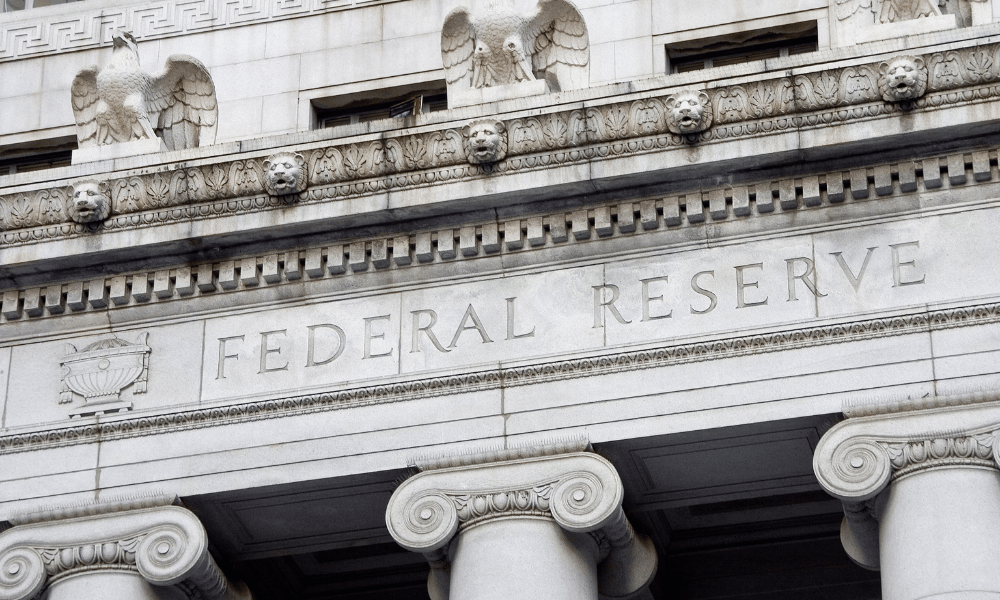
The Federal Reserve stuck to its path of keeping its policy rate steady at 3.5% to 3.75% Wednesday, once again shrugging off pressure from President Donald Trump to lower interest rates.
The move hardly took advisors and their clients by surprise. The central bank made three consecutive rate cuts last year, but outgoing Fed Chair Jerome Powell has resisted Trump’s calls to slash rates further.
However, the Fed's latest decision was decisive. Governor Stephen Miran, who wanted to see a quarter percentage point reduction, was again a dissenting voice, while Cleveland Fed President Beth Hammack, Minneapolis Fed President Neel Kashkari, and Dallas Fed President Lorie Logan supported maintaining the target range rate but did not support inclusion of an easing bias in the statement.
“A minor food fight broke out at the FOMC today," said Brad Conger, Chief Investment Officer at Hirtle & Co., in a note. "The dissenters’ preference for a tightening bias stakes out the battle lines for the incoming Chair."
Conger noted that bonds have been pricing this scenario out for several weeks now. "We think the hawks have the upper hand here based on stronger growth in both private consumption and booming business investment," he added. "The question is whether equities will hear the message over the siren song of strong corporate earnings.”
The trio of dissenting regional Fed presidents caught the attention Chris Zaccarelli, Chief Investment Officer for Northlight Asset Management. "There was no surprise that the Fed kept rates unchanged or that Governor Miran dissented in favor of a rate cut, but what was surprising was that 3 voting members dissented over more dovish language in the statement around an easing bias," he said, in a note. "The Fed is clearly in a difficult position, coming into this year intending to cut rates over the course of 2026, but the war in Iran – and the resulting spike in oil prices – are creating an obstacle to lowering rates sooner rather than later."
The Fed meeting garnered even more attention than usual given that it was Powell's last as chair of the central bank before his term ends in May. President Trump has nominated former Fed governor Kevin Warsh to be his successor.
During a press conference Powell said that he will stay on as a Federal Reserve governor after his tenure as chair ends. "My concern is really about the series of political attacks on the Fed," he said, when asked how long he might stay for. "These legal actions by the adminstration are unprecedented," he added.
Powell expressed his concern that the attacks are "battering the institution," and said that he will leave when he feels that it is appropriate to do so.
Powell also used the press conference to extend his congratulations to Warsh, who on Wednesday won the backing of the Senate banking committee.
Last week, during a fiery confirmation hearing, Warsh said that “monetary policy independence is essential.” Warsh added that he does not believe that independence of monetary policy is threatened when elected officials state their views on rates. “Fed independence is up to the Fed,” he said.
However, Senator Elizabeth Warren slammed Warsh over his ties to Trump, describing him as a “sock puppet” for the president.
Nonetheless, Warsh looks set to assume the hotseat soon to be vacated by Powell. “This nomination is now likely to proceed through the confirmation process,” said David Doyle, head of economics at Macquarie Group, in a note released this week. Doyle note that Senator Thom Tillis dropped his objection to the Warsh’s nomination over the weekend, following the Justice Department's announcement that it had closed its investigation into Chair Powell.
Andrzej Skiba, head of U.S. fixed income at RBC Global Asset Management recently told InvestmentNews that, before the war in the Middle East, the market was pricing in two to three rate cuts this year, but because of the conflict, that expectation is no longer valid.
In RBC’s opinion, the base case for this year is either no cuts, or one cut towards the end of the year, according to Skiba.
However, Macquarie Group thinks that a rate hike could be on the horizon, albeit coming next year. “Our view remains that the next policy move is likely to be a hike with the most likely timing in 1H27,” said Macquarie Group's Doyle.

Salespeople at the firm often went beyond the matching algorithm to recommend network advisors on its Zoe Wealth platform, according to the regulator.

The Protect College Sports Act would cap school payments and codify NIL rights, with implications for advisors guiding young athletes.

"I know the number that I want to be able to retire on, and now I just want out," says Wilmington Trust's Marguerite Weese, describing a common refrain among business-owner clients.

Bessemer and Brown Brothers Harriman veteran Robert Ludricks III and private markets specialist Olof Akesson join the ultra-high-net-worth push on the East Coast.
765 investors were promised 260% annual returns on truck leases
As AI makes financial information more accessible than ever, Lana Hock explains why human judgment, trust, and empathy remain the qualities clients value most in a financial advisor
Northern Trust’s Ken Lassner shows advisors how to convert volatility into after-tax portfolio gains

