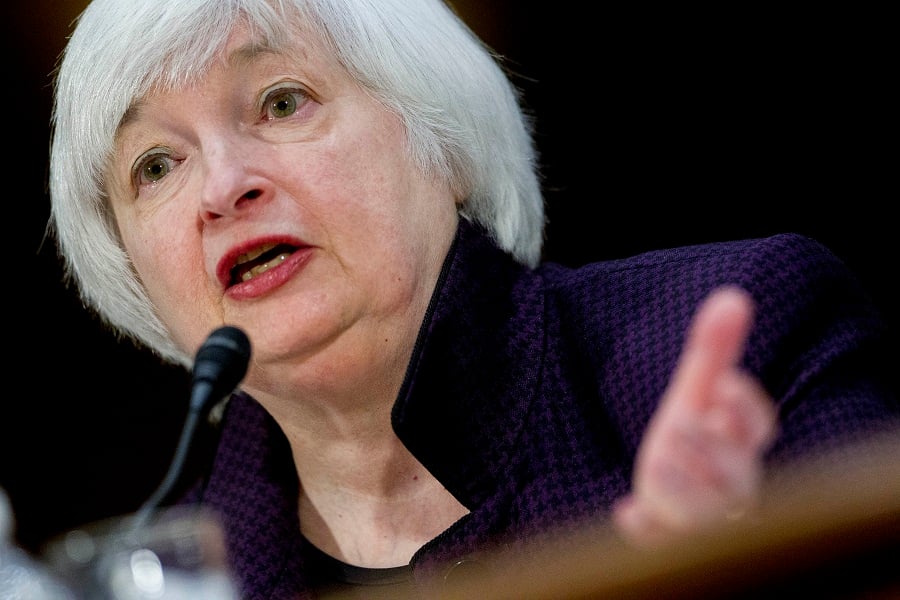
As Fed Reserve Chair Janet Yellen
kicks off two days of testimony before Congress, financial advisers have all but given up trying to adjust portfolios based on near-term monetary policy.
Across the universe of financial intermediaries, opinions on how to best navigate Fed policy vary, but one constant appears to be that there is no upside in trying to anticipate the Fed's next move.
“I'm diversifying bond portfolios more than I would have 10 years ago and I'm using more short-duration bonds and TIPS, but once I decide on that I'm not deviating because of a Fed meeting,” said Kristi Sullivan, owner of Sullivan Financial Planning.
“Investing based on the Fed would go against what I tell my clients, which is not to market time,” she added. “I just don't feel like there's going to be this big plummet in bond prices when rates rise, but there's always something you won't like about your portfolio — that's a diversified portfolio.”
The Fed last
raised short-term interest rates in 2006, and rates have been held near zero since the Fed started cutting them in the immediate aftermath of the 2008 financial crisis.
With the $5 trillion bond-buying program known as quantitative easing having ended in October, the Fed has indicated its next step will be for a rate hike sometime this year.
But even as unemployment has fallen to 5.7%, which nearly qualifies as full employment, some believe the Fed is reluctant to raise rates on what could still be described as an otherwise fragile U.S. economy.
“I don't see a rate hike this year,” said David Haraway, principal at Sustainable Financial.
Like Ms. Sullivan, but from a different perspective, Mr. Haraway is holding firm to his strategy, and plans to ride it out for as long as it takes for the interest rate cycle to change.
He continues to use cash and low-duration bond funds as a substitute for longer-term bonds in his clients' portfolios, meaning some clients might have up to 40% in cash while waiting for rates to move higher.
“I'm not going to be caught holding fixed income as rates are rising,” he said.
By some measures, it can be argued that the Fed could start hiking rates immediately, but that doesn't mean it will happen, according to Douglas Cote, chief investment strategist at
Voya Financial Inc.
“It's really hard to anticipate what the Fed will do, but I'm paying attention to any indication that Janet Yellen thinks the labor market is strong, because that would be a tilt toward hawkishness,” he said.
Mr. Cote entered the year with the contrarian view that the Fed wouldn't raise rates until the end of 2015 at the earliest, and possibly not until 2016. But as the positive economic data stack up, he now thinks central bankers might try to raise rates as early as June.
“The last employment report we saw was a blockbuster, showing more than a million jobs added after revisions from November to January, and the consumer is also really strong,” he said. “I'm not expecting a lot out of this week's testimony, but ultimately, the Fed has to get off the zero-interest-rate policy because it is dangerous for asset bubbles when the economy is approaching full employment.”
Jeff Klingelhofer, fixed-income portfolio manager at Thornburg Investment Management, believes the Fed is fully aware of the market's growing unease with the current monetary policy.
“However, given the period of slow growth and low inflation, officials prefer to err on the side of caution in terms of their statutory mandate,” he said. “There is some evidence that wage inflation is beginning to take shape, but it is more toward healthy levels rather than worrisome levels at this point.”
For David Mendels, director of planning at Creative Financial Concepts, it is all just noise that he refuses to let distract him from his advisory duties.
“The Fed will either say something or nothing, but I'm doing absolutely nothing in response,” he said. “Market timing is a great way to lose money, and Fed timing is probably a close second.”
In terms of
building fixed-income allocations at a time when the Fed is artificially holding down interest rates, Mr. Mendels said, “We set it and take what the Fed gives us.”
“Indirectly, almost everything is affected by what the Fed does, so I do have clients invested in shorter- and intermediate-term bond funds,” he said. “I'm avoiding long-term bond exposure because the one thing that's guaranteed to lose money eventually is the 30-year Treasury.”
As far as trying to gauge exactly when the Fed might start raising rates, Mr. Mendels said he wouldn't even venture a guess.
“I think the Fed has the intention to eventually raise rates,” he said. “But I don't think Janet Yellen even knows when she wants to do it.”