
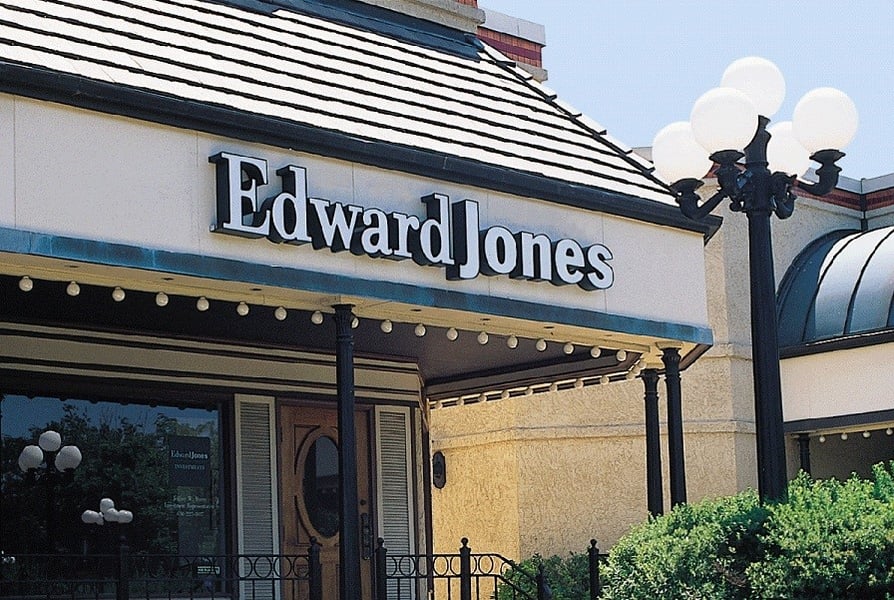
Giant retail brokerage Edward Jones' decision last year to give its financial advisors more flexibility to work in ways other than its tried and tested, one-advisor, one-office model has spurred 700 financial advisors, or more than 3%, to combine and work in bigger offices, an Edward Jones executive said.
"We've always had the traditional single-financial-advisor branch office," Don Aven, principal for branch and regional development at Edward Jones, said in an interview. "We've been doing that for 100 years."
The firm's founder, Edward D. Jones Sr., opened the first office in 1922 in St. Louis.
About a year ago, the firm revamped the way its advisors could potentially work, including introducing an option for multiple financial advisors to work under the same roof, with two or more sharing real estate while maintaining their separate relationships with clients, Aven noted.
"This is personal preference," he said. "A lot of advisors will stay in the branch as a solo operator with a branch office administrator.”
"Now that our multi-financial advisor office is open, there is a definite wow factor for clients and with members of the community," Jeff Kitchen, an Edward Jones advisor and principal, wrote in an email. "That's just one of the reasons we wanted to create a multi-FA office."
Combining offices is also a way for financial advisors to reduce costs; each Edward Jones advisor operates under his or her own profit-and-loss statement.
Edward Jones is a private partnership that also happens to be one of the largest firms in the retail securities industry. For years, it has focused on training financial advisors and finding professionals — think retired schoolteachers or firefighters — who have strong connections to their communities and might want a second, and far more lucrative, career as a financial advisor.
That simple structure has paid off. Because of the large size of the partnership, Edward Jones reports some information publicly even though it is a private company that opened its doors at a time when investment houses on and off Wall Street were private firms.
In 2022, when the S&P 500 was down more than 18%, net revenue for the Jones Financial Cos. was $12.3 billion, a slight decrease compared to 2021, according to the company. Meanwhile, income before allocations to partners decreased 13% to $1.4 billion in 2022 compared to 2021.
Edward Jones is also starting to introduce another option: financial advisors working together as teams with a group of shared clients, an approach that has been embraced by large competitors that work with the wealthiest clients, such as Merrill Lynch, UBS and Morgan Stanley.
"We can enhance service and ultimately better serve the client," Aven said. "The firm is gearing up to meet this demand."
A recruiter questioned the timing of Edward Jones' move.
"You can accomplish more with financial advisors working in a team, but why is Edward Jones doing this now?" said Casey Knight, executive vice president at ESP Financial Search. "Is the old model antiquated, and is revenue suffering as a result?"
According to the InvestmentNews Advisors on the Move database, the top three firms recruiting Edward Jones advisors since 2021 are Raymond James Financial Services Inc., LPL Financial and Ameriprise Financial Services Inc., which work with advisors who are independent contractors rather than employees.
A team of four financial advisors who left Edward Jones in June and are now registered at LPL Financial, Isaac J. Hart, Robert Entwistle Jr., Matthew L Malvitz and Sam Asani, declined to be interviewed for this story.
But last month in a statement, Hart said they left Edward Jones in order to build their own independent advisor practice, Omnia Wealth Group, with $400 million in client assets.
An independent practice gives advisors more control over products and investment strategy as well as potentially granting advisors a big increase in compensation compared to being an employee, as Edward Jones financial advisors are.
"It was important for us to be able to build out our office the way we want, with our own branding and guidelines," Hart said in the statement.

Elsewhere, Wells Fargo Advisors adds a $400 million Morgan Stanley veteran in Naples as an ex-Cetera advisor goes independent with LPL

According to a federal charges Bradley Heppner, 60, received more than $150 million in payments through funneling money from GWG Holdings to a shell company.

A $1B fund allegedly skimmed 30% off the top, then swapped cash for locked-up stock.

Insiders allegedly rewrote projections three times in four days.

TCI Wealth Advisors also has also tapped JIFFYAI to unify onboarding and servicing, while TradePMR adds ICE market data to its Fusion advisor platform
Knighthead Life entered the market with a competitive MYGA. A strong launch earned advisor confidence and paved the way for FIAs.
As AI makes financial information more accessible than ever, Lana Hock explains why human judgment, trust, and empathy remain the qualities clients value most in a financial advisor

