

A new report from AdvizorPro and Muriel Consulting shows that 653 advisors have departed Commonwealth since the firm announced its sale to LPL, resulting in a 77.5 percent retention of the 2,900 advisors Commonwealth had at the time of its purchase by LPL for $2.7 billion.
LPL’s acquisition of Commonwealth was announced March 31. The AdvizorPro-Muriel report tracked 653 advisor departures from April 1 to Dec. 31, 2025, equating to approximately 22.5% headcount attrition. LPL previously stated its on track to reach its 90% target retention rate of Commonwealth advisors, but industry sources have said they’ve been unsure on if the broker-dealer is referring to advisor headcount or assets in their retention target.
“LPL has been careful not to specify how the 90% has been measured,” Muriel Consulting founder Shelby Nicholl told InvestmentNews. “I think the biggest thing of those [Commonwealth advisors] who left is that they still want a boutique culture. They wanted to go somewhere where they mattered, or were feeling like they were going to matter fully.”
LPL’s press release from Aug 1 announcing the close of its Commonwealth acquisition says the firm “remains on track to achieve its 90% retention target,” without specifying headcount or assets as its metric. LPL also previously wrote, "we are tracking towards our 90% retention target, with advisors representing nearly 80% of assets signed to-date," in a Q3 2025 earnings report dated Oct. 30. A spokesperson for LPL declined to comment for this story, adding they plan to share Commonwealth updates on an earnings call next week.
“Nearly 80% of assets [have] signed their agreements to stay with Commonwealth and [we are] on track for the 90%. Putting all of that retention aside, we feel over the moon with this transaction,” LPL CEO Rich Steinmeier said in an earnings call on Oct. 30. LPL totals over 32,000 advisors, marking a much bigger operation than Commonwealth's roughly 2,900 advisor headcount at its sale.
"I think the biggest thing that I saw, especially in those early days, was an almost gut reaction of not wanting to move to LPL, and that is really because Commonwealth has spent decades defining itself in contrast to LPL," said Nicholl. "So when Commonwealth sold to LPL, it felt to many advisors as just very much a right turn in the history of the firm."
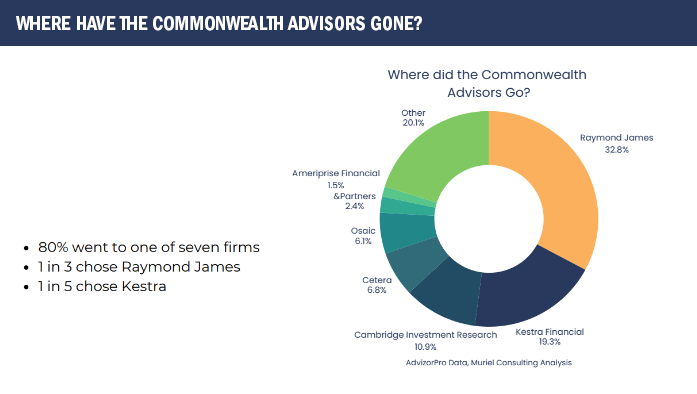
Muriel Consulting’s report found Raymond James (33%) to be the biggest winner of departing Commonwealth advisors, followed by Kestra (19%), and Cambridge Investment Research (11%). Of the 697 advisors who exited Commonwealth throughout all of 2025, the report found 64% (446 advisors) left for broker-dealers and 36% (251 advisors) moved to to an RIA with Farther and Savvy Wealth among the destinations.
Nicholl started her advisor consulting firm in 2024 after working in credit lending solutions at LPL Financial and as a director of bank product and experience at Edward Jones. She says that Commonwealth advisors who prioritize high-net-worth clients were particularly drawn to Raymond James over LPL due to investment banking at Raymond James, and pointed out the tech stach differences in RJ versus LPL.
“Some advisors love to pick out their own technology, and so the build your own tech stack approach that LPL has is better for that advisor versus the Raymond James tech stack, which is a much more home built integrated system,” said Nicholl. “The persona of somebody who wants to stay at LPL is going to be a little bit more of that full business owner mindset, they want to pick their own technology.”
InvestmentNews previously reported on details of Raymond James’s offer to Commonwealth advisors, and that Ameriprise was offering up to 125% of an advisor's trailing 12 months revenue in the recruiting battle for Commonwealth talent.
“Raymond James was offering 125% trailing 12 revenue at the time, and the initial bonuses coming out of LPL were significantly lower than that. LPL did over time raise some of those, and that helps them compete better. But the initial offers were much lower than Ray J's," said Nicholl. "Traditionally one place where LPL can win versus Raymond James is LPL generally has a higher gross payout percentage, but then Ray J adds in payout bonuses."

Texas securities regulators initially accused Lasater RE Fund of fraud in June but later dropped those claims.

Cornerstone Advisors and Clear Pointe Wealth Management mark an unusual double-team addition for LPL as recruiting run extends in Utah.

Investors were promised guaranteed returns from mobile homes that never existed

The Osaic-acquired broker-dealer failed to catch reps steering 295 clients into costly early UIT sales, regulator finds.

Rick Hu of Midas Wealth breaks down the fee-based planning shift that transformed his advisory practice and reshaped client relationships
As AI makes financial information more accessible than ever, Lana Hock explains why human judgment, trust, and empathy remain the qualities clients value most in a financial advisor
Northern Trust’s Ken Lassner shows advisors how to convert volatility into after-tax portfolio gains

