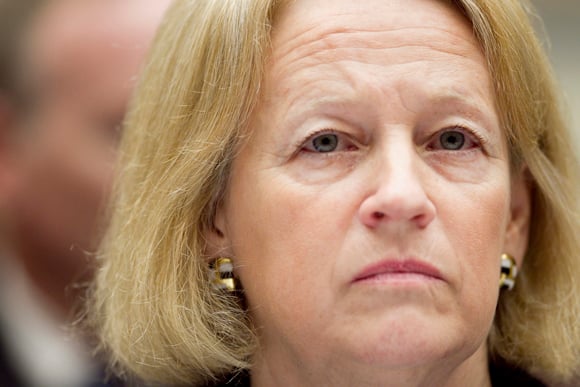
SEC boss says work continues on proposal; 'I've kept the issue alive and moving forward'
Securities and Exchange Commission Chairman Mary Schapiro said she continues to champion a rule that would impose a fiduciary standard of care for anyone providing retail investment advice, an initiative that advocates say appears to have stalled at the agency.
“I still think this is a really important thing for the SEC to do for investors,” Ms. Schapiro said in an interview with InvestmentNews. “There's a fair amount of work going forward inside the building. I would like to see it happen.”
The Dodd-Frank financial reform law gave the SEC the authority to promulgate a regulation requiring brokers to act in the best interests of their clients, or provide the same fiduciary duty that is required of investment advisers. Brokers now adhere to a less stringent suitability rule when selling investment products.
After delivering a report to Congress in January 2011 that recommended a fiduciary-duty rule and harmonization of adviser and broker regulations, the agency has not acted.
Part of the problem is the crush of about 90 rules required by Dodd-Frank. Another obstacle was the dissent to the SEC fiduciary-duty report by two Republican commissioners, who said its conclusions lacked sufficient economic analysis.
The commission will conduct such a regulatory assessment before proposing a fiduciary-duty rule. It has yet to put out a request for data — even though observers have been expecting it for months.
Though Ms. Schapiro did not indicate when the agency would launch its data collection, she said the issue is not dormant.
“The industry has engaged with us in a reasonable way,” Ms. Schapiro said. “I think we've advanced the ball quite a bit. It continues to have prominence today because I've kept the issue alive and moving forward.”
But some fiduciary advocates are getting impatient.
“We see little if any sign that the agency is ready to move forward on an issue that Chairman Schapiro once identified as a priority,” Barbara Roper, director of investor protection at the Consumer Federation of America, told reporters earlier this week.
On Sept. 11, the Institute for the Fiduciary Standard will meet with Ms. Schapiro to urge her to speed up the SEC's work on the topic. That meeting is part of what the organization has deemed “Fiduciary September,” an initiative designed to create momentum for a regulation.
Ms. Schapiro said that the demands Dodd-Frank placed on the agency have contributed to the slowdown.
“At the end of the day, everything goes through a pretty small funnel,” she said. “It's more been a matter of bandwidth.”
But the issue also has generated controversy. The agency received more than 3,000 comment letters for its study. Commissioners have conducted dozens of meetings with financial firm representatives and fiduciary advocates.
A flawed rule would increase regulatory costs and litigation threats for brokers and potentially price middle-income investors out of the advice market, according to fiduciary skeptics. They have been calling for the SEC to be careful to allow a range of products, services and payment methods under a proposed rule.
Ms. Roper asserts that fiduciary opponents have emphasized cost-benefit analysis as a way to slow the rule. A federal court in 2011 vacated an SEC rule on proxy access over what it deemed weak economic justification.
Ms. Roper said Ms. Schapiro may be reluctant to proceed without the support of at least one of the two Republican commissioners.
“Republican support is seen as essential to buffer against the threat of legal action,” Ms. Roper said.
Conducting a thorough cost-benefit analysis leads to more effective rules, according to Ms. Schapiro.
“I don't think economic analysis is a roadblock,” Ms. Schapiro said. “The new economic analysis approach is informing better decision-making.”