
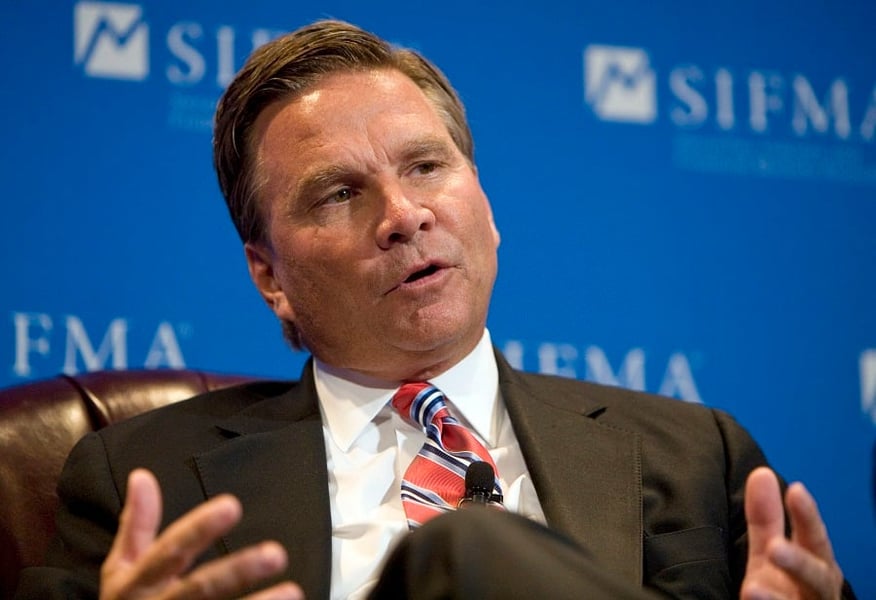
Artificial intelligence “really helps advisor productivity,” but shows poor judgement in investment-related decisions, Stifel Financial Corp. CEO Ron Kruszewski said during the firm’s first quarter earnings call on Wednesday.
“The models are mathematically driven, and they're great at summarizing, organizing, helping you solve math,” said Kruszewski. “When you move to judgment, which is what our advisors do, it just really isn't that good, and I'm not really comfortable thinking that we're going to serve our clients with some consensus-building mathematical AI, to be honest with you.”
Companies like Raymond James, Savvy Wealth, and Altruist have rolled out AI products to streamline operations and tax services for advisors. But firms like Anthony Pompliano’s ProCap Financial or RIA startups Range and Era have taken the technology a step further with platforms positioned to outright replace human advisors.
“I believe, at least on the advisor side, that [AI] will make our advisors more productive. It will unearth, potentially, more opportunities, more ideas, more things on tax savings, more on estate, more things that will help our advisors do what they do,” said Kruszewski. “I see this as a tailwind to advice, not a headwind. It's a more sophisticated version. We've seen it in the past with robo-advisors and a number of things.”
For this year’s first quarter, Stifel reported net revenue of $1.48 billion, which is the second most in the firm’s history and an 18% boost from last year’s $1.26 billion. In October, the St Louis-based brokerage sold Stifel Independent Advisors, which had around 110 registered reps and $9 billion in client assets, to Equitable Advisors.
“Across Stifel, we're seeing real benefit from our AI investment,” added Kruszewski. “The technology enables our advisors, our investment bankers, our commercial lenders, and support teams to work faster and smarter. In every case, we're working to enhance client relationships with AI, keeping our professionals at the center of the value proposition.”
Kruszewski did voice some concern around Mythos, the new AI model from Anthropic whose recent launch triggered emergency cybersecurity risk responses from banks and government agencies globally. Independent broker-dealer giant LPL Financial and wealthtech firm Orion have partnered with Anthropic to integrate its AI wealth management plug-ins for advisors.
“I'd be less than candid if I didn't raise a concern about frontier models like Mythos that are becoming an entirely new category of technology,” said Kruszewski. “Models this powerful increase capability on both sides of the table, for those defending and for those who would do harm. If you ask me what our industry needs to get right before anything else, the answer is cyber. Not just for Wall Street. This requires a national response.”

Salespeople at the firm often went beyond the matching algorithm to recommend network advisors on its Zoe Wealth platform, according to the regulator.

The Protect College Sports Act would cap school payments and codify NIL rights, with implications for advisors guiding young athletes.

"I know the number that I want to be able to retire on, and now I just want out," says Wilmington Trust's Marguerite Weese, describing a common refrain among business-owner clients.

Bessemer and Brown Brothers Harriman veteran Robert Ludricks III and private markets specialist Olof Akesson join the ultra-high-net-worth push on the East Coast.

765 investors were promised 260% annual returns on truck leases
As AI makes financial information more accessible than ever, Lana Hock explains why human judgment, trust, and empathy remain the qualities clients value most in a financial advisor
Northern Trust’s Ken Lassner shows advisors how to convert volatility into after-tax portfolio gains

