
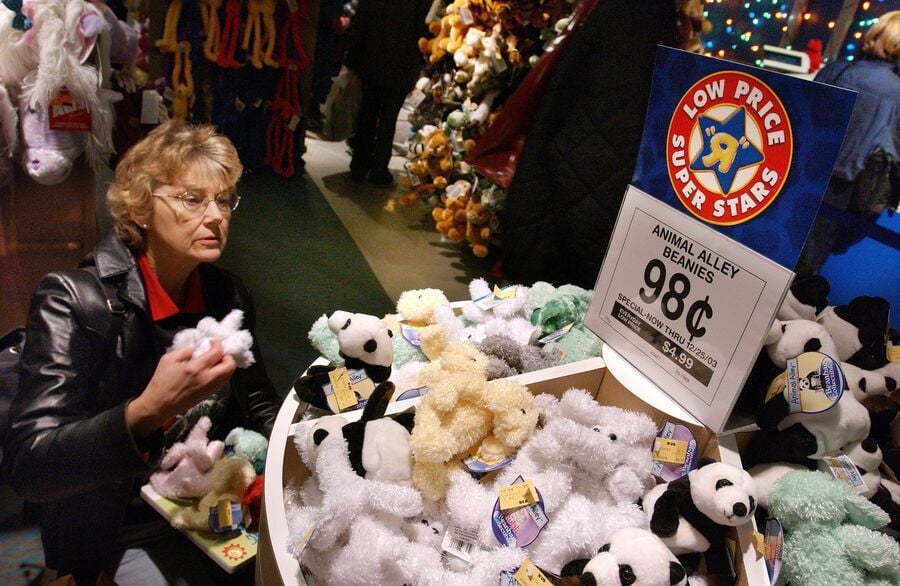
Few things epitomize an economic bubble as well as the Beanie Babies explosion of the 90s, and there are some lessons for collectors who fancy themselves as investors.
On Friday, a film based on the craze debuted in theaters, a week after it appeared on Apple TV+. "The Beanie Bubble," starring Zach Galifianakis and Elizabeth Banks, comes 30 years after the plastic bead-filled animals were created.
By creating a sense of exclusivity and restricting the distribution and lifespan of some of its models, the company, Ty Inc., prompted many people to treat the tiny figures as commodities. The company took full advantage of the rise of the internet, which further stoked the fever among collectors.
Some poured thousands of dollars into acquiring Beanie Babies, viewing their caches of the plushies as investments that might fund retirement or college.
That was the case for one man whose son 10 years ago made a short documentary about $100,000 of the family’s money being used to buy thousands of the toys, only to have them decline in value and sit in storage bins years later. The purchases had been meant to pay for college for three children.
Of course, few people likely got rich off of the craze, with an obvious exception being company owner and CEO Ty Warner, who made billions and went on to add the Four Seasons Hotel New York to his portfolio.
“It’s an awful lot like the tulip craze in Holland,” Bart Brewer, an adviser at Global Financial Advisory Services, said of the recent rise in interest in collectibles in general.
Brewer, who has been an avid baseball card collector since he was 6, said the same principles drive all collectibles: scarcity, condition and emotional connection.
“The Beanie Babies aren’t going to be any different,” he said.
Emotional connection and nostalgia for collectibles can be reignited by events — such as a major motion picture about Beanie Babies. While that can lead to changes in the going rates for items, it should be noted that collectibles can be difficult to value and their prices can experience significant volatility.
“They can be an asset class. They’re exotics, but you need to be in for the long term — and this isn’t like trading stocks. The bid/ask spreads are big,” Brewer said. “You want to be in and be prepared to be in for a long period of time. Buy scarcity and buy high-grade.”
Assessing authenticity and actual scarcity are important steps. According to a group that tracks the plushies’ value, the Beanie Baby Price Guide, there are a range of scams, including counterfeits and eBay listings that misrepresent common items as extremely rare — such as Claude the crab, who is listed on auctions for more than $20,000 while being worth only a few dollars. Other listings for the well-known purple bears dedicated to Princess Diana ask as much as $900,000 for the “rare” item, though there are dozens available for as little as $20.
Unlike the Wild West market for Beanie Babies that existed in the late 90s, very few today have much value. And it isn’t usually the rarity of certain Beanie Baby models that causes high demand — it’s often manufacturing defects or irregularities in the toys’ tags.
That’s similar to valuations in the coin-collecting world, where “mint errors are key,” Brewer said. In the baseball card realm, a corollary is the Topps 1990 Frank Thomas card that's missing the player’s name, he noted.
What separates valuable collectibles from others is sometimes the strength of the intellectual property behind them — which explains why vintage Nintendo games and Pokemon cards, with massive followings and staying power, can bring high prices, said Rob Petrozzo, co-founder of Rally, a group that provides fractional shares of rare collectibles.
“I definitely lost money on Beanie Babies as a 13-year-old in Brooklyn,” Petrozzo said.
At the height of the Beanie Baby craze, the items became more of a commodity than an emotionally valued possession, he noted.
Irrational behavior led people to stock up on the toys, and when eBay provided an outlet for them at inflated values, there was a lot of traffic, Petrozzo said. “The prices surged, and everyone tried to get out at the same time, so the prices no longer reflected the fundamentals.”
Although Rally does not include Beanie Babies in its fractional ownership model, “we have Beanie Babies that trigger a lot of nostalgia in museum space in New York,” he said. “As soon as people walk in, that’s a space where they can stop and have a conversation.”
Value in collectibles is a matter of true rarity, cultural relevance and a story that withstands time, Petrozzo said. “The moment from which it came will never be recreated but will be talked about for generations to come.”

Bessemer and Brown Brothers Harriman veteran Robert Ludricks III and private markets specialist Olof Akesson join the ultra-high-net-worth push on the East Coast.

Senate Democrats seek data on data center deductions under the 2025 tax law as proposals to tax artificial intelligence multiply.

Geopolitical shocks and market volatility pushed advisor deal decisions off course, denting third-quarter transaction volume by 19 percent.

Hendershott Wealth Management's Hilary Hendershott on turning a niche for women into an operating strategy, not a marketing pitch.

Iowa's Greenwood Wealth Partners exits D.M. Kelly as UBS and Ameriprise win Merrill Lynch recruits in California and Florida
As AI makes financial information more accessible than ever, Lana Hock explains why human judgment, trust, and empathy remain the qualities clients value most in a financial advisor
Northern Trust’s Ken Lassner shows advisors how to convert volatility into after-tax portfolio gains

