
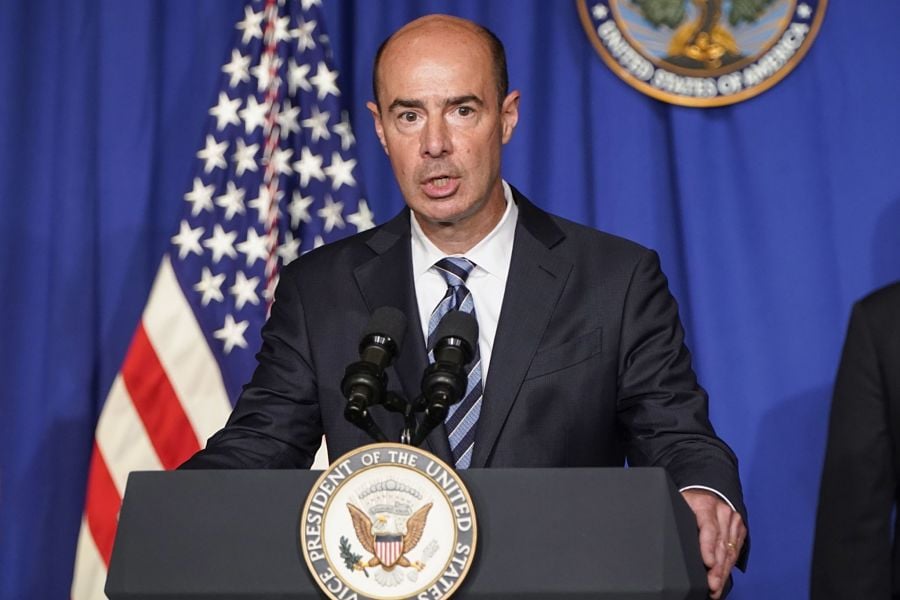
Despite widespread objections from the money management industry, President Donald Trump, through the Department of Labor led by Eugene Scalia, is speeding ahead with a proposal to make it more difficult for fiduciaries of retirement plans to direct money to ESG-focused funds.
The Employee Benefits Security Administration submitted the rule change, called Financial Factors in Selecting Plan Investments, to the White House last week. The administration’s stance is that ESG investment strategies sacrifice returns and promote goals unrelated to financial performance. It wants to adjust the Employee Retirement Income Security Act of 1974 to require those overseeing pension and 401(k) plans to always put economic interests ahead of so-called non-pecuniary goals, in what seems intended as a direct attack on ESG and green investing.
More than 130 fund management and financial advisory firms have written letters opposing the plan since it surfaced in June. And the complaints keep coming.
“You can’t simply disentangle ESG from the risk-and-return analysis in a 21st century investment process,” said Jonathan Bailey, head of ESG at Neuberger Berman Group.
The government is “moving at warp speed” to push through the rule, said Bryan McGannon, director of policy and programs at US SIF, a Washington-based group that supports sustainable investment businesses. It typically takes 18 months, not 4½ months, for an “impactful” rule change like this one, he said, adding the administration may be violating the Administrative Procedure Act in the attempt.
“It’s clear the Labor Department is not taking the public-comment process seriously,” McGannon said. “Our letter alone had six or seven studies that contested the underlying arguments. Across the financial services world, from huge asset managers to small sustainable-investment firms, there has been enormous opposition.”
The proposal, if enacted, would almost certainly be challenged in court. Moreover, if former Vice President Joe Biden wins the Nov. 3 election, it’s equally likely his administration would seek to undo such a change. Last month, another effort by Scalia to speed through rule changes under the Fair Labor Standards Act was partly overturned by a Manhattan federal court for — you guessed it — violating the APA.
“Not sure how they’re bracing for similar fallout from the ERISA change, or maybe officials there don’t even care,” McGannon said.
Jon Hale, director of ESG research for the Americas at Chicago-based Morningstar Inc., said the proposed rule is so “shoddily constructed” that it’s unlikely to withstand legal scrutiny.
“It has significant implications for the retirement savings of millions of Americans, yet the DOL saw fit to allow only the shortest possible time for comment and now seeks to finalize it before the current administration gets tossed out of office,” Hale said. “In a normal process, such overwhelming opposition would send regulators back to the drawing board.”
The Labor Department’s decision to undermine environmental, social and governance investing emerged after the White House called for a review of retirement plans’ investments in the energy sector. It’s no secret that the fossil fuel industry has been a critical supporter of Trump, who has called the globally accepted science behind global warming a “hoax.”
Investors have been increasing their bets on ESG, in part because they want to avoid polluters like Big Oil. About $20 billion flowed into ESG- and values-focused exchange-traded funds this year as of Sept. 30, exceeding the calendar-year record of $9.2 billion set in 2019, data compiled by Bloomberg Intelligence show.
Climate change ranks right behind corruption among the biggest ESG-related concerns for investors, according to a survey of about 800 fund industry officials and consultants by RBC Global Asset Management.
But America lags behind the rest of the world when it comes to putting ESG to work financially. While 94% of respondents in Europe, 89% in Canada and 72% in Asia said they have incorporated ESG into their investment approach, only 65% of U.S. investors have done so.
Despite the growing global consensus that ESG makes financial sense, some 26% of American investors still think ESG-integrated portfolios will perform worse than non-ESG-integrated portfolios. Worldwide, only 16% of investors think that way.
The bottom line, Neuberger & Berman’s Bailey said, is “focusing on material ESG factors that have an economic impact on companies is directly aligned with the best interests of shareholders.”

TIAA survey finds 53% of Americans worry about running out of money, as AI and medical advances scramble retirement income planning.

Two wirehouse veterans choose advisor-owned model as independents target ultra-high-net-worth clients beyond portfolio management.

Guardian's Nancy DeRusso tells InvestmentNews how advisors can help close the 'longevity gap'.

Goldman Sachs retirement survey finds 83% want guaranteed income, while the annuities providing that income increasingly hold private credit.

The AI meeting assistant's Advisor Intelligence plugin turns client conversation data into annual reviews, tax scans and attrition alerts.
As AI makes financial information more accessible than ever, Lana Hock explains why human judgment, trust, and empathy remain the qualities clients value most in a financial advisor
Northern Trust’s Ken Lassner shows advisors how to convert volatility into after-tax portfolio gains

