
Attracted to cheaper alternatives, a cohort of Wall Street investors are increasingly eschewing the most liquid products on the planet.
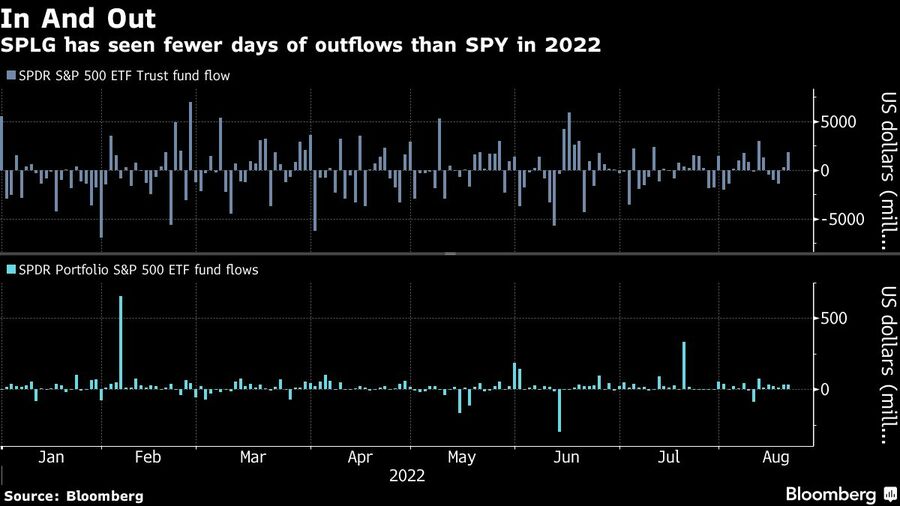
The world’s largest and famously easy-to-trade ETF — the mighty $387 billion SPDR S&P 500 Trust (SPY) — continues to fall victim to the trend this year as money managers gravitate to its lower-cost clone.
While $25 billion has exited SPY across roughly 80 days of outflows this year, its smaller sibling tracking the very same index has absorbed around $3 billion with only 32 days of redemptions.
The proximate cause: SPY charges a comparatively beefy 10 basis points versus just 3 bp for its younger clone, known as the $15 billion SPDR Portfolio S&P 500 exchange-traded fund (SPLG).
A similar dynamic has hit big-name ETFs investing in everything from big tech stocks and high-yield credit. For example the $181 billion Invesco QQQ Trust Series 1 ETF (QQQ) has posted nearly 70 days of outflows, compared to just 20 for the $5.5 billion Invesco NASDAQ 100 ETF (QQQM).
Rising demand for lower-cost products is a long-established trend in an industry famous for its fee wars. But it may be an increasingly smart option for those seeking to rebuild long-term exposures given cost pressures everywhere this year.
“For a retail or purely buy-and-hold investor who is looking for a position for the longer term, cheaper mini ETFs that offer identical access make a lot of sense because they don’t have to spend more for that massive liquidity,” said ETF Think Tank’s Cinthia Murphy.
Credit traders have been swapping out of the $14 billion iShares iBoxx High Yield Corporate Bond ETF (HYG) for the smaller iShares Broad USD High Yield Corporate Bond ETF (USHY), Bloomberg data show. USHY is on track to outpace HYG in flows for the second straight year.
The more expensive ETFs such as SPY or QQQ offer virtually unrivaled liquidity with high daily volumes for hedge funds and the like. But cost-conscious financial advisers and retail traders are looking to save a couple of basis points per year, according to industry experts.
The sheer volume of SPY turnover and its massive size have spawned an ecosystem around the ETF, with institutions and professional traders using the product to shift exposures — often on an intraday basis. That’s a different use case than for SPLG, which is more appealing for buy-and-hold allocators, rather than fast-money traders transacting frequently.
“SPY is the most liquid security on the planet,” said Bloomberg Intelligence’s James Seyffart.
“You add in the options and futures and everything,” he said, “and nothing else comes close.”
In addition to QQQ and QQQM, Invesco launched the Invesco Optimum Yield Diversified Commodity Strategy No K-1 ETF (PDBC) in 2014, a follow-up to the 2006 vintage Invesco DB Commodity Index Tracking Fund (DBC). PDBC, which charges 59 basis points, has accumulated over $8 billion in assets, surpassing the $3.6 billion DBC, which has an expense ratio of 88 basis points.
Rather than simply lowering fees, it makes sense for issuers to launch two different-priced tiers of the same strategy to appeal to the broadest swath of investors possible, said Invesco’s Jason Bloom.
“It might look on the surface like you’re just launching a clone of an older fund with a lower expense ratio because people are complaining about the management fee. That’s usually not the whole story,” said Bloom, head of fixed income and alternatives ETF strategies. “It’s going to take many years to build assets under management up to levels that might be comparable to the older fund. So the older fund may have a much deeper liquidity profile and it’s going to stay relevant.”
There’s also the simple fact that the higher fees generate more money for the Wall Street fund giants. SPY brings in about $368 million annually for State Street Global Advisors, compared to SPLG’s roughly $4.6 million haul. That math also applies to the largest commodity ETF, the $56 billion SPDR Gold Shares fund (GLD), which carries a relatively lofty fee of 40 basis points and pulls more than $220 million per year.
“These funds — SPY, GLD, QQQ — are some of the biggest funds out there, being big sources of revenue for these firms,” ETF Think Tank’s Murphy said.

Elsewhere, Wells Fargo Advisors adds a $400 million Morgan Stanley veteran in Naples as an ex-Cetera advisor goes independent with LPL

According to a federal charges Bradley Heppner, 60, received more than $150 million in payments through funneling money from GWG Holdings to a shell company.

A $1B fund allegedly skimmed 30% off the top, then swapped cash for locked-up stock.

Insiders allegedly rewrote projections three times in four days.

TCI Wealth Advisors also has also tapped JIFFYAI to unify onboarding and servicing, while TradePMR adds ICE market data to its Fusion advisor platform
Knighthead Life entered the market with a competitive MYGA. A strong launch earned advisor confidence and paved the way for FIAs.
As AI makes financial information more accessible than ever, Lana Hock explains why human judgment, trust, and empathy remain the qualities clients value most in a financial advisor

