

There’s a new champion in the battle for bragging rights atop the $5.3 trillion exchange-traded fund industry, while a familiar laggard is seeing its slice of the U.S. market shrink toward a record low.
Vanguard Group is on track to beat BlackRock Inc. in attracting ETF flows for the first time since 2013, with a record of $194 billion so far in 2020, according to data compiled by Bloomberg.
The world’s largest asset manager lured $113 billion, while State Street Corp. was a distant third place, with $32 billion. The Boston-based firm’s market share is poised to drop for a fifth straight year after a $29 billion exodus from its crown jewel -- the $324 billion SPDR S&P 500 ETF Trust (SPY).
In a year that saw a pandemic send shockwaves through global financial markets, Vanguard and BlackRock have vaulted ahead of rivals in attracting cash to their ETFs. Both asset managers were helped in part by their popularity with financial advisers and their presence in model portfolios, which bundle funds into ready-made strategies. State Street hasn’t seen the same level of success given that fees on some of its top funds are relatively high, said CFRA Research’s Todd Rosenbluth.
While SPY is among the most profitable products partly due to its expense ratio of 0.095%, BlackRock’s $234 billion iShares Core S&P 500 ETF (IVV) and the $174 billion Vanguard S&P 500 ETF (VOO) each charge only 0.03%.
“As more retail and wealth management investors have joined the ETF market, State Street has missed out on a good chunk of those inflows,” said Rosenbluth, CFRA’s head of mutual fund and ETF research. “They were late to bring pricing down for products that are used as building blocks of investor portfolios.”
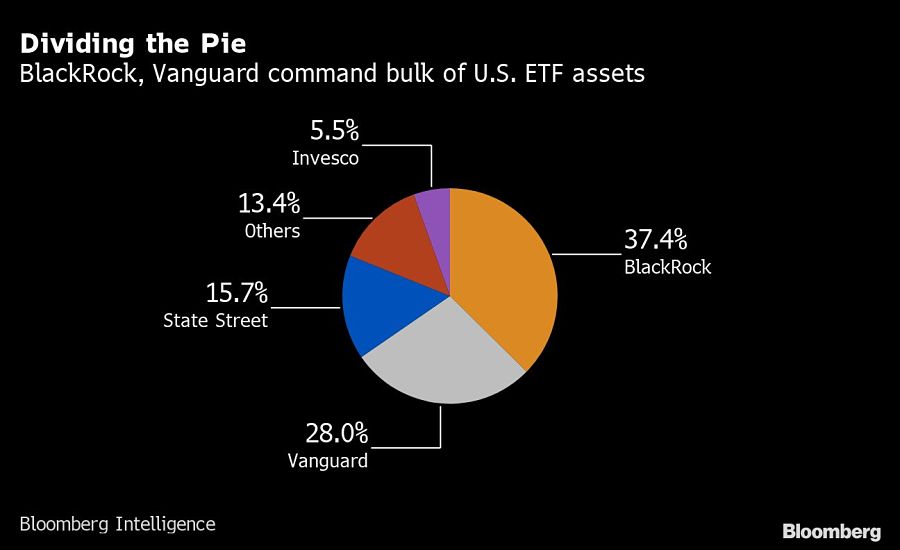
But flows alone don’t tell the complete story of State Street’s funds this year, said Matt Bartolini, head of SPDR Americas Research. SPY is the most actively traded ETF -- a status it cemented in 2020.
“We saw a significant increase in trading volume through the year, particularly in periods of volatility,” Bartolini said. “Investors gravitated toward our suite when they needed liquidity the most.”
Another highlight of the year was the booming demand for leveraged and niche products. The Ark Innovation ETF (ARKK) has become the largest actively managed fund, with Cathie Wood’s firm posting year-to-date inflows of $18.8 billion. Smaller issuers such as ProShares, First Trust and Direxion have also climbed the ranks.
“You are certainly continuing to see innovation coming from smaller issuers,” said Jillian DelSignore, principal at Lakefront Advisory. “You have these clusters of the industry that are nipping at the heels of the much larger issuers.”
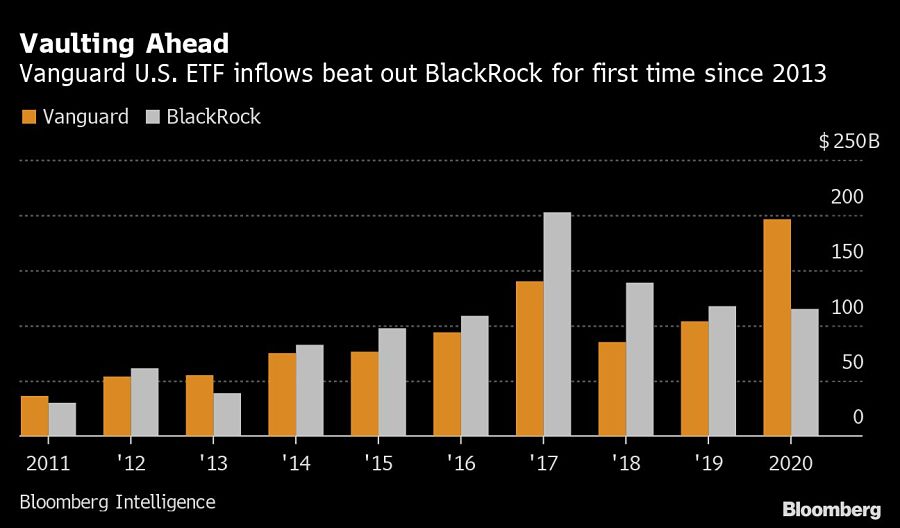
Vanguard’s intake has been boosted by the conversion of some of its mutual-fund clients to lower-cost ETF shares, transactions that totaled $37 billion through the end of November, according to a Vanguard spokesman.
The steady inflows into those funds showcase the buy-and-hold ethos of the typical Vanguard investor -- financial advisers and wealth managers, according to Citigroup’s Scott Chronert. While BlackRock is also popular with that set of investors, its ETFs -- which tend to be highly liquid -- are often used as trading tools, the analyst said.
“When investors wanted to easily and conveniently access market opportunities anywhere in the world, they turned to iShares,” a BlackRock spokeswoman said, adding that those funds “have repeatedly demonstrated their versatility and resilience this year.”
Several analysts say it’s still unclear whether the gap between the top two ETFs and the rest of the pack will continue to widen in 2021. Bloomberg News reported earlier this month that State Street was exploring options for its asset management business -- including a merger with a competitor -- to gain scale, according to people familiar with the matter. A State Street representative declined to comment on the article.
“The pie is growing and State Street is getting some of the slices,” CFRA’s Rosenbluth said. “That can be appealing to a smaller ETF provider or a firm that has been on the outside looking to break into the ETF market.”

Elsewhere, LPL recruits a $160M Edward Jones advisor in Alabama as William Blair opens a Dallas office with an ex-UBS wealth team

Rick Wurster says Schwab is shutting out unauthorized logins as agents like Meta's Muse, Instinct and OpenAI's Dots push into consumer finance

Schwab wants RIAs on Claude’s enterprise plan for its security controls, but most of its firms are too small to fill the 20-seat minimum

Looks like the LPL doubters were right all along.

Echelon Partners counted 125 wealth management deals in Q3 2026, with the quarter's biggest deal targets by assets selling minority stakes rather than getting swallowed.
Knighthead Life entered the market with a competitive MYGA. A strong launch earned advisor confidence and paved the way for FIAs.
As AI makes financial information more accessible than ever, Lana Hock explains why human judgment, trust, and empathy remain the qualities clients value most in a financial advisor

