

James Traylor, president and co-founder of Rivent Partners, found his advisory niche the way a lot of advisors do: It was personal.
Traylor, 38, has a 27-year-old sister, Nathalie, who was born with developmental disabilities and will likely never be fully independent to care for and support herself.
So far, that responsibility has been managed by their parents, but at some point Traylor believes it will be passed on to him and his family.
The challenges of caring for people with disabilities from a financial perspective was especially apparent to Traylor because his mother is a certified public accountant and an accounting professor at the University of Connecticut and his father is a former deputy comptroller for the state of New York.
Yet even with that kind of background in money and finance, Traylor said his parents were essentially lost when it came to accessing the services and programs available for people with disabilities and their caregivers.
“They had no idea what to do with my sister,” he said.
Traylor was just a year out of college in 2008 and working at MassMutual when he recognized the challenge that his family was facing could be an advisory niche.
"I came into the business during the financial crisis and I needed to develop some kind of expertise so people would want to talk to me,” he said. “I saw an opportunity to help a lot of families.”
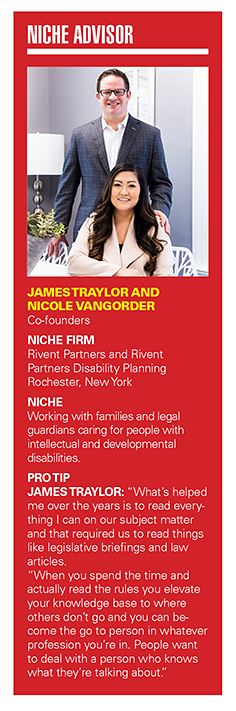
Traylor and his wife, Nicole VanGorder, left MassMutual in 2014 to launch their own firm, Upstate Special Needs Planning in Rochester, New York. The name of the RIA was changed to Rivent earlier this year to better reflect the focus on the greater New York metropolitan area and to avoid the less-sensitive reference to special needs.
In addition to the financial planning business, which has nearly $200 million under management, Traylor and VanGorder operate a consulting business, Rivent Partners Disability Planning.
The consulting business is key to the success of the advisory niche, Traylor said.
While 80% of Rivent’s business is with people caring for people with disabilities, Traylor said a lot of those clients are in the unique position of needing direction on how to navigate the services available for people with disabilities more than they need investment advice and financial planning.
“A lot of our clients are smart people, including hedge fund managers and other financial advisors, but the common denominator is they have no idea what to do for a family member with disabilities,” he said. “We help them figure out every benefit they can get, how to structure legal work, who is paying what bill, affording independent living and a long-term plan when parents die. If someone is a Merrill Lynch advisor, we’re typically not going to manage their money, but they need this consulting help.”
What makes the consulting niche so crucial is the unique intersection of affluence and public services.
“Trust and estate attorneys don’t know about public benefits and the person advising on public benefits doesn’t know anything about having money, and that creates a knowledge gap we wanted to fill,” Traylor said. “Most financial planners looked at this niche as a source of product sales and not how to add value, but most of the families were really just looking for very technical advice, so we became experts in things like Social Security, Medicaid planning, disability benefits and maximizing every benefit out there.”
Traylor, a member of the InvestmentNews 2018 class of 40 Under 40, was chair of the New York State Developmental Disabilities Planning Council for six years up to 2021.
Rivent also does workshops and various forms of educational programs, he said.
But marketing has never been a big priority because they're currently managing between 200 and 300 referrals a year.
“There’s no one in the world that can replace these families, but we’re trying to do the best we can to get them the next best option,” Traylor said. “It’s about making sure the values are carried through and the child doesn’t end up alone without a strong advocate and resources.”

South Carolina estate planning firm joins Osaic’s IBD network, citing succession planning tools and multigenerational growth resources.

A new SIFMA and KPMG study of more than 2,100 US investors finds satisfaction high, AI-only trust falling, and demand for human guidance growing across every generation.

Retail banks and private wealth firms scored 40 in Fitch's AI stress test, signaling possible one-notch downgrade risk under an adverse scenario.

Elsewhere, Wells Fargo Advisors adds a $400 million Morgan Stanley veteran in Naples as an ex-Cetera advisor goes independent with LPL.

According to a federal charges Bradley Heppner, 60, received more than $150 million in payments through funneling money from GWG Holdings to a shell company.
Knighthead Life entered the market with a competitive MYGA. A strong launch earned advisor confidence and paved the way for FIAs.
As AI makes financial information more accessible than ever, Lana Hock explains why human judgment, trust, and empathy remain the qualities clients value most in a financial advisor

