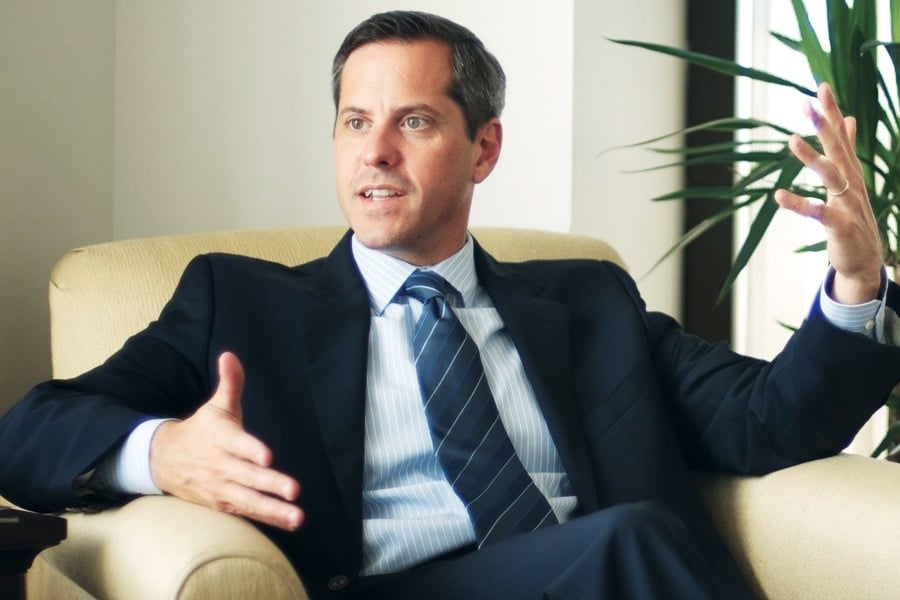
With $10.4 billion under advisement, Aspiriant is muscling its way toward the top tier of serious consolidators of registered investment advisers.
Rob Francais, the enthusiastic CEO of the Los Angeles-based RIA, likes to reference his “100-year plan” for the business. But he is equally keen to lay out the details of what it takes to join Aspiriant's unique ownership model.
“We are 100% independent and employee-owned," he says. "All of our owners are working in the business. We want to have a boutique nature and feel, but we also want to have the advantages of scale.”
Aspiriant's strategy of growth through acquisition is on track to close its third RIA transaction in a year.
Silicon Valley-based Stanford Investment Group Inc., which has $850 million under management and serves 260 clients, is on schedule to officially start operating under the Aspiriant banner when the acquisition closes Jan. 31.
The Stanford deal, like all Aspiriant deals, involves a private stock swap that essentially turns sellers into owners, and helps reinforce the “two pillars” of Mr. Francais' business model.
When the latest deal is finalized,
Aspirant will boast 175 employees, including 62 equity owners, serving 1,400 clients.
To Mr. Francais, those numbers represent the promise and potential of scale, but only if that scale is leveraged, managed and used properly.
“Just adding a bunch of people with credentials doesn't do you any good,” he said.
With that in mind, the Aspiriant model is all about aggregation of people, services and resources.
“Any clients are clients of the firm, and the lead adviser's job is to bring whatever resources necessary to bear on each client relationship,” Mr. Francais said. “If the compensation model was eat-what-you-kill and the culture was eat-what-you-kill, then we would have advisers that are incentivized to have very large client bases. But nobody owns client relationships in our firm.”
With the primary goal being to put advisers in front of clients, Mr. Francais summed up the first pillar as “We're trying to institutionalize all the time spent back at the desk researching solutions for clients.”
The second pillar is also about aggregation, but it involves the aggregation of assets for “negotiating and purchasing power on behalf of clients,” Mr. Francais said.
“It's basically about using the scale of wisdom and the scale of assets,” he added.
When the Stanford deal was first announced in December, CEO Helen Dietz cited the appeal of joining a larger organization, without all the negatives often associated with larger organizations.
“Joining Aspiriant will allow us to provide our clients with access to more services, including tax, estate, family office and a large dedicated investment team, as well as the strength and stability that comes with being part of a nationwide firm,” she said in December.
Neil Hokanson merged his 30-year-old advisory firm with Aspiriant a year ago, and he is now chairman of the board of directors and team leader for the San Diego office.
“For us, the motivation was that we looked into the future and thought markets aren't going to give us the kinds of returns our clients have become used to, and the costs associated with running a business are all going up,” he said. “We wanted more depth on the investment team, and we wanted to think about a succession plan, so the idea of a dynamic, large group of owners that could maintain the firm's independence appealed to us.”
David DeVoe, founder of the research firm DeVoe & Co., describes Aspiriant's strategy as a “methodical approach to inorganic growth that is part based on succession planning and part based on smaller advisers being able to generate scale.”
“I think their growth strategy makes a lot of sense, and it's good for the advice industry,” he added. “When firms join a bigger organization they get access to a broader set of products and services, and they can capitalize on the greater investments being made in technology, and taking compliance headaches off their plate.”
With the Stanford deal, Aspirant will have 10 offices, including five in California. The other offices are in New York, Boston, Minneapolis, Milwaukee and Cincinnati.
Mr. Francais said there is at least one more deal already in the works, but he was not more specific.
Even though Aspiriant has recently emerged as one of the fastest growing consolidators of RIAs, it is not seen as growing for growth sake.
“They don't want to just be an acquirer, because they are seeking to merge firms into their organization and culture,” Mr. DeVoe said. “They are very selective on a couple of levels, because they are guardians of a brand and a business model, and they are looking for a core client base that is higher-net-worth.”