

For decades, executives at giant brokerage firms, including the Big Four wirehouses and others, scoffed at the notion that independent registered investment advisors posed a threat to their lucrative, cash-flow rich wealth management businesses, where tens of thousands of financial advisors work with the wealthiest clients in the country.
Why would these advisors ever leave the mothership, they would ask in private conversations.
We have the richest clients and better technology than any RIA. We spend millions of dollars on national marketing campaigns featured during broadcasts of the NFL, and we offer advisors’ clients access to investment banking deals and research that no RIA or independent broker-dealer can touch.
That side of the industry is a joke.
Well, it’s quite clear that the laughing at big firms, who by design pay advisors less than at RIAs or independent broker-dealers, stopped some time ago. And some of those same big firms are turning to compensation as a way to tie advisors to the mothership.
Giants like Morgan Stanley for years have taken a small amount of an advisor’s gross revenue, called it deferred compensation, and required advisors to stay for years in order to vest.
If a financial advisor leaves a firm with a deferred compensation plan, he or she forfeits that compensation, which is also known on Wall Street as golden handcuffs.
A new wrinkle in 2026 and 2027? Major industry players like UBS and Ameriprise Financial are introducing retention bonuses as a way to keep advisors in their seats.
Compensation to advisors used to be all about pushing advisors’ behavior and getting them to sell certain products, like credit cards, mortgages or insurance products.
Now, firms are shaping compensation and pay increasingly to tie advisors to the firm and make sure they don’t jump to a private-equity backed RIA network or independent broker-dealer that features an RIA.
“Pretty much every brokerage firm has deferred compensation, but the wirehouses tend to defer more of an advisors’ pay,” said Louis Diamond, CEO of Diamond Consultants, a recruiting and consulting firm. “Deferred compensation is a retention tool and better for the firms’ financials.”
“But a new dynamic is the retention bonus for advisors, and that’s different,” Diamond said. “With a retention bonus, the firm is saying, let’s do what we can to keep this group before they jump. That’s a strategic move.”
“Ameriprise sees advisors leaving and would rather pay up to keep guys than see them go,” he said. “There is plenty of speculation that other firms are considering using retention notes for larger teams.”
Firms are rejiggering pay as some of their most experienced and profitable financial advisors move to RIAs or independent broker-dealers, where the compensation is often much higher and the opportunity exists to own their own businesses.
Wirehouse attrition, or the net loss of financial advisors at the leading wealth management firms in the industry, is climbing in 2026. The Big Four Wall Steet firms – Merrill Lynch, Morgan Stanley, Wells Fargo and UBS, lost a net total of 517 advisors over the first six months of the year, according to a recent report by Diamond Consultants.
Annualized, that would represent a net loss of 1,034 advisors, or more than three times the total of 2025.
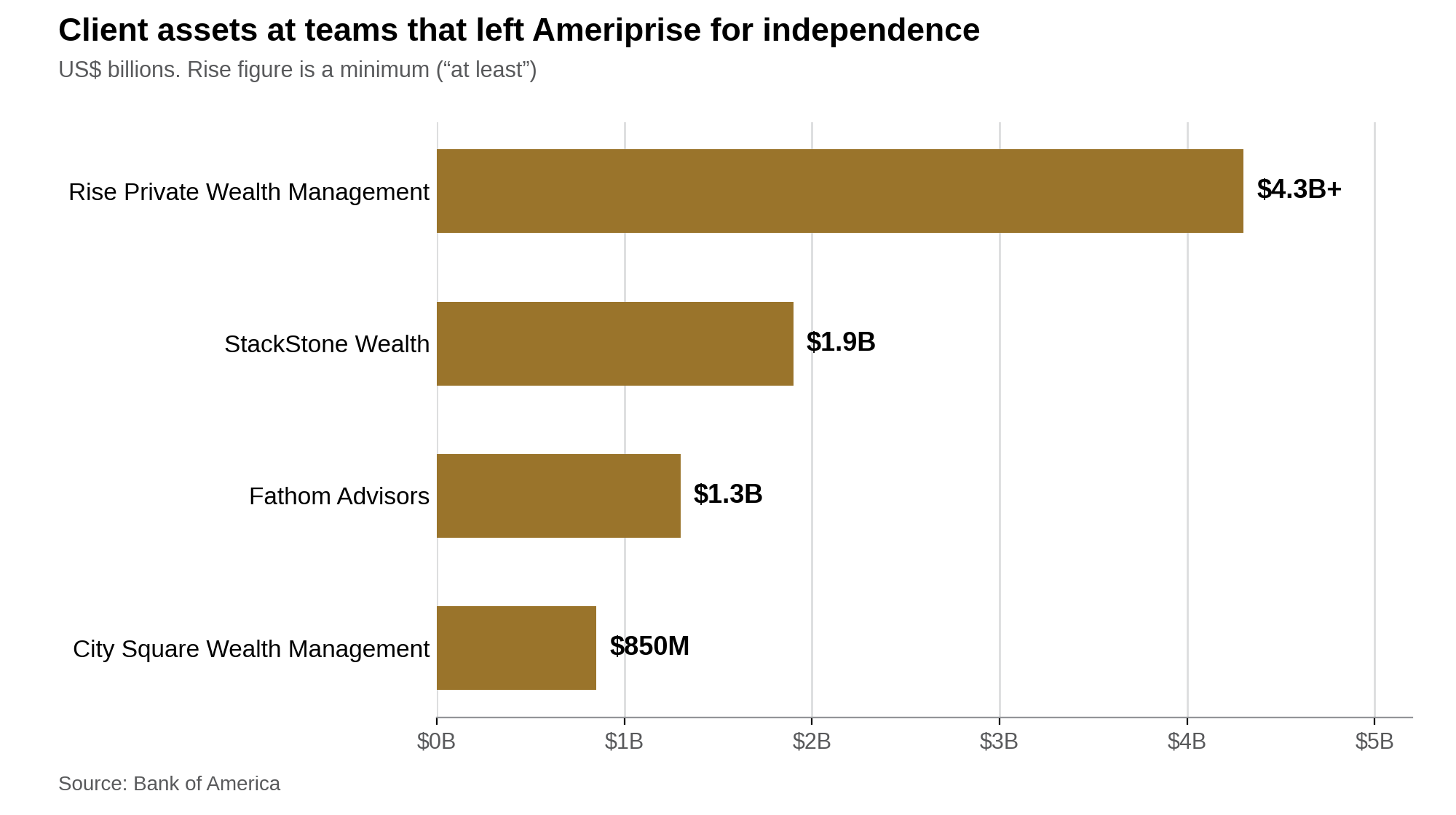
According to a report in October of advisors by Bank of America analysts, Ameriprise Financial Inc. lost several large teams recently, with three moving to the custody platform of the Charles Schwab Corp., the largest custodian for RIAs.
Advisors who own or control their own RIAs keep a much larger percentage - if not all – of the revenue generated from their firms.
At Ameriprise, “large team departures may now be structural given the attractive economics in RIA ownership while stronger recruiting and retention from the wirehouses has also slowed breakaways to IBDs,” wrote Craig Siegenthaler, a Bank of America analyst and North American Head of Diversified Financials in the note.
Ameriprise has reportedly responded “by re-recruiting its own advisors which could include cash retention bonuses - forgivable loans based on production and assets under management - and reduction to platform fees,” Siegenthaler wrote. Ameriprise could offer the retention bonuses selectively, according to industry sources.
According to the Bank of America report, the Ameriprise teams that have recently left Ameriprise to work as independent RIAs include: Rise Private Wealth Management, with at least $4.3 billion in client assets; Fathom Advisors, with $1.3 billion in assets; StackStone Wealth, with $1.9 billion in assets; and City Square Wealth Management, with $850 million.
“There is no broad-based program,” an Ameriprise spokesperson said when asked about the retention bonuses. “We wouldn’t comment further given the firm is in a quiet period before third quarter earnings.”
UBS is also now focused on retaining its advisors after changing its compensation plan to advisors a couple years ago backfired and spurred some advisors to leave.
Earlier this year it introduced a program called Pathway to Plus, which it expanded in September, to make it easier for advisors to qualify for new pay sweeteners.
“Advisors get a benefit if they agree to stay at the firm for a certain number of years,” said one industry executive with knowledge of the program who spoke privately to InvestmentNews about the plan. “It’s basically a way for financial advisors to monetize their book of business if they agree to stay at UBS earlier in their careers.”
Wells Fargo Advisors as of October 26 had not issued its 2027 compensation plan to advisors.
But in the past the firm has used retention bonuses as a way to hang onto advisors who no longer want to be employees but want to work as an independent advisor or RIA; the bonuses essentially replaced the deferred compensation money for certain employee advisors who lost it when they became independent contractors or business owners.
Morgan Stanley and Merrill Lynch are not introducing retention bonuses as part of their 2027 pay plans for advisors, adhering to a more traditional approach.
As it has in the past, Morgan Stanley is increasing a pay threshold for advisors by 10% in 2027, meaning advisors have to generate that much more revenue to see the same pay next year. Merrill Lynch is leaving its core pay plan for advisors, known in the industry as the grid, unchanged for next year.
“The industry continues to be more competitive when it comes to recruiting advisors, and competition is at an all-time high,” said Jodie Papike, CEO of recruiting firm Cross-Search. “That means the firms that have high-quality advisors are doing more than ever, including retention bonuses and dollars, to keep people at their desks.”

William Tunink, an industry veteran, was indicted for running a Ponzi scheme this month in Des Moines.

Broker-dealers will soon share targeted returns under SEC-approved Rule 2210 changes, but one securities lawyer warns the regimes aren’t identical.

Insurers ranking independent broker-dealers ahead of RIAs for near-term growth as fee-only fiduciaries still find annuities a hard fit

Most voters 50-plus in swing districts favor candidates backing a caregiver tax credit, as caregiving drains retirement savings

New F2 Strategy research finds more firms growing without M&A, yet one-third still lack a defined growth process.
Knighthead Life entered the market with a competitive MYGA. A strong launch earned advisor confidence and paved the way for FIAs.
As AI makes financial information more accessible than ever, Lana Hock explains why human judgment, trust, and empathy remain the qualities clients value most in a financial advisor

