

The age of coronavirus lockdowns helped fuel a blistering rise in retail trading, and many rookies even beat the market. But day traders also found that the year’s market gyrations required constant attention and that their amateur trading tools were limited.
So many do-it-yourself investors have decided that they need professional help.
Jeremy Johnson, a 31-year-old ad tech sales manager in Atlanta, started out trading popular stocks on Robinhood and making deposits to his Roth individual retirement account. But after investing more than $15,000 a year on average by himself, in November Johnson decided that it was time to turn to a financial adviser.
“You can save your money all you want,” he said, “but if it’s not doing anything, what does it look like long term?”
The pandemic-fueled surge in the ranks of day traders could have been seen as a death knell for the financial planning and advice industry. But the field continues to grow, since even day traders and people who prefer set-and-forget index fund investments have come to realize that there are a lot more components involved in building wealth.
Johnson’s new adviser, chosen based on a friend’s recommendation, helped package his life insurance with a mix of whole- and term-based features, bolstered his savings habits and altered his retirement investments to improve their tax structure.
According to a Cerulli Associates research study from October, 40% of U.S. investors surveyed said they need more advice. Those who said they were willing to pay a financial professional rose to 56%, up 5 percentage points from 2019. And 82% of those who are paying for financial advice said that it’s worth the price.
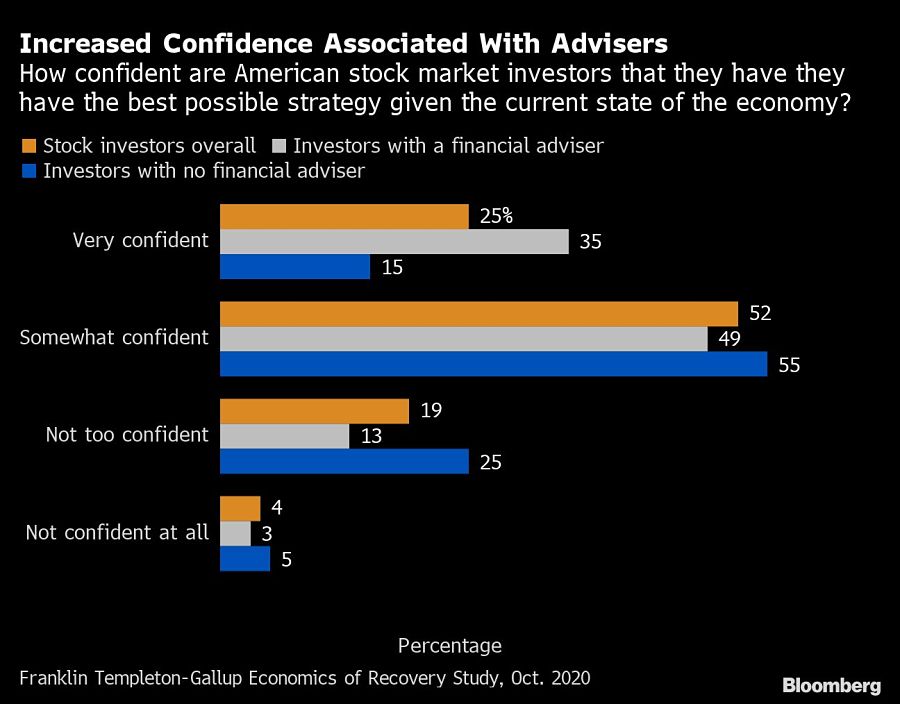
In fact, stock investors who have a financial adviser were more than twice as likely to say that they are very confident that they have the best investment strategy compared with those going at it alone, according to a survey by Franklin Templeton and Gallup.
After stocks plunged in March over COVID-19 fears, Los Angeles wealth management firm Aspiriant saw greater demand for its services. Another set of new clients arrived later in the year as a wave of initial public offerings hit the market, according to Sandi Bragar, the company’s managing director for planning strategy and research. All told, she said, the firm’s client list grew 32% in 2020.
When Tia Ware, a 30-year-old pharmacist in Virginia, first considered hiring a financial adviser five years ago, she was taken aback by the $1,200 yearly fee.
“At first I was like ‘Hell no,’” Ware said in a FaceTime interview. “But now, yes, when I see my accounts. If I didn’t have a financial adviser, I’d only have shoes and bags to show for it.”
In the early years, Ware saw her adviser just once or twice a year. But last year after the pandemic hit, she realized how imperative it was to engage more often.
Eddie Welch, whose Montgomery, Alabama-based advisory firm was bought by Captrust Financial Advisors last year, said that any time there’s been financial upheaval, people “have been more warm and receptive to paying for and receiving advice.”
Welch, now a principal at Captrust, said that while apps like Robinhood make it easy to trade stocks, “it’s a little more difficult to get into the market with a plan. And in most cases I think that’s what people seek from us.”
The growth of retail trading on free apps prompted major brokerage firms to also offer no-fee trades, with the hopes of convincing some of those customers to pay for advice. Many firms also added robo-advisers -- software programs that use algorithms to mimic flesh-and-blood financial advisers.
Charles Schwab Corp., which in October 2019 became the first of the majors to offer zero trading commissions, added 142,000 new accounts that month. This created “more of a pipeline for paid financial advice,” according to Morningstar analyst Michael Wong, who said that many of these clients would likely gravitate toward Schwab’s robo-advice.
In fact, Schwab’s digital advisory assets grew 18% year-over-year to $57.9 billion in 2020. This was part of the explosion in robo-advisers, with users increasing to 71 million from 46 million in 2019, according to data compiled by LearnBonds.com.
But most traders still want a personal touch. An Investopedia survey of young adults with household incomes of $50,000 or more found that 56% trusted a human financial adviser more than an automated one.
Phyllis Klein, who leads Captrust’s education and advice programs, said clients’ desire for insights was growing sharply as the coronavirus pandemic wreaked havoc on society. “We’ve had almost 12,000 webinar attendees and that is threefold of what it was the prior year,” she said.
“I can’t emphasize how much people need help,” Klein said, “and how much they just want to talk to somebody.”
[Listen: InvestmentNews Podcast: A new day in Washington, but what does that mean for financial services?]

Thrivent Investment Management Inc. in May fired Nicholas Hale, according to his BrokerCheck profile.

About 70 bank and credit union advisors move to the Raymond James platform, while a $480M New Jersey team goes independent with LPL

The best tax plan asks not only how much a client could save, but what they would have to give up to save it.

A 20-year financial services veteran brings values-driven planning expertise to the St. Louis-based RIA.

New research shows a 71% plunge in actions in fiscal year 2026, with total settlements the lowest since the database began.
Growing wealth, evolving priorities, and untapped opportunities are reshaping how women approach long-term investing.
Knighthead Life entered the market with a competitive MYGA. A strong launch earned advisor confidence and paved the way for FIAs.

