

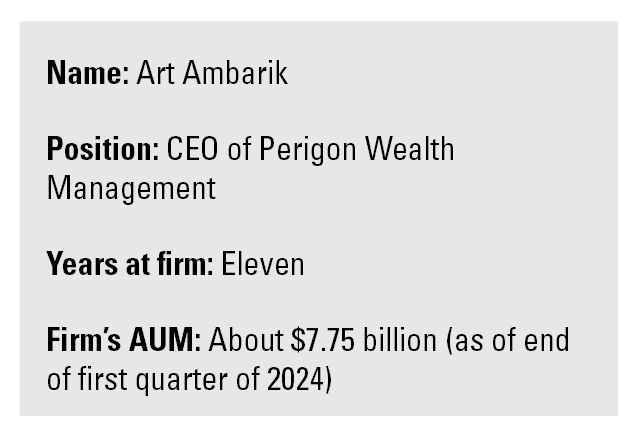
Over the past 11 years, Perigon Wealth Management has seen remarkable growth, expanding from under $150 million to approximately $7.75 billion AUM by the end of the first quarter, driven by more than 10 acquisitions. CEO Art Ambarik attributes the expansion to a strategic approach that balances autonomy and collaboration within the firm.
“When I started thinking about this back around 2013, there were two kinds of firms in the industry – enterprise firms, where everybody did the same thing, and platform firms, where everyone had complete autonomy but lacked a collaborative environment,” he says.
Instead, Ambarik envisioned a firm that maintained the sanctity of the client-advisor relationship, a core value sought by those going independent, while fostering a collaborative back office that shared intellectual capital and created a unified culture.
“Creating a true partnership where advisors have a seat at the table was crucial,” adds Ambarik. “From early on, when we started being inquisitive, I believed in equity being part of the partnership. On the other side of things, [it’s about] embracing technology and using that to create a more efficient back office.”
This combination of people power and technology is something that’s continuing to gain traction in the wealth management field. According to research from WorldMetrics, approximately 75 percent of wealth management firms have already adopted AI technologies, with 80 percent of industry executives adding that they believe the new tech will reduce costs.
But it’s not just new tech that industry veterans are having to keep a close eye on – there’s the fiduciary rule, too.
“Any fiduciary, whether as an RIA, under DOL, or CFP, means putting the client’s interests first,” he emphasizes. “We’ve been preparing for it all along, and have already done the vast majority of the work on that front.”
Compliance, Ambarik notes, has grown significantly in scope over the years – with the expanded compliance efforts, while resource-intensive, being seen as essential to maintaining the firm’s integrity and client trust.
“Twenty years ago, the role of compliance was small,” he explains. “Now, we’ve gone from having one compliance person to three, with an outsourced compliance team plus attorneys. [What’s more,] the proposed non-compete bill has been discussed and [is] causing lots of debate in the industry. It's going to be a little bit complex, depending on how the advisors are affiliated with the firm. Here in California, the courts have not been supportive.”
Ambarik emphasizes that the firm’s responsibility is to provide value to both clients and advisors, ensuring they remain with the firm through the quality of support and resources provided. However, he also acknowledges the complexity of situations involving equity or capital exchange.
“It gets more complex when there’s an exchange of equity or capital, requiring fair and reasonable contracts,” he explains.
Looking ahead, Ambarik identifies key focus areas for the coming year, emphasizing talent acquisition and retention, client service, and strategic partnerships.
“Creating a culture that attracts and retains the best talent is a hot spot right now,” he says. Perigon remains majority advisor-owned, but recognizes the need for exceptional employees and leaders to ensure advisors can focus on servicing their clients.
“Clients, for the future, are looking for firms that can help them in all areas of their financial lives, not just traditional investment or financial planning,” adds Ambarik. “Our industry is seeing a lot of money moving to the RIA space, and with that come potential partners like institutional money managers, custodians, and technology providers.”
Organic growth, Ambarik notes, is also evolving. Historically driven by referrals and custodians, it now requires the leveraging of digital strategies.
“Firms will have to take advantage of digital lead acquisition, online lead generation, and SEO,” adds Amarik.

The financial advice industry has been facing inquiries into its cash sweep programs for years now.

Investor money allegedly went to strip clubs, exotic cars, and landscaping

Procyon adds $415 million in assets under management in New Jersey while Savant picks up a $213 million Southern California planning firm

With a growing number of real estate-rich Baby Boomers aging into retirement, some advisors may be failing to consider all the options available for those clients' assets.

Cornerstone Advisors study reveals compliance bottlenecks stall campaigns weeks after customer opportunities close.
As AI makes financial information more accessible than ever, Lana Hock explains why human judgment, trust, and empathy remain the qualities clients value most in a financial advisor
Northern Trust’s Ken Lassner shows advisors how to convert volatility into after-tax portfolio gains

