
When the Securities and Exchange Commission brings an enforcement case, one of the increasingly frequent responses from alleged violators is that they didn’t know that what they did was a violation.
This reaction is at the heart of an effort by some financial industry representatives to rein in what they call the SEC’s tendency toward regulation by enforcement. That term has been used by critics of the SEC’s ongoing crackdown on inadequate disclosures by brokerages surrounding the sales of funds with 12b-1 fees and revenue sharing.
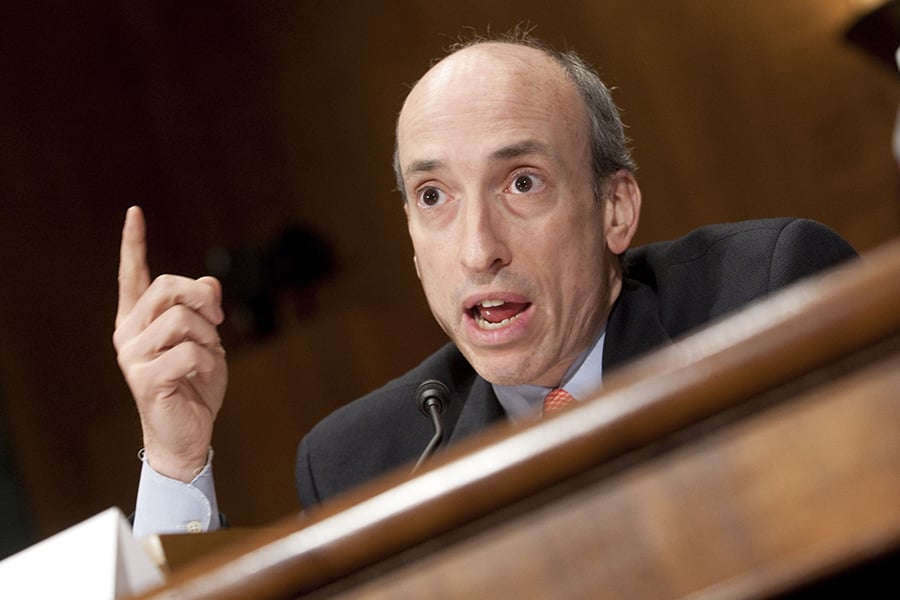
This grumbling came out in an appearance last Wednesday by SEC Chairman Gary Gensler at an online event hosted by the Exchequer Club of Washington, which is made up mostly of professionals from trade associations and law firms that represent the financial industry.
The phrase “regulation by enforcement” was never mentioned, but it was the subtext of exchanges that gave a hint of what Gensler thinks about that charge.
The topic came up in a Q&A moderated by Dale Brown, chancellor of the club and chief executive of the Financial Services Institute. Brown’s organization often has been the point of the spear on industry efforts to target what it views as regulation by enforcement.
Brown read this question from the webinar participant: “As a general matter, is it a regulator’s responsibility to eliminate ambiguity to the greatest extent possible before announcing enforcement actions?”
Gensler, knowing he was facing a tough crowd on that issue, chuckled.
“You’re often representing companies that are trying to find ambiguities in a footnote or a comma or an expression of thought that a commission has put in place,” he said.
Gensler argued that lobbying organizations have a responsibility not only to maximize their members’ and clients’ revenue and profit but also to promote good public policy.
“If you’ve got a client that’s sort of in that ambiguity, step back from that line and think about the spirit of what we’re trying to do, about investor protection, about anti-fraud, about disclosure,” Gensler said. “I think that that’s a part of your gatekeeper function. And, in some cases, Congress actually put an obligation on the lawyers and accountants and gatekeepers, and we’ll take a look at that, too, in our enforcement area.”
The SEC needs help from financial industry interest groups to do its job, he said.
“We’ve got a big mission; we’ve got limited resources,” Gensler said. “You’re part of making sure there’s trust in capital markets.”
The SEC will base its enforcement actions on facts, circumstances and the law, he said, but warned the audience to be careful in ambiguous gray areas.
“Step back from the line,” he said. “That’s not a place to be.”
In the last question about enforcement, Brown referred to Gensler’s vow that the SEC would pursue misconduct wherever it’s found.
“All Exchequer Club members support these efforts to ensure market integrity,” Brown said.
But he asked Gensler about the SEC’s promise to pursue “novel cases.” He asked how the SEC would ensure that those cases would be based on existing regulations and not used to announce new regulatory requirements.
“They’re going to be right down the middle of the plate,” Gensler said. “It’s just that sometimes, with all respect, companies innovate and as they innovate, they raise novel questions about what the law is.”
The novel cases could arise from cryptocurrency and digital engagement practices by financial advisers.
“Don’t just assume if it’s artificial intelligence and machine or deep learning or a new robo-adviser, that there aren’t obligations in terms of how you connect with the public,” Gensler said.

Retiring RIA seller David Laidlaw alleges the Carnegie valued his stake on $11.7 million EBITA while pitching potential buyers on $21.3 million.

New tool gives RIAs and family offices AI help vetting private market deals, with some users reportedly halving review time.

Investors got projected returns dressed up as real ones, SEC says

Parents must still act to get the $1,000 federal seed and employer contributions, giving financial advisors a role in the rollout.

FINRA booted Rudy Anguiano from the industry for “conversion - the intentional and unauthorized taking of another person’s property.”
As AI makes financial information more accessible than ever, Lana Hock explains why human judgment, trust, and empathy remain the qualities clients value most in a financial advisor
Northern Trust’s Ken Lassner shows advisors how to convert volatility into after-tax portfolio gains

