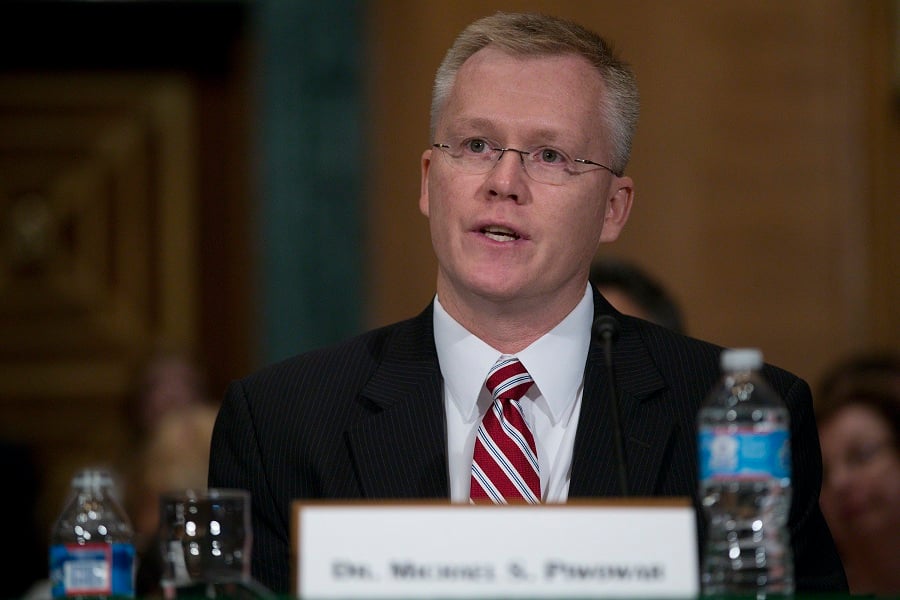
A Securities and Exchange Commission member criticized Finra's proposal for a massive brokerage data collection mechanism Thursday, signaling opposition from at least one member of the regulator that would ultimately have to approve a rule.
SEC commissioner Michael Piwowar said the
Financial Industry Regulatory Authority Inc. has not yet justified the need for the Comprehensive Automated Risk Data System.
“What problem are we trying to solve? The justification for CARDS has changed multiple times since it was first proposed,” Mr. Piwowar said at a meeting of the SEC Investor Advisory Committee. “Is this yet another Washington solution in search of a problem?”
He also raised doubts about the privacy of investor data, citing a recent study by the Massachusetts Institute of Technology about the vulnerability of credit card information based on just a few purchases.
“The fact that the Office of Financial Research (OFR) within the Department of Treasury already has access to credit card transactions from the Consumer Financial Protection Bureau, and could similarly grab brokerage account transactions from any CARDS-type program, heightens my concerns,” Mr. Piwowar said.
SEC Chairman Mary Jo White said Finra is trying to strengthen investor protection but declined to give her own opinion of CARDS, noting that the SEC would have to approve the proposal before it goes into effect.
“The objective they've stated pretty clearly is an important one, but I don't want to get ahead of the train there,” Ms. White told reporters on the sidelines of the IAC meeting.
The SEC Investor Advisory Committee discussed CARDS further Thursday afternoon. The group does not often delve into Finra initiatives, but it has the scope to do so.
“I don't know that we've done it before, but it's well within the defined parameters of our jurisdiction,” said Barbara Roper, an IAC member and director of investor protection at the Consumer Federation of America.
In the Thursday afternoon session, Daniel Sibears, Finra executive vice president for regulatory operations/shared services, did not directly address Mr. Piwowar’s criticisms. He said the organization was analyzing the
dozens of comments it’s received about CARDS, but did not provide a timeline for the next steps in the rule-proposal process.
“We are in listening mode,” Mr. Sibears said.
Finra is “taking seriously” the concerns it’s hearing about data security, he said, but he left no doubt that the regulator wants to move ahead with CARDS.
“We are convinced that to be a modern regulator we have to be able to do a better job with data and analytics to protect investors,” Mr. Sibears said.
CARDS would collect reams of customer-account data from clearing firms and brokerages on a monthly basis and enable the regulator to detect dangerous industry trends and harmful product-sales practices more quickly, Finra officials have said.
First proposed in December 2013 as a concept release, CARDS has gone through a couple of iterations. A rule proposal released last fall has drawn
strong resistance from the Securities Industry and Financial Markets Association and other financial industry groups, which have raised objections to the technology costs associated with the program as well as concerns about data security.
The industry-funded broker-dealer regulator has asserted that the
regulatory benefits of CARDS would justify its costs.
The emphasis that Finra has put on using big data to regulate its more than 4,000 member firms was made clear Wednesday, when the organization announced it is
creating an Office of Advanced Data Analytics.
The office will be headed by Erozan Kurtas, who is currently assistant director of the Qualitative Analytics Unit at the SEC Office of Compliance Inspections and Examinations. In his SEC role, Mr. Kurtas developed the National Exam Analytics Tool, which allows the agency to systematically analyze large amounts of trading data to identify compliance violations.
“It is critical for regulators to use 21st century data analytics in order to keep up with 21st century markets,” Finra chairman and chief executive Richard Ketchum said in a statement. “Building on his pioneering work at the SEC, [Mr.] Erozan and his team will develop cutting-edge data analytics tools to help Finra better utilize the data we collect in order to fulfill our mission of protecting investors and ensuring the integrity of our markets.”