
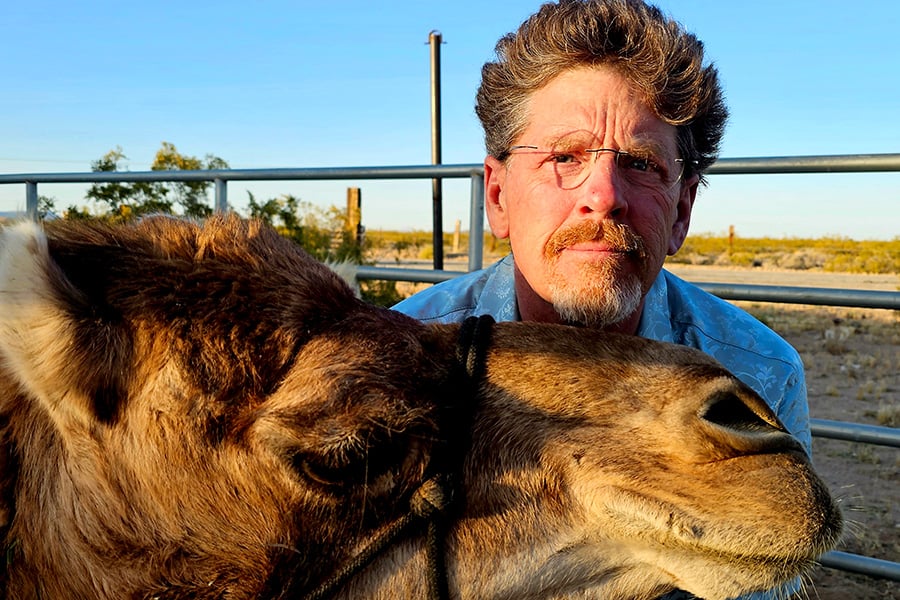
Mike Wood might be the perfect candidate for sustainable investing.
He spent much of his career as an environmental lawyer, and he’s incredibly interested in the nexus of social responsibility and investment, appreciative of the nuances and complications of topics such as engagement versus divestment.
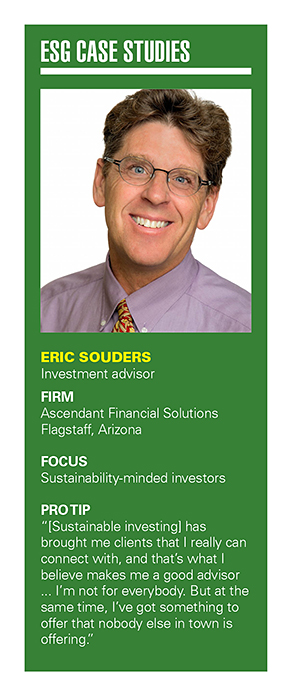
When he read an op-ed by Arizona financial advisor Eric Souders about environmental and social issues around investing, he knew it was time for a change.
“We had a [different] financial advisor in Flagstaff … he was great,” Wood said. “He had everything dialed in, but it seemed like every time I would broach the topic of sustainable investing — maybe even to the point of impact investing — it seemed like he hemmed and hawed.”
Wood said he feels his former advisor’s pain a little, as 10 years ago, environmental, social and governance themes were more complicated for financial professionals to address, given a range of standards and lack of data that is available today.
Wood called Souders, investment advisor at Ascendant Financial Solutions, and after a couple of conversations, he hired him.
Specializing in sustainable and responsible investing “has brought me clients that I really can connect with — and that’s what I believe makes me a good advisor,” Souders said. “I’m not for everybody. But at the same time, I’ve got something to offer that nobody else in town is offering. There’s an added value with that. I’m not just another advisor trying to pump out the highest return as possible.”
A lesson for other advisors might be that if you want to attract like-minded clients, don’t be shy about putting yourself out there. But that approach, which has won Souders numerous customers, also has a downside.
“I’ve lost a few [clients], too,” he said.
His clients “are all the perfect clients,” Souders said, “because we share values. And in this business, in order to do well by your client, you have to be as honest and vulnerable as you are asking them to be.”
Before his career in financial advice, Souders, like Wood, had a lot of interest in environmental causes. In the early ’90s, he was selling energy-efficient light bulbs, solar panels and organic gardening supplies at a specialty store.
Shortly afterward, he moved on to work for an annuity provider. Only later did he focus on his passion — socially responsible investing.
“I’ve come to this with a value structure that was already in place,” Souders said. Often “advisors get into this business because they want to make a lot of money. Most of the advisors I meet, that’s their MO. How does an advisor change their values to incorporate and really believe the talk to sell the ESG story?”
Currently, 98% of his clients are invested in the socially responsible portfolios he runs. Those portfolios, built with institutional shares of mutual funds, are largely fossil fuel-free and exclude companies involved in oil and gas extraction as well as weapons manufacturers. He also provides clients with a carbon-intensity estimate for their portfolios, which on average are about half the rate of comparable indices, Souders said.
As of the end of 2022, he managed about $32 million in assets for 150 families.
“In order to obtain the returns, we have to manage risk. Fiduciary responsibility is being twisted around these days,” Souders said. Sustainable investing represents “the next level of managing risk. This is what investors are looking for.”
That of course resonated with Wood, who now runs a leadership consulting firm. He trusts his advisor to make sound investment decisions.
“I’m your traditional investor in that way,” he said. "What I really want to know is what is the average return.”

Eight in 10 pre-retirees say the US retirement system wasn't built for them and most still haven't planned how to make their money last.

Just over 10% of advisors' wealth clients come from defined contribution plans, as capacity, data and technology gaps block the bridge to wealth

Deal creates a $20B-plus custody platform for private market investing in IRAs, months after Schwab closed its Forge Global purchase

Despite the good times, advisors should tread carefully, said one veteran industry executive.

Gallagher data reveals a huge gap in financial confidence between employees who work with an advisor and those who don't.
Knighthead Life entered the market with a competitive MYGA. A strong launch earned advisor confidence and paved the way for FIAs.
As AI makes financial information more accessible than ever, Lana Hock explains why human judgment, trust, and empathy remain the qualities clients value most in a financial advisor

