
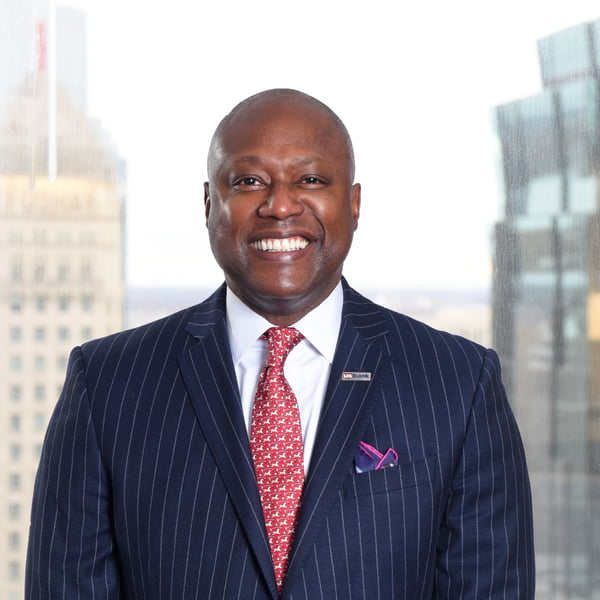
Following the death of George Floyd, U.S. Bank decided to look for ways to economically uplift the African American community and narrow the wealth gap. It didn’t have to look very far, according to Scott Ford, president of wealth management at U.S. Bank.
“U.S. Bank is headquartered in Minneapolis and George Floyd Square is a mile and a half from the office. We can see it from the buildings,” said Ford. “So we went on a listening tour and engaged community leaders and business leaders.”
Ultimately, the team found that the African-American community needed greater access to financial information and resources. As a result, Ford said they launched an overarching strategy called Access Commitment to focus on individuals and businesses in those underserved communities.
Ford, who grew up in a middle class household on Long Island, says home and real estate ownership is one of the biggest ways African-Americans can increase their wealth. He cites a statistic that black Americans have a homeownership rate of approximately 45 percent versus 75 percent for the white population in the country.
“We did a building black wealth insight study a couple of years ago, and homeownership was one of the most important things to the black community, especially those who were affluent and trying to build wealth,” said Ford. “Increasing homeownership and using real estate as an investment vehicle, not just to build wealth, but to pass along intergenerational wealth to subsequent generations.”
When it comes to the biggest financial mistakes made by members of the African-American community, Ford says first and foremost is not having an emergency fund. It's a danger not unfamiliar to other communities in America, but one that he calls “pervasive” in black neighborhoods.
Another financial risk often found in black communities, according to Ford, is overwhelming debt loads.
“Most people don't realize that across all Americans, more than half could not come up with $500 in the event of an emergency. So what happens? The hot water heater breaks, you get an unexpected expense, and then you end up running up a lot of credit card debt,” said Ford.
In terms of investing, Ford says he always encourages people to contribute to their work retirement plans and take advantage of any matching programs. He adds that it's especially vital for African-Americans who “have generally had less information about how those programs work.”
Finally, for financial advisors seeking to tap into the widely underserved black community, Ford says the key is to be "culturally sensitive" because a high percentage of African-Americans have at some point had a difficult interaction with banks or bankers.
“A lot of our research has shown us that there's a general distrust of the financial services community. So just be sensitive to that, be aware of that when you go into the conversation,” said Ford.

Salespeople at the firm often went beyond the matching algorithm to recommend network advisors on its Zoe Wealth platform, according to the regulator.

The Protect College Sports Act would cap school payments and codify NIL rights, with implications for advisors guiding young athletes.

"I know the number that I want to be able to retire on, and now I just want out," says Wilmington Trust's Marguerite Weese, describing a common refrain among business-owner clients.

Bessemer and Brown Brothers Harriman veteran Robert Ludricks III and private markets specialist Olof Akesson join the ultra-high-net-worth push on the East Coast.

765 investors were promised 260% annual returns on truck leases
As AI makes financial information more accessible than ever, Lana Hock explains why human judgment, trust, and empathy remain the qualities clients value most in a financial advisor
Northern Trust’s Ken Lassner shows advisors how to convert volatility into after-tax portfolio gains

