

Residents of New York, Virginia and 11 other states could end up with a surprise tax hit of hundreds of dollars next year on forgiven student loans.
President Joe Biden’s announcement that the government would forgive some student debt for individuals earning less than $125,000 was welcome news to many carrying large loan balances. But 13 states have laws that treat this forgiven debt as income, meaning that it’s subject to state levies on earnings.
That means that taxpayers in those states who have $10,000 in debt forgiven could end up owing a few hundred extra dollars -- or in Hawaii more than $1,000 -- on their state tax returns next April.
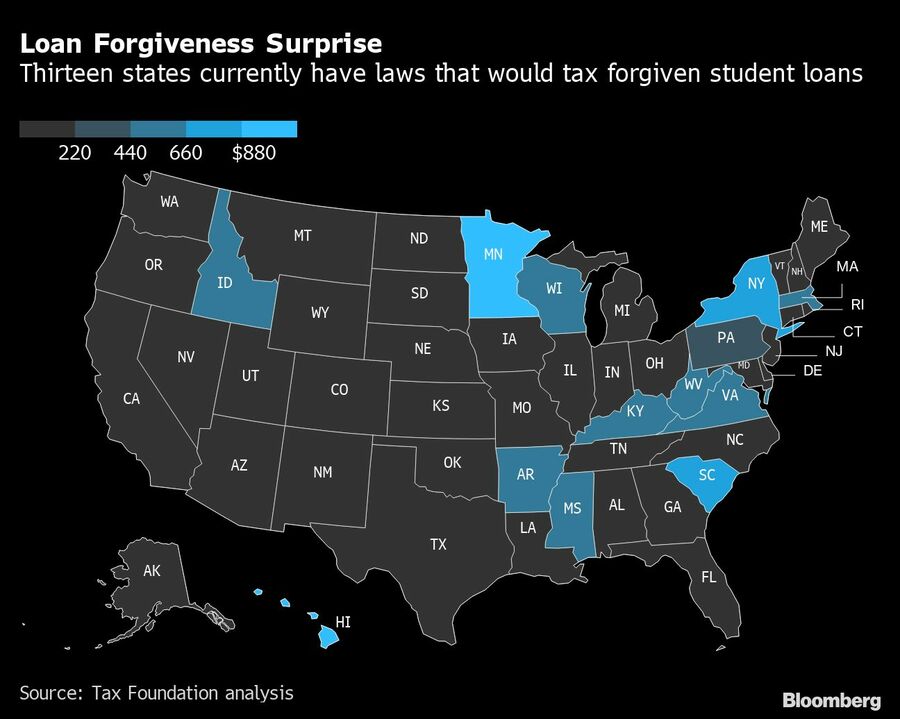
Student borrowers who received a Pell Grant as an undergraduate, which the White House estimates is about 60% of borrowers, can get up to $20,000 in loans forgiven. Individuals with the full $20,000 cancelled would pay double the tax amounts.
The federal tax code also generally treats forgiven debt as income, but in 2021, Congress included in the American Rescue Plan a measure that would temporarily exempt canceled student debt from taxation.
It’s possible that some of the 13 states where the laws would tax these forgiven student loans will revise their rules before the taxes are due next spring. Depending on the state, that could come in the form of an administrative change from the governor or state tax department, or may require the state legislature to pass a new law.
Jared Walczak, a vice president at the Tax Foundation focusing on tax policy, calculated the maximum tax hit for $10,000 in forgiven loans in various states. His figures are based on the highest tax rate filers who qualify for loan forgiveness are likely to pay in their state. His tabulations found that residents of Pennsylvania are likely to pay the lowest amount, with Hawaiians paying the most.
| State | Maximum Likely Tax Liability |
|---|---|
| Arkansas | $550 |
| Hawaii | $1,100 |
| Idaho | $600 |
| Kentucky | $500 |
| Massachusetts | $500 |
| Minnesota | $985 |
| Mississippi | $500 |
| New York | $685 |
| Pennsylvania | $307 |
| South Carolina | $700 |
| Virginia | $575 |
| West Virginia | $650 |
| Wisconsin | $530 |
Walczak said that states will need to act with “some urgency” if they want to change how their tax laws treat student loans in light of Biden’s changes. He added that it isn’t likely to matter whether the state is led by Republicans or Democrats. Since the change has already been made at the federal level, there will be some pressure on states to reduce tax burdens for their residents, he said.

Elsewhere, Wells Fargo Advisors adds a $400 million Morgan Stanley veteran in Naples as an ex-Cetera advisor goes independent with LPL

According to a federal charges Bradley Heppner, 60, received more than $150 million in payments through funneling money from GWG Holdings to a shell company.

A $1B fund allegedly skimmed 30% off the top, then swapped cash for locked-up stock.

Insiders allegedly rewrote projections three times in four days.

TCI Wealth Advisors also has also tapped JIFFYAI to unify onboarding and servicing, while TradePMR adds ICE market data to its Fusion advisor platform
Knighthead Life entered the market with a competitive MYGA. A strong launch earned advisor confidence and paved the way for FIAs.
As AI makes financial information more accessible than ever, Lana Hock explains why human judgment, trust, and empathy remain the qualities clients value most in a financial advisor

