
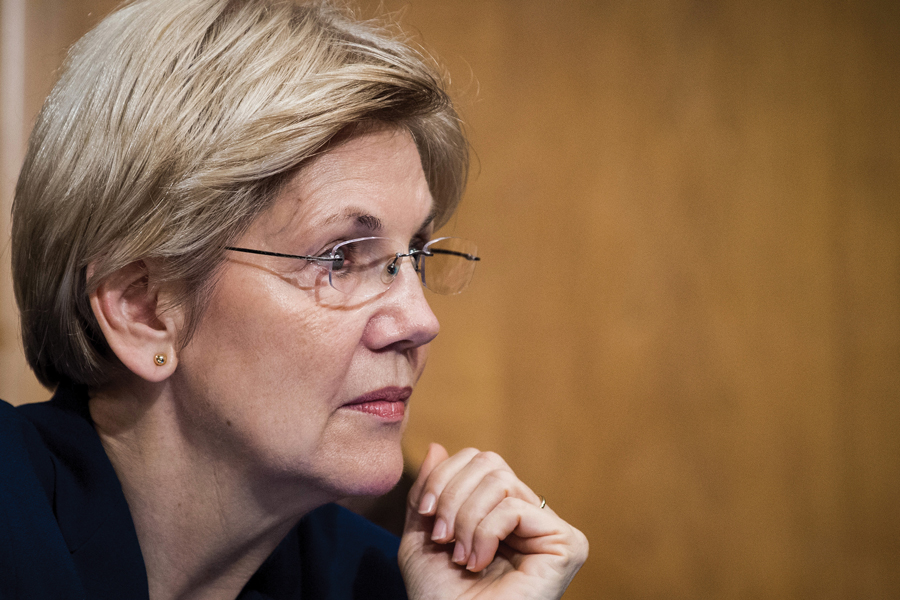
Senate and House lawmakers pressed Finra Thursday on the fairness of the broker-dealer regulator’s arbitration system following a recent court ruling in which a judge asserted the forum was biased against an investor claimant.
Sen. Elizabeth Warren, D-Mass., and Rep. Katie Porter, D-Calif., sent a letter to Finra Chief Executive Robert W. Cook citing the decision by Georgia Superior Court Judge Belinda E. Edwards to vacate an arbitration claim that Wells Fargo won in 2019 against a customer who accused the firm of mismanaging his account.
In her decision, Judge Edwards said Finra allowed Wells Fargo to strike certain arbitrators from the roster of those available to hear the case, undermining the neutrality of the arbitration forum. Finra said there was no agreement regarding the appointment of arbitrators.
The judge’s ruling raised Warren’s ire. She had written to Cook last year following the GameStop trading frenzy, and in his response to one of her questions, he assured her of the fairness of the arbitration system administered by the broker-dealer self-regulator.
“These findings by a federal judge in the Wells Fargo case raise serious questions about your assertions that the Finra arbitration process is ‘neutral, efficient and fair,’ and about whether Wells Fargo has once again sought to undermine consumer protection rules,” Warren and Porter wrote.
They posed several questions for Cook to answering, zeroing in on the details about how arbitrators were chosen for the Wells Fargo case and whether the firm talked to Finra officials about their selection.
“Finra takes this issue very seriously,” Finra spokesperson Michelle Ong said in a statement. “We are reviewing the letter and look forward to responding appropriately.”
The controversy over the Wells Fargo arbitration case was a trifecta for Warren. She’s been a longtime critic of Wells Fargo and Finra, as well as of the broker-dealer self-regulator's arbitration system.
“This latest report brings all three problems into focus: it reveals troubling new allegations about the atrocious behavior of Wells Fargo, the inability of FINRA to effectively police the financial system, and the unfairness of the arbitration process,” Warren and Porter wrote.

A Nationwide survey finds 47% of GLP-1 users have never discussed the drugs’ financial impact with an advisor, even as many dip into savings.

The hundreds of millions of dollars from a sale of Inspired Healthcare properties does not mean an immediate windfall for investors.

Its SEC filings said one thing - a congressional probe said another.

Sham agreements allegedly padded revenue by 345%.

"Most pre-retirees are uncomfortable making key retirement income decisions without an advisor's help," said Chris Bailey of Cerulli.
Knighthead Life entered the market with a competitive MYGA. A strong launch earned advisor confidence and paved the way for FIAs.
As AI makes financial information more accessible than ever, Lana Hock explains why human judgment, trust, and empathy remain the qualities clients value most in a financial advisor

