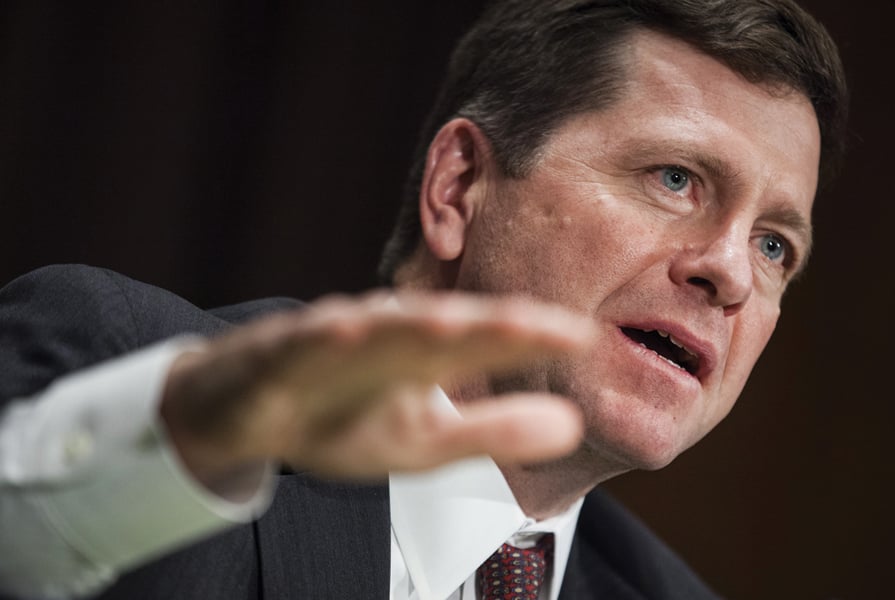
Securities and Exchange Commission chairman Jay Clayton called Wednesday for an end to sales contests that encourage brokers to recommend certain products.
Mr. Clayton said that in recent roundtables with investors he has heard concerns about the harm that can come from such promotions.
"Main Street investors have no tolerance for certain questionable sales practices such as high-pressure, product-based sales contests," Mr. Clayton
said in a statement.
When brokers participate in sales contests, they put their own interests ahead of their clients' interests, according to Mr. Clayton.
"I believe — and it is clear to me that Main Street investors believe — that these practices should be eliminated," he said.
Investor input was focused on the SEC's investment advice reform proposal. The centerpiece is a regulation designed to raise broker standards by requiring them to act in the best interests of their clients. Although sales contests are mentioned in the
preamble to the so-called Regulation Best Interest, no language banning them is included in the rule text.
The Securities Industry and Financial Markets Association, a trade group representing brokerages and other financial firms, backed Mr. Clayton's attempt at moral suasion.
"SIFMA agrees with chairman Clayton that there is no place for high-pressure, product-based sales contests and such contests should be eliminated," said Ira Hammerman, SIFMA executive vice president and general counsel, in a statement.
But Mr. Clayton's attack on sales contests fell flat with an investor advocate.
Barbara Roper, director of investor protection at the Consumer Federation of America, said
Financial Industry Regulatory Authority Inc. rules governing brokers already curb sales contests.
She said the SEC instead should target sales quotas for proprietary products and policies that encourage brokers to move clients into managed accounts and cross-sell a firm's other products and services.
"It's an odd example to offer," Ms. Roper said. "There are plenty of incentives you can focus on that aren't already addressed under securities rules."
In a footnote to his statement, Mr. Clayton said performance-based compensation, such as an adviser being awarded for increasing a firm's assets under management, is appropriate.
"There is an important distinction between compensating individuals based on broad performance metrics — an important component of the compensation structure of many professional services firms that have served clients well — and incentivizing individuals to recommend a particular product through time-based quotas, bonuses, sales contests, etc., that experience shows us often are not in the best interests of clients," Mr. Clayton said.
Christopher Iacovella, chief executive of the American Securities Association, which represents regional financial services firms, welcomed Mr. Clayton's stance.
"It is very important for firms to have the flexibility to offer incentives to their brokers to expand their book of business," Mr. Iacovella wrote in an email. "We also appreciate that the chair seems to be setting out exactly what is permissible as it relates to product compensation."
DISCLOSURE FORM
In his statement, Mr. Clayton also said investors support and have offered "valuable feedback" on another part of the investment-advice package: disclosure forms that highlight differences in services, fees and compensation between investment advisers and brokers, who will continue to be regulated separately.
"They have focused on simplifying, clarifying and tailoring the disclosure, including through the use of graphics, and have urged us to limit or eliminate legalese, otherwise the summary will not be read," Mr. Clayton said.
But Ms. Roper said her review of the
roundtable transcripts shows the SEC still has a long way to go.
"There was a consistent message from participants that the proposed disclosures didn't clarify the very issues chairman Clayton says investors don't understand — starting with the differences between broker-dealers and investment advisers, including the difference between fiduciary duty and best interest," she said. "In several roundtables, chairman Clayton describes these differences in a simplistic way that doesn't fully capture the complexity of the range of options that exist in the investment adviser and broker business models."
Mr. Clayton attended roundtables in Atlanta, Houston, Miami and Denver — as well as other meetings the SEC staff conducted over the last several weeks. Another session has been scheduled for
Sept. 20 in Baltimore.