
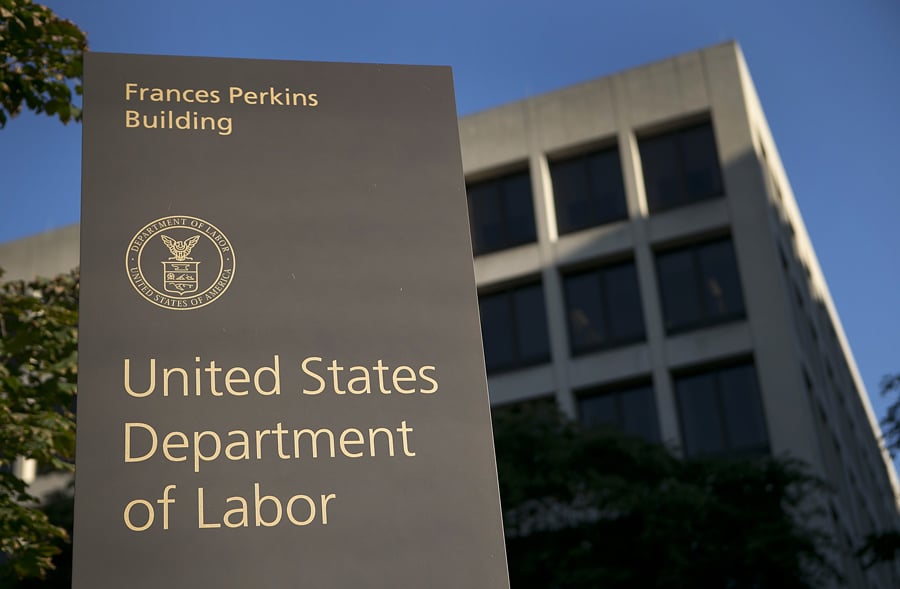
The Department of Labor on Wednesday assured retirement plan providers that they can include private securities in funds that they offer to their individual account participants.
In an information letter responding to a question from Pantheon Ventures and Partners Group, the DOL said plan sponsors can incorporate private equity investments in a multi-asset target-date, target-risk or balanced fund.
A plan administrator would not violate the fiduciary requirements of federal retirement law “solely because the fiduciary offers a professionally managed asset allocation fund with a private equity component,” the letter said.
The DOL said that encouraging the prudent use of private equity would help boost retirement account diversification and performance in defined-contribution plans. Defined-benefit retirement plans already can utilize private equity.
“This information letter will help Americans saving for retirement gain access to alternative investments that often provide strong returns,” Labor Secretary Eugene Scalia said in a statement. “The letter helps level the playing field for ordinary investors and is another step by the department to ensure that ordinary people investing for retirement have the opportunities they need for a secure retirement.”
Allowing ordinary retirement investors to access private securities markets has been a priority for Securities and Exchange Commission Chairman Jay Clayton, who endorsed the DOL’s move with a statement contained in the DOL’s press release.
Anya Coverman, senior vice president and general counsel at the Institute for Portfolio Alternatives, welcomed the DOL’s guidance.
“It’s a big step toward giving plan participants access to the same range of investment tools and portfolio diversification that has traditionally been used successfully by defined-benefit plans,” Coverman said.
Investor advocates blanched at the DOL’s effort to ease private equity into retirement accounts, citing the opaque nature of unregistered securities.
“The last thing the DOL and the SEC should be doing is directing more investment money from transparent public markets to high-risk dark private markets,” said Dennis Kelleher, chief executive of Better Markets.
One of the criticisms of private equity funds is their high fees. The California state pension system, for example, disclosed several years ago that it paid 700 basis points in private equity fees.
The DOL should have been more cautious about opening the door to private equity, said Tyler Gellasch, executive director of Healthy Markets Association.
““The pension and retirement community’s track record with private equity has been mixed at best,” Gellasch said. “The fees and risks associated with investments in private funds compared to public funds may be very significant. It’s frankly the exact opposite direction I would hope the DOL would be taking to protect the retirement funds of millions of Americans.”
But David Levine, a partner at Groom Law Group, said the DOL is properly focused on the mix of investments that can generate better returns.
“Having a portfolio-diversifying alternative allows you to create a more holistic framework for retirement wellness,” said Levine, whose firm represents Pantheon Ventures. “It’s almost more dangerous to limit the tools that retirement savers can use.”
Teresa Ghilarducci, an economics professor at the New School for Social Research, said private equity can be a healthy part of well-managed long-term portfolios.
“Most 401(k)s are not well-managed and are often used for short term purposes,” she wrote in an email. “Private equity in 401(k)s is a half-step towards solving the fatal flaws in the voluntary, individual directed, for profit 401(k) system.”
Christine Lazaro, a law professor at St. John’s University, cautioned that ordinary investors don’t have the background to parse private equity.
“By exposing non-accredited investors to private placement through the context of their retirement accounts, they are being subjected to risks that they don’t always have the ability to assess and knowingly accept,” Lazaro wrote in an email.
The DOL implied the letter on private equity investments was in part a response to President Donald Trump’s recent executive order exhorting agencies to be innovative in spurring economic recovery from the coronavirus pandemic.
Kelleher scoffed at that motivation.
“It’s mendacious for the DOL to use the pandemic as a pretext for its latest anti-investor move,” he said.

Halbert Hargrove senior wealth advisor weighs in on the products' guaranteed income upside, the operational drag and his wish list for carriers.

With 8.6% of advisors set to switch firms in 2026, Cerulli says advisor recruitment hinges on technology, branding and HNW support.

“I’m seeing more disputes like this between advisors and other advisors at the same practice,” said one industry executive.

Longer retirements and steady inflation could drain retiree portfolios before heirs inherit, with 4% net returns running dry by year 34.

A single fintech partner triggered a $68.8M credit hit.
As AI makes financial information more accessible than ever, Lana Hock explains why human judgment, trust, and empathy remain the qualities clients value most in a financial advisor
Northern Trust’s Ken Lassner shows advisors how to convert volatility into after-tax portfolio gains

