Jump to Winners | Jump to Methodology
The firms managing billions for high-net-worth Americans
share the philosophy behind their standout results
Sponsored by:

InvestmentNews’ 5-Star RIA Firms (High Net Worth) 2026 identifies 110 registered investment advisors across the United States whose practices are built around HNW clients, verified through SEC Form ADV – Annual Amendment to the Uniform Application for Investment Advisor Registration – filings.
To qualify, each independent RIA must derive more than 70 percent of its assets under management from HNW individuals and manage at least $100 million in total regulatory AUM. The 2026 list spans four AUM tiers and is based entirely on objective, publicly available regulatory data with no pay-to-play component.
110 registered investment advisors across the US earned 5-Star status by building practices where more than 70 percent of assets under management come from HNW clients, verified through publicly filed SEC Form ADV data.
The best-performing firms are not the largest: boutique RIAs in the under-$500M tier average 97.1 percent HNW concentration, outpacing the 81.9 percent average among Tier 4 firms managing more than $5 billion.
Client loyalty is in crisis: only 17 percent of HNWIs report a seamless advisory experience, and the share working exclusively with a single firm has fallen from 39 percent in 2019 to 19 percent in 2025, according to Capgemini’s World Wealth Report 2026.
With $62 trillion of HNW wealth set to transfer by 2048 and a projected shortage of 100,000 wealth advisors by 2034, the firms that have built deep, fiduciary-based, multigenerational relationships are best placed to define the next era of wealth management.
Sources: SEC Form ADV (InvestmentNews analysis); Capgemini World Wealth Report 2026;
Cerulli Associates; McKinsey & Company.
American wealth has never been more concentrated – or more in motion. In 2025, the United States added 736,000 new millionaires, bringing its HNW population to 8.7 million and its share of global HNWI wealth to a record high. Yet, in the same period, an estimated $1.5 trillion in assets walked out the door at traditional advisory firms, flowing to competitors better built for the clients they were supposed to be serving. Wealth is concentrating. Loyalty is not.
The numbers behind that shift are stark. According to the Capgemini Research Institute’s World Wealth Report 2026, only 17 percent of HNW individuals feel their advisory experience has been seamless and personalized. The share of HNW investors working exclusively with a single firm has halved since 2019 – from 39 percent to 19 percent. The advisory industry is not losing clients because returns are bad. It is losing them because the experience is.
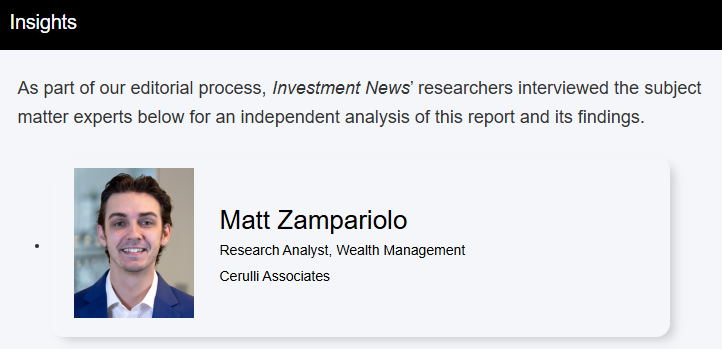
The drivers are structural, not cyclical. Matt Zampariolo, associate director of wealth management research at Cerulli Associates in Boston, points to rising complexity as the core issue: estate planning, alternative investments, integrated tax strategy, and philanthropic structuring have made the HNW advisory mandate more demanding with every passing year, not less.
“There are still rising complexities around asset allocations with the growth of alternatives, growing appetite for philanthropy, and myriad other financial needs that are essentially unique to the HNW space,” says Zampariolo.
Clients are also demanding something that large institutional platforms struggle to provide: a single, coherent view of their entire financial life.
“They likely want to know about how the firm might help manage, or at least have a view into, their outside and held-away accounts and assets,” says Zampariolo. “It is not at all uncommon for HNW-plus investors to have third-party brokerage accounts, direct investments, real assets, or real estate holdings that sit outside of their primary financial advice relationship.”
For a wirehouse advisor constrained by platform limits and proprietary products, that expectation is structurally difficult to meet. For a fee-only fiduciary RIA, it is simply the job.
The firms built to meet that standard – purposeful, fiduciary, unconflicted – are the subject of this report. IN’s 2026 5-Star RIA Firms (HNW) list identifies 110 registered investment advisors across four AUM tiers whose commitment to the HNW segment is verifiable, auditable, and public: drawn from publicly available SEC Form ADV filings, ranked by HNW-attributed assets under management, with no pay-to-play element. More than 70 percent of every firm’s business, by AUM, comes from HNW clients. For the eight firms on this list reporting 100 percent, it is the only business they do.
The IN 5-Star RIA Firms (HNW) 2026 list spans an extraordinary range of scale. At one end sit boutique independent advisory firms managing just over $100 million in HNW-attributed assets. At the other sit institutional giants managing hundreds of billions. Yet all 110 firms qualified under the same objective criteria: a Form ADV filing dated on or after March 1, 2025; total regulatory assets under management of at least $100 million; managed assets reported for US clients; and more than 70 percent of business derived from the ‘HNW individuals’ client type as defined on Form ADV.
The firms are ranked within four AUM tiers based on the dollar value of HNW-attributed assets under management – not total firm AUM, not headcount, and not growth rate. This methodology rewards concentration and commitment to the HNW segment above all else. A firm managing $500 million with 100 percent of assets from HNW clients qualifies on equal terms with one managing $5 billion with 80 percent HNW attribution.
The resulting list is dominated by fee-only registered investment advisors operating under a strict fiduciary standard – legally required to act in clients’ best interests at all times, with no proprietary products, no brokerage conflicts, and no suitability-standard wiggle room. This is not incidental. For independent financial advisors and fee-only wealth managers, the fiduciary model is structural to HNW specialist success: it removes the conflicts of interest that erode trust precisely where trust matters most. By 2027, wirehouses are projected to hold just 27.7 percent of industry assets, down from more than 50 percent in 2005, as advisors and clients alike continue gravitating toward the independent RIA model, according to research from Alden Investment Group. IN’s guide to navigating BD vs. RIA compliance requirements examines this shift in depth.
Across the four tiers, geographic spread is broad – winners are headquartered in at least 20 states, from Florida and Texas to Illinois, California, New York, and Pennsylvania – and HNW concentration ranges from 70.5 percent to 100 percent. Several firms, including Yale Capital (St. Petersburg, FL), Gordian Wealth Advisors (Mill Valley, CA), Cypress Capital Partners (Chicago, IL), Galecki Financial Management (Fort Wayne, IN), and BT Family Office (Atlanta, GA), report 100 percent of assets under the HNW client type, accepting nothing else.
Of the 110 firms recognized in InvestmentNews' 2026 5-Star RIA Firms (HNW) report, eight report that high-net-worth clients account for the entirety of their client base under SEC Form ADV, Item 5.D(b)(3). No other client segment appears in their regulatory filings.
Yet AUM concentration alone is not the full picture of a firm’s quality. Zampariolo argues that the metric says more about the strength of individual advisor relationships than about the firm itself.
“At a baseline, it says less about the firm’s specific quality than one might think, and more about the quality of the advisor and their ability to maintain relationships,” he says. “The firm has to be set up from an operational perspective to handle larger clients, but it comes down more to the advisors’ ability to serve and maintain the relationships with those client families.”
A 2026 analysis by Financial Planning found that despite their scale advantages, the industry’s largest RIAs – those with more than $10 billion in AUM – are actually falling behind smaller peers in per-client wealth growth.
“Simply saying you serve high-net-worth or ultrahigh-net-worth clients doesn’t make it so,” says Kevin Hrdlicka, head of wealth at Savant Wealth Management in McLean, VA. “Moving upmarket is more of a personalization decision.”
Cerulli’s Zampariolo describes the service breadth required in the HNW segment as baseline rather than differentiating. “Knowing that HNW and UHNW clients tend to need much more bespoke planning and asset allocation – being able to provide access to estate planning, alternative investments, and the liquidity and tax implications of those investments – is essentially table stakes,” he says. What elevates a firm above that baseline, in his view, is the quality of its relationship model.
“HNW investors tend to take a pretty mixed approach when engaging with their financial advisors – the relationships tend to be more collaborative,” Zampariolo says. “They want to have a view into the ‘what’ and the ‘why’ from their financial provider but also want to know that the advisor and their team are handling everything proactively without the end-client having to be overly involved from an operational perspective.”
The 5-Star list reflects exactly that distinction. Being listed is not a function of firm size. It is a function of what a firm has chosen to be.
At the top of the highest tier – firms with more than $4 billion in HNW-attributed assets under management – sits Yale Capital. The St. Petersburg, FL-based RIA manages $4.92 billion, 100 percent of it attributed to HNW clients. By that single measure, it ranks first among all 110 firms on this list. By almost every other operational measure, it is also an outlier.
Yale Capital maintains what is believed to be one of the highest employee-to-client ratios in the RIA industry. The firm employs eight to nine people for just over 100 family relationships – a ratio that founder and managing partner Cheyne Pace says has defined the firm since inception and will not change.
“We generally came in below 100 clients. We just passed 100 fairly recently. With eight or nine employees, it was a ratio that we like to keep and still have, and that we’re very proud of. And that won’t change,” he says.
That ratio is not an accident. It is a deliberate choice that shapes everything else about how the firm operates. When the firm’s capacity filled, Pace did not lower the bar for new clients. He moved upstream, concentrating instead on larger relationships – most recently, nine-figure mandates.
“It was either we can hire a lot more people or we can start working with larger dollar amounts, because money’s infinitely scalable.”
The practical consequence of that ratio is a service model that functions less like a financial advisory firm and more like a concierge operation. Every client at Yale Capital holds a direct cell phone number for their advisor. Same-day callbacks are standard. When a client in a distant city needs a face-to-face meeting, the firm goes to them.
“All the clients have our cell phone numbers. We text, call any hour of the day. If we can sense there’s a need to be face to face, even though we have clients across the country, we’re there at the drop of a hat,” adds Weston Newman, vice president at the firm.
Pace is direct about the competitive implication of Yale Capital’s employee-to-client ratio: it obligates the team to outperform on service because it has no excuse not to. “That has to be a given – that you’re going to beat everybody else on service – when you have the highest employee-to-client ratio,” he says.
The firm also operates with a flat internal structure that pushes responsibility downward quickly. Weston Newman, who joined six years ago, describes being given significant ownership of client relationships and complex processes – including managing nine-figure transfers from bulge-bracket banks – within a short time of arriving.
Yale Capital was built entirely through cold-calling and referrals – no advertising, no marketing budget, no country club networking. The firm’s entire client base, described by Pace as “almost 100 percent cold-call strangers and referrals,” was earned through direct outreach to individuals at the moment of a liquidity event: an IPO founder, the recipient of a business acquisition, and someone who suddenly has $100 million in cash or stock and an immediate need for sophisticated guidance.
That targeting is deliberate. Pace makes a distinction that many advisory firms miss: the difference between approaching a wealthy person and approaching a wealthy person with an immediate, defined need.
Once the firm is in front of a prospect, who begins calling long-term clients for references, the conversion rate rises sharply.
“Our hit ratio has been, like, 90 percent once you get to that point. Getting to that point is much lower than 90, obviously, Pace explains. “But once we’re at that point – because we can lead with people who are literally 20-year-plus clients – there’s not a lot of people who can do that in our business.”
The model is, in Pace’s own framing, fundamentally different from the inherited-client model at large institutional firms. And while he acknowledges the appeal of being handed clients ready-made, he views the earned, organic nature of Yale Capital’s book as its most durable asset.
That dynamic – the advisor as the true driver of HNW relationships – is a factor that Cerulli’s Zampariolo identifies as a defining structural reality of the RIA channel. “The core driver of HNW assets flowing into the RIA channel outside of service offerings is advisor migration into the channel, in which cases they often bring a great majority – typically 70 percent or more – of their client assets to the new firm,” he says. It is a pattern that reinforces the centrality of personal trust over institutional brand: clients follow advisors, not logos.
What Yale Capital’s model illustrates most sharply is not just service intensity, but a willingness to be unconventional in ways that require real conviction. Nowhere is that clearer than in the firm’s investment philosophy.
Yale Capital’s approach is one articulation of a philosophy that runs, in different forms, through the wider 5-Star cohort. Not every firm on this list rejects active management outright. What they share is something more foundational: a willingness to build their investment process around the client’s actual situation rather than around a product shelf or a benchmark. For Yale Capital, that conviction produces the clearest and most counterintuitive version of the argument.
In a market where most RIA firms competing for HNW mandates lead with claims of superior manager selection or market-beating strategies, Yale Capital leads with market efficiency. The firm’s approach, grounded in academic research from Nobel Prize-winning economists, accepts the fundamental premise that beating the market consistently after taxes and fees is not a realistic investment objective. Its goal is to minimize friction, maximize tax efficiency, and preserve capital – which, Pace argues, will outperform the active-management field over any meaningful period.
Pace uses a pointed analogy for why active manager selection fails: sophisticated participants exist on both sides of every trade, and after paying what he calls ‘the bookmaker’ in fees and taxes, consistent outperformance is structurally improbable. He acknowledges this view is unusual in practice, despite being the foundation for the growth of index funds and the entire ETF industry.
“I don’t think I’ve ever run into anyone with a similar philosophy. And I think it’s for pecuniary reasons, partially, and partially because of ignorance. In a jump ball situation with four other people, three of them are saying, ‘We have this manager selection process, it’s going to enable you to beat the market’ – which is, in my opinion, a scam. But if the Nobel Prize winners are saying the opposite, I probably at least allow that guy a seat at the table,” says Pace.
The proof, for Pace, came in the early 2000s. When the NASDAQ fell 80 percent during the dot-com collapse, Yale Capital’s balanced approach and deliberate diversification away from concentrated technology positions meant clients were meaningfully protected. Pace describes that period as his best years of portfolio management on a relative basis.
“My best years managing portfolios were in 2000, because I was getting people out of Internet stocks into the most opposite thing I could find. Everything looked fantastic on paper when everybody else was down,” he says.
The HNW context makes this philosophy particularly compelling. Yale Capital’s typical client arrives at a moment of change – an IPO, an acquisition, a business sale – and what they need above all else is not to generate alpha but not to lose what they have just made. Pace frames this directly:
The fiduciary structure reinforces the philosophy. As a RIA operating under a strict fiduciary standard, Yale Capital is never in the position of recommending a product because of a commission structure, a proprietary relationship, or a manager incentive. Pace frames this as the core of the firm’s value proposition to HNW clients.
Yale Capital also brings a specialist skill set that further distinguishes it: deep experience in restricted stock hedging, monetization strategies, and the tax-efficient structuring of non-taxable acquisitions – capabilities developed during Pace’s Goldman Sachs years and applied directly to the firm’s change-of-circumstance client base.
The fee model surrounding that kind of work is also evolving, and Cerulli’s Zampariolo flags it as one of the clearest structural gaps in the RIA market.
“One of the clearest gaps from our view is the issue of serving and charging UHNW clients who may have large portions of their wealth concentrated in less-liquid private holdings – private equity, direct co-investments – which don’t necessarily contribute to a firm’s AUM,” he says.
Many such clients have built their wealth entirely through private investments and may require less in terms of asset allocation, but still need significant guidance on liquidity planning, estate and intergenerational structuring, tax, and philanthropy.
“Firms that are primarily generating revenue through AUM-based fees need to find other ways to charge for these services,” says Zampariolo, “often through retainers, flat fees, or one-off engagements.” It is a tension that boutique RIAs with deep HNW relationships are navigating directly, and one that the fiduciary model – with its freedom to price transparently and without product conflict – is structurally better placed to resolve.
If the 2025 HNWI wealth figures represent a record present, the coming decade represents a structural future opportunity that will reward exactly the kind of depth and relationship intensity the firms on this list have built.
Cerulli Associates projects that $124 trillion in wealth will transfer through 2048, with $105 trillion flowing to heirs and $18 trillion to charity (Cerulli Associates, ‘US High-Net-Worth and Ultra-High-Net-Worth Markets,’ 2024). More than 50 percent of that total – roughly $62 trillion – is expected to come from HNW and ultra-HNW households, which together represent just two percent of all US households. The first baby boomers turned 80 in January 2026, and boomer deaths are projected to accelerate from 2.6 million per year today to four million annually by 2037. The bulk of estate transfers is still ahead.
The advisory relationship risk embedded in that transfer is severe. Capgemini research found that 81 percent of next-generation HNW individuals plan to switch wealth management firms within one to two years of inheriting assets. For firms that have not built relationships across family generations, the great wealth transfer is not an opportunity – it is an existential threat. InvestmentNews’ 5-Star Wealth Management Teams 2026 report explores how leading firms are building cross-generational relationships.
With regard to their HNW concentration and high-touch service model, the firms on the 5-Star list are better positioned than most to navigate that transition. The service intensity that defines the best HNW specialists – proactive communication, face-to-face relationships, direct advisor access, and family-level engagement – is precisely what research shows next-generation inheritors are most likely to demand and most likely to defect from when they find it absent.
There is also a broader competitive context to consider. The tax environment for HNW individuals – and for the business owners who make up a significant share of the change-of-circumstance clients that firms like Yale Capital serve – is neither stable nor predictable. Pace, whose client base consists largely of business sale recipients and IPO founders, has watched the policy debate around capital gains and business sale taxes shift materially over his career.
“Taxes could change from 20 to 50 percent on business sales, which changes the M&A market dramatically, which changes the allocation of capital dramatically,” he says. For advisors built around tax efficiency and multigenerational planning, that uncertainty is not just a risk to manage – it is the reason the relationship exists in the first place.
The advisory talent shortage adds further urgency. McKinsey & Company estimates a shortage of approximately 100,000 wealth advisors in the US by 2034, even as the HNW population continues to expand. Firms with high retention rates, strong referral pipelines, and a model that attracts clients organically – as Yale Capital and many other firms on this list have demonstrated – will face less pressure from that supply constraint than competing wealth management firms.
The 110 firms on IN’s 2026 5-Star RIA Firms (HNW) list span an AUM range from just over $100 million to more than $700 billion, operate across more than 20 states, and serve clients through every model the independent advisory channel offers. What they share is not size. It is not a specific investment strategy. It is not a particular technology stack or a branded value proposition.
What they share is a commitment to a specific kind of client – the HNW individual – that is deep enough, purposeful enough, and durable enough to be reflected in publicly filed regulatory data. More than 70 percent of every firm’s business, by AUM, comes from that segment. For many firms on this list, that figure is 90, 95, or 100 percent.
The best HNW specialists, as this report shows, earn that concentration through a recognizable set of practices. They operate as genuine fiduciaries, with all the freedom that entails to serve the client’s interests without proprietary conflict. They build their client base slowly, through referrals and earned trust rather than marketing campaigns. They invest in the relationship at a ratio the industry at large cannot match – whether that means an eight-to-one staff-to-family ratio or simply an advisor who picks up the phone at 4:30 on a Friday afternoon. They hold their investment philosophy with conviction, resist the temptation to overpromise on market performance, and focus instead on tax efficiency, capital preservation, and not going backward.
In a market where the global HNWI population is growing, advisor numbers are declining, and $62 trillion of HNW wealth is about to change hands, those practices are not just admirable. They are the competitive advantage that will determine which firms define the next era of wealth management.
For investors evaluating which firm to trust with complex, multigenerational wealth, Cerulli’s Zampariolo offers a deceptively simple test. “The big question I would ask if I were in their shoes is something like: ‘How have you helped serve another client in the past whose needs were similar to mine?’” he says. “These clients want to understand the team’s ability to help manage their complex financial lives – and how they would go about solving certain issues that they may otherwise not have had to deal with in the past.”
The 110 firms on this list have, in the most objective terms available – public regulatory filings, audited Form ADV data, years of client commitment – already begun to answer that question.


| Firm | City | State | Tier | HNW AUM | HNW % |
|---|
What is a 5-Star RIA firm for HNW clients?
A 5-Star RIA firm (HNW) is a registered investment advisor recognized by InvestmentNews for its commitment to HNW client service. To qualify, a firm must manage a minimum of $100 million in total regulatory assets under management, have filed its most recent Form ADV with the SEC on or after March 1, 2025, and derive more than 70 percent of its business from the ‘high-net-worth individuals’ client type as reported on Form ADV. The recognition is based entirely on publicly available regulatory data and is not pay-to-play.
What is the difference between an RIA and a
wirehouse advisor when it comes to HNW clients?
Registered investment advisors operate under a fiduciary standard, legally requiring them to act in clients’ best interests at all times, disclose all conflicts of interest, and select products and strategies without being influenced by proprietary incentives. Wirehouse advisors have historically operated under a suitability standard, which requires only that a recommendation be appropriate – not necessarily the best or lowest-cost option available. For HNW clients managing complex, multigenerational wealth, the fiduciary structure removes conflicts that can subtly distort advice at critical decision points.
How big is the HNW wealth management market in the US?
According to Capgemini’s World Wealth Report 2026, global HNWI wealth reached $98.3 trillion in 2025, up 8.7 percent year-over-year. The United States leads global HNWI growth, with its HNWI population growing 9.2 percent in 2025 to 8.7 million individuals. Ultra-HNW individuals (those with more than $30 million in investable assets) represent the fastest-growing segment, with their global population rising 9.4 percent year-over-year. By 2026, registered investment advisors are projected to manage approximately 33 percent of all advisor-managed assets in the US.
What is the great wealth transfer and why does it matter for RIA firms?
The great wealth transfer refers to the intergenerational transfer of assets expected to total $124 trillion through 2048, according to Cerulli Associates. More than 50 percent of that total – approximately $62 trillion – will come from HNW and ultra-HNW households, which represent just two percent of all US households. For RIA firms, the transfer creates both opportunity and risk: Capgemini research found that 81 percent of next-generation HNW individuals plan to switch wealth management firms within one to two years of inheriting assets. Firms that have built multigenerational relationships and high-touch service models are best positioned to retain assets through the transition.
What investment approach do leading HNW-focused RIAs typically take?
The leading HNW-focused RIAs on this list prioritize tax efficiency, capital preservation, and minimizing investment friction over active market timing or manager selection. This philosophy – grounded in market efficiency research – accepts that consistently outperforming the market after taxes and fees over long periods is unlikely, and focuses instead on maximizing net returns through disciplined asset allocation, low-cost structures, and tax-efficient strategies including restricted stock management, qualified opportunity zones, and charitable giving vehicles. Envestnet research found that 73 percent of HNW-focused advisory practices cite tax minimization as among their most important investment objectives.
What does the InvestmentNews 5-Star RIA Firms (HNW) award
not measure?
The InvestmentNews 5-Star RIA Firms (HNW) recognition does not measure investment performance, client satisfaction scores, or advisory fee levels. It does not reflect the results of client or peer surveys, and it is not influenced by any payment or commercial relationship between a firm and InvestmentNews. The designation is based exclusively on an objective analysis of publicly available SEC Form ADV data, specifically the HNW client type concentration and total HNW-attributed AUM as filed by each firm.
InvestmentNews selected the 5-Star RIA Firms (HNW) 2026 using data self-reported by registered investment advisors to the US Securities and Exchange Commission (SEC) on Form ADV. To qualify, firms were required to meet four criteria: the latest Form ADV filing date must be on or after March 1, 2025; total regulatory assets under management must be at least $100 million; the firm must report managed assets for US clients; and more than 70 percent of the firm’s business must be derived from the ‘HNW individuals’ client type as reported on Form ADV.
The Top List ranking within each of four AUM tiers is based on AUM attributed to the ‘HNW individuals’ client type. In cases where a firm filed more than one annual update to its Form ADV during the year, the latest filing for that year was used. This recognition is not pay-to-play. Firms do not pay a fee to be considered or selected for inclusion on the list. Eligibility and rankings are determined exclusively through an objective analysis of publicly available regulatory data.