When the
2008 financial crisis is documented by historians and market watchers, it's often pegged to Lehman Brothers' record-setting $691 billion bankruptcy. But for financial advisers the overall
bear market period between 2007 and 2009 is more often recalled as a series of punishing waves that have forever altered the way
financial planning and investing are done.
"Lehman may have been the bulls-eye event, but it was just so much more than just letting Lehman fail," said Paul Schatz, president of Heritage Capital.
Lehman Brothers has been cynically described as a real estate
hedge fund disguised as an investment bank, given its lopsided exposure to mortgage origination. But the problems at Lehman were just one of many extreme risks overshadowing the financial markets at the time.
Mr. Schatz cited other 2008 events such as the
fire sale of Bear Stearns to JPMorgan Chase, the government takeover of
Fannie Mae and Freddie Mac, the sale of Merrill Lynch's brokerage business to
Bank of America and the
"breaking of the buck" by the Reserve Primary Fund, a money market fund. "Every week it was something else until it ended," he recalled.
"In hindsight, everyone now says investors should have just stayed the course, which is something I believe is complete and utter nonsense," Mr. Schatz added. "Stocks gave back more than a decade's worth of returns and then had to begin to recoup the losses."
While
Lehman's Sept. 15, 2008, bankruptcy still stands as the largest in U.S. history, it's worth noting that of the 10 largest U.S. bankruptcies, six occurred in 2008 and 2009.
Financial advisers
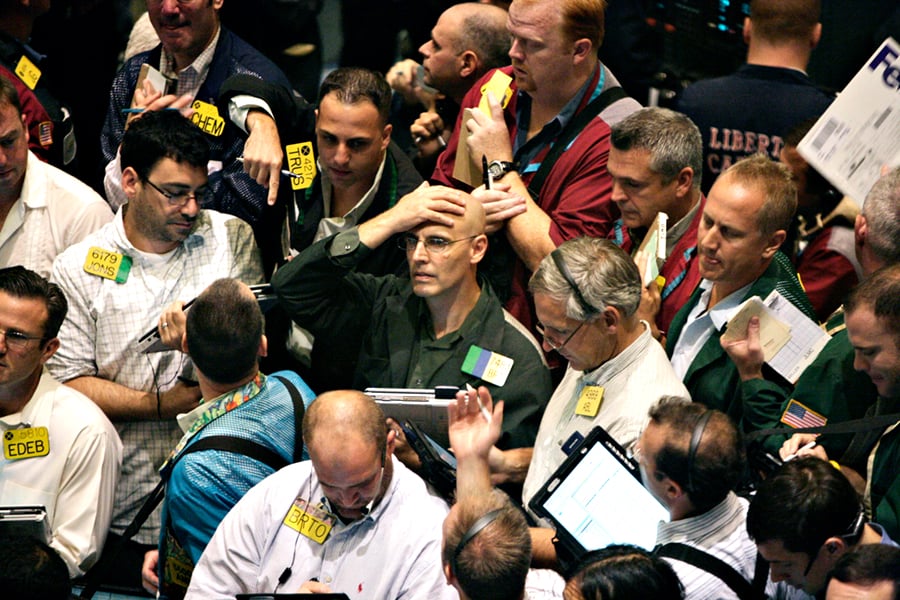
who lived through the period say they will never forget the disorientation and panic that ensued as they watched the S&P 500 Index suffer a 54% peak-to-trough drop from October 2007 to March 2009.
"We are all products of our past, so I think that means we are all more aware of how bad markets can get if seemingly everything goes wrong," said Tim Holsworth, president of AHP Financial Services.
"It also teaches the lesson that good investments recover, and at the same time, no one is immune, as any GM stockholder can attest," Mr. Holsworth said. "Clients still reference that time; it's way too early to forget."
Leon LaBrecque, managing partner and chief executive of LJPR Financial Advisors, vividly recalls the panic felt by his clients and himself.
"I remember thinking, 'This could be the end,' and that it might be time to start panicking," he said. "And I learned some lessons about being too smug, because I thought I had gotten out of all the subprime mortgage exposure and the really risky stuff, but I didn't realize it had infected everything."
By the time 2008 was complete, everything was in negative territory except for Treasury bonds and the Japanese yen. Even gold, which since the dawn of time has been considered a hedge against disaster, was negative.
Mr. LaBrecque said that while his "natural optimism" helped him get through the crisis, many of his clients are still frozen with fear of another financial market pandemic.
"I tell people, we will get another downturn of 20% and we will have another
recession, but they're still afraid of another 40% market pullback," he said.
Our timeline of the main events of the 2008 crisis
Historic market crashes leave deep scars on some investors, according to a
survey by Hartford Funds. Of the more than 1,000 adults surveyed by Hartford last year, 42% said they now avoid the stock market.
When asked about retirement planning, 26% of respondents said they have adjusted their timeline and plan to postpone retirement.
But Rose Swanger, president of Advise Finance, said her biggest challenge in the wake of the financial crisis is investor overconfidence because the equity markets have experienced such a steady climb off the bottom nine years ago.
"I have been through tech bubbles and the financial crisis, but this time is different because we have the longest bull market without any hiccups," she said.
Even the 1,600-point drop by the Dow Jones Industrial Average in February was "shrugged off and the market recovered beautifully," Ms. Swanger said.
"The general investment attitudes have become, 'I wish I had bought more in 2008, and this time around, you bet I'm not going to make the same mistake again,'" she Swanger said. "That's what I worry about the most: Investors have shown signs of aggressiveness that I have never seen before."
Mr. LaBrecque said the government's monetary policies in the wake of the financial crisis have contributed to advisers and investors taking on more risk, and ultimately riding the bull market higher.
"I've been saying for a while that 70% stocks and 30% bonds is the new 60-40 blend because quantitative easing programs have made it so difficult to make money on the fixed-income side," he said.
Meanwhile, Mr. Schatz of Heritage Capital has learned that sometimes it makes the most sense to play things a little closer to the vest.
"The financial crisis was an indelible event in my professional life, and I actually had pretty decent performance in 2008," he said. "Hopefully, investors learned that if you need a certain amount of money and stocks are doing well, you shouldn't expect to continue without risk. Waiting to react after a devastating loss is a no-win situation."