
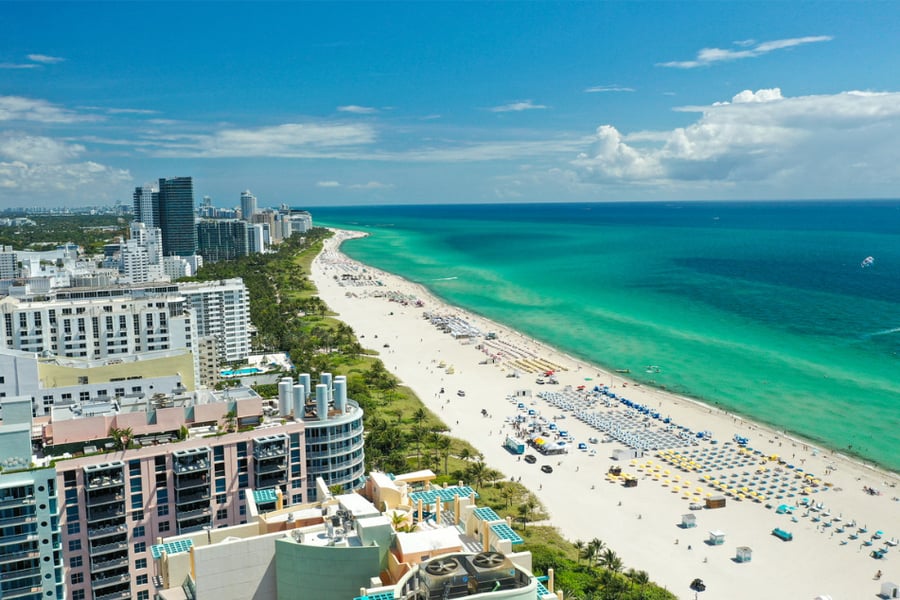
Miami Beach wants to do away with rowdy spring break crowds in favor of ballet and botanical gardens.
To help pull it off, the Florida city is selling $97.6 million of municipal debt on Wednesday that will fund improvements to cultural projects, such as the Miami City Ballet and the Bass Museum of Art. The bonds will be backed by property taxes, which surged in recent years as the city became a magnet for the wealthy.
The sale is part of a broader effort by the barrier-island city to ditch its reputation as a spring-break destination, that every year lures in thousands of young people to its South Beach neighborhood for non-stop partying. The rush of partiers forced Mayor Dan Gelber to declare a state of emergency for two years in a row. Miami Beach now wants “cultural tourists,” Gelber said.
“I want to put a stake in the heart of spring break,” he said in an interview. “I think we’ve sort of moved past that economic model.”
Miami Beach has seen a surge in residential property values, which grew by nearly 125% over the past decade. Between 2019 and 2022 alone, the number of million-dollar zip codes in the Miami metropolitan area have more than doubled, with places like Star Island or Palm Island among the most expensive in the US.
The number of high-net-worth individuals in Miami increased 75% in 2022 from 2012, according to investment migration firm Henley & Partners. Billionaires like Ken Griffin, Dan Loeb and Josh Harris have scooped up lush waterfront Miami Beach mansions. The wealth influx has led to modern office buildings, new restaurants and conferences, following years of successfully hosting Art Basel, an international art fair.
Miami Beach has long served as an arts hub, housing cultural institutions like the New World Symphony and the Miami Beach Botanical Garden, which are among the projects receiving bond funding.
Local officials are building on that history with the debt sale to shift the perception of the city, playing up its arts and cultural options. They marketed the sale saying residents will have the “opportunity to invest in the cultural expansion” of Miami Beach in an “unprecedented” growth of museums, theaters and public performance venues, according to a July 7 release.
Municipal bonds are often favored by wealthy individuals because the income earned on the investments is often tax-exempt. The Miami Beach securities are being sold in minimum denominations of $5,000.
Some institutions are already reaping benefits from the influx of people. The Miami City Ballet has seen attendance surpass pre-pandemic levels and its affiliated school has experienced an explosion in student enrollment, said executive director Juan Jose Escalante.
Miami Beach “is more than just a vacation destination. It’s its own vibrant community here,” Escalante said.
Residents have backed a broader lending plan for cultural renovation. Back in November, almost two-thirds of voters approved roughly $160 million of property tax-backed bonds to fund cultural facility improvements. Wednesday’s deal would still leave almost $60 million of approved funding available for future projects.
Moody’s Investors Service has graded the upcoming bonds Aa2, while S&P Global Ratings gave a rating of AA+. To John Generalli, a managing director at Wells Fargo who’s underwriting the deal, Miami Beach’s reputation actually helps with the marketing.
“The city is in a fantastic position in terms of the growth that it’s experienced,” Generalli said. “We wouldn’t expect to spend any time trying to explain to anyone where Miami Beach is.”

Elsewhere, Wells Fargo Advisors adds a $400 million Morgan Stanley veteran in Naples as an ex-Cetera advisor goes independent with LPL

According to a federal charges Bradley Heppner, 60, received more than $150 million in payments through funneling money from GWG Holdings to a shell company.

A $1B fund allegedly skimmed 30% off the top, then swapped cash for locked-up stock.

Insiders allegedly rewrote projections three times in four days.

TCI Wealth Advisors also has also tapped JIFFYAI to unify onboarding and servicing, while TradePMR adds ICE market data to its Fusion advisor platform
Knighthead Life entered the market with a competitive MYGA. A strong launch earned advisor confidence and paved the way for FIAs.
As AI makes financial information more accessible than ever, Lana Hock explains why human judgment, trust, and empathy remain the qualities clients value most in a financial advisor

