

Ten years ago, when Julian Schubach was just a year out of college, his boss at ODI Financial asked him to make a presentation about the importance of saving money to a group of professional dancers on the Upper East Side of Manhattan.
Schubach, now senior vice president at the Long Island, New York, advisory firm, recalls his boss reminding him, “You never know who’s in the room.”
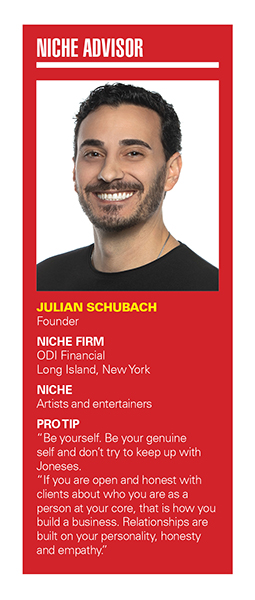
Schubach wasn’t specifically looking for an advisory niche, but that’s exactly what he found.
It just so happened that a woman attending his presentation was the program director for one of the largest arts grantmaking organizations in the country. Its unrestricted grants to artists can range from $50,000 to $650,000 and can present financial challenges and tax consequences for recipients. That was Schubach’s foot in the door.
“That presentation and the introduction led to this incredible organic growth of introductions to different arts grants,” he said. “It’s a space I fell into and it’s a great space.”
From that initial presentation and introduction to the world of unrestricted grants, Schubach has developed an advisory niche working with artists and entertainers who are mostly based in New York, Los Angeles and Miami.
“That’s how my practice began, by working with these folks providing grants, then it developed on the television and film side through the relationships I had built,” he said. “I built relationships with the artists, their peers, business managers and this amazing network of folks in the entertainment space.”
ODI Financial is a fee-only advisory firm that also works with clients outside the entertainment industry, but 95% of Schubach’s clients are artists and entertainers.
By relying on relationships with industry insiders and centers of influence, Schubach has bypassed traditional financial planning marketing strategies, which is why the firm’s website features founder Mark Dorfman and is void of references to celebrities and entertainers.
Schubach said part of his job as an advisor to this niche is not drawing attention to his clients.
“My clients’ lives are very public, so I’m very private about who I work with,” he said. “When you’re living public lives, it’s nice to have something very private.”
Without naming names, Schubach said his clients run the gamut of television and movie actors, musicians and even a world-class puppeteer.
“We work with folks who are legends and folks who are up-and-coming artists,” he said. “I have a new client who just turned 18 last week and is on track to earn $10 million this year.”
Schubach recognizes that ODI Financial operates in the shadow of firms like Alliance Bernstein, Morgan Stanley and UBS that dominate work with the entertainment industry, but he feels comfortable with his grasp of the niche.
“We manage money, but the real important work is helping these clients understand key financial concepts, and helping them understand that there are bad actors and vultures out there trying to get their money,” he said. “We’ve chosen to be selective about who we work with.”
Considering the network of lawyers, agents and business managers that typically work with entertainers, Schubach said part of his role is to “quarterback the team to keep everyone on the same page.
“Some advisors try to make it more complex than it needs to be in order to justify their services, and that’s especially true when working with folks who aren’t that familiar with finance,” he said.
But when Covid happened and entertainers saw their incomes take a hit, Schubach said his role became very clear.
“When the touring stopped and production stopped, the income dried up,” he said. “A lot of clients introduced to us during the pandemic were in a tough spot, and that reinforced the importance of education and saving and building a lifestyle around current income.”

Also, Raymond James's employee advisor channel adds breakaways from Wells Fargo and Stifel, while UBS welcomes an ex-Morgan Stanley duo in Indiana.

It promised guaranteed principal and 10% monthly returns. The SEC says it invested nothing.

Ten years after entering the fee-based annuity market, MassMutual Ascend says nearly half its lifetime sales came in the past two years alone – but barriers remain among fee-only advisors.

Amplify, WealthReach, Zeplyn and Zocks have unveiled partnerships aimed at automating portfolio management, content creation, account opening, and client communication.

New Treasury and IRS proposals would let employers add tax-free payroll contributions to the retirement accounts as advisors weigh the fit for client families.
Northern Trust’s Ken Lassner shows advisors how to convert volatility into after-tax portfolio gains
Dan Biagini of American Equity says the steady decline of pensions, longer lifespans and a reset in interest rates are rewriting how advisors build retirement income

