
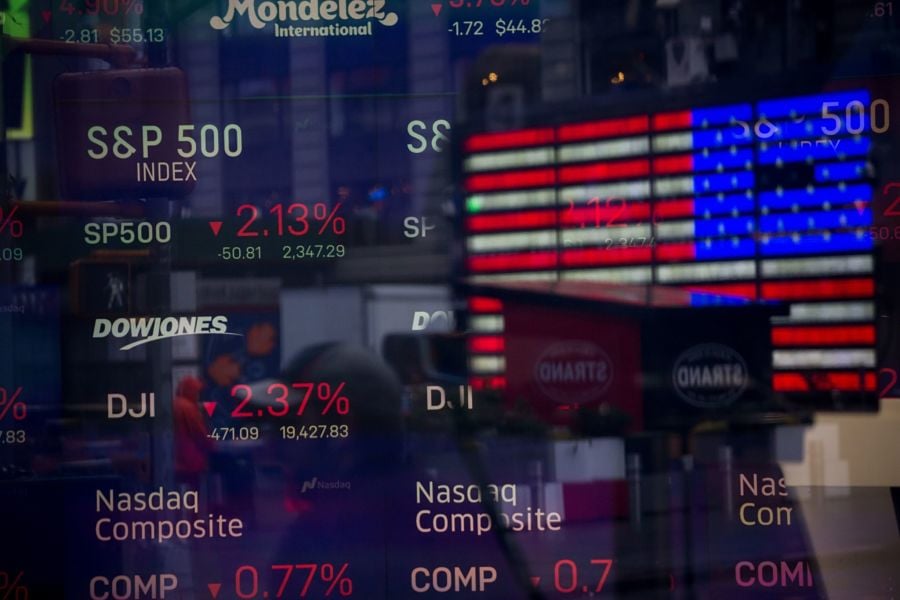
A relatively rough start to the year for stocks, rising interest rates and persistently stubborn inflation not seen in four decades have financial advisers walking a tightrope as they manage client expectations along with their portfolios.
“We believe it is important to have a long-term planning strategy that can sustain these volatile markets,” said Jodi Viaud, partner and adviser at Knox Grove Financial. “When markets are down, we communicate; when markets are up, we can reallocate if that client feels uncomfortable with any long-term plans we created.”
Tim Holsworth, president of AHP Financial, is trying his best to put the recent market volatility behind him.
“Any new money coming in now, we’re putting into the market,” he said. “We feel like the worst is behind us, and the markets will be higher through the summer and fall.”
The S&P 500 Index is down just 5.5% from the start of the year, but the ride has been volatile, and the down first quarter stands in stark contrast to a 28.7% gain last year, which followed gains of 18.4% in 2020, and 31.2% in 2019.
That strong performance of the past few years only makes the start of 2022 look worse, especially paired with a Fed tightening cycle that is already driving up consumer-sensitive rates for things like mortgages and auto loans.
Add to that the uncertainty of inflation, which the Biden administration is still calling transitory more than a year in, and financial advisers have plenty to navigate.
“We are faced with a very unique time in investments,” said Paresh Shah, managing principal at Pareshah Partners.
“Stocks and bonds are at risk at this moment,” he added. “We are also in a high volatility scenario, which may take away the top upside days if we were to move to cash.”
Shah said he applies a series of moves to reduce risk in client portfolios, including moving from growth to value stocks, allocating to shorter-term bonds, using alternatives such as real estate and credit funds, and allocating to market-linked certificates of deposit.
Katie Binns, senior product manager at Morningstar Indexes, said the current market environment is pushing investors and advisers even further from the traditional 60-40 portfolio model, and toward alternative investments.
Yields across the bond market are getting flatter and closer to inversion territory, where yields on short-term bonds are higher than the yields on longer-term bonds.
“The bond markets offer some forward-looking insight into what’s happening, and it looks like we’re still in for a rough ride,” Binns said. “Investors are starting to feel the pain in their fixed income portfolios, and it’s becoming harder for investors to stay true to investment strategies.”
The first quarter of 2022 saw the Morningstar U.S. Core Bond Index decline 6%, marking the worst quarter for the benchmark since it launched in 1999. And it’s only gotten worse, with the bond index now down 8% from the start of the year.
“The bond market is sending signals that investors should be watching,” Binns said.
De-risking is certainly on the table for Chris Mellone, partner and adviser at VLP Financial Advisors.
“We have been preparing clients for elevated levels of volatility for multiple quarters now by de-risking in both stock and bond positions of client portfolios,” he said. “Within stock positions, we have de-risked by placing an emphasis on utilizing managers who incorporate balance sheet strength into their security selection process. We have also layered in high-dividend paying holdings across client portfolios.”
A shaky near-term economic outlook has Dennis Nolte, vice president of Seacoast Investment Services, thinking about both de-risking and the risk of de-risking.
To address the stock market risk, portfolios are being tilted toward value and domestic large-cap stocks, along with some extra cash and gold, he said.
In terms of currency risk, Nolte said he has moved away from international stocks.
“We think this quarter is going to be a rough one, so we've been shifting our asset allocation for the last six-to-eight weeks,” he said. “People also seem to be holding more cash in their bank accounts because they are less enthusiastic about committing new funds to the equity markets. Since we're entering the ‘sell in May and go away’ time of year, we're not arguing against that thought.”

Elsewhere, Wells Fargo Advisors adds a $400 million Morgan Stanley veteran in Naples as an ex-Cetera advisor goes independent with LPL

According to a federal charges Bradley Heppner, 60, received more than $150 million in payments through funneling money from GWG Holdings to a shell company.

A $1B fund allegedly skimmed 30% off the top, then swapped cash for locked-up stock.

Insiders allegedly rewrote projections three times in four days.

TCI Wealth Advisors also has also tapped JIFFYAI to unify onboarding and servicing, while TradePMR adds ICE market data to its Fusion advisor platform
Knighthead Life entered the market with a competitive MYGA. A strong launch earned advisor confidence and paved the way for FIAs.
As AI makes financial information more accessible than ever, Lana Hock explains why human judgment, trust, and empathy remain the qualities clients value most in a financial advisor

