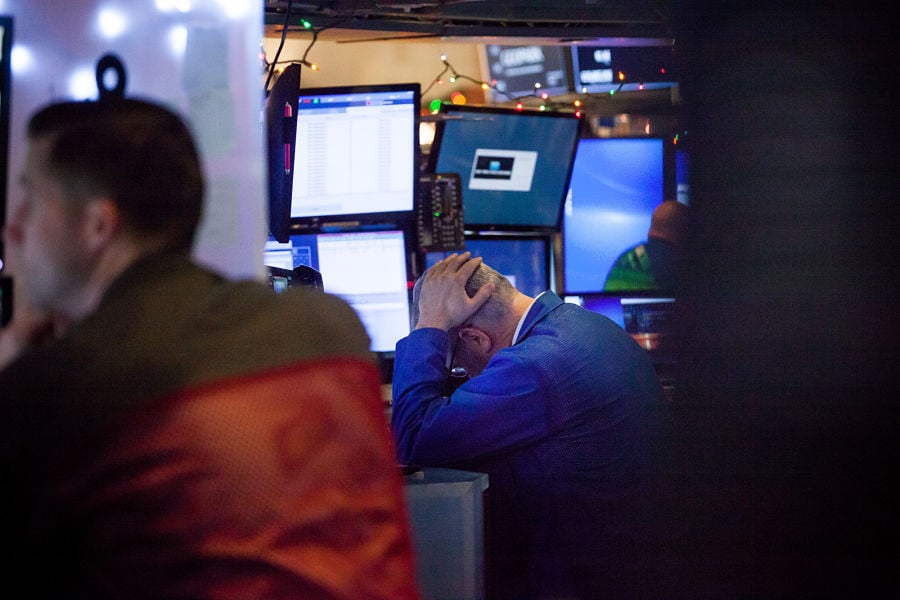
Increased stock market volatility, including the market's 3% drop on Wednesday, has put financial advisers back into a position of defending buy-and-hold investing strategies to nervous clients.
"A big part of our job is convincing people they're on the right path and to stay on that path," said Tim Holsworth, president of AHP Financial Services.
"Nobody has figured out how to successfully move in and out of the market, or if they have, they're keeping it to themselves," Mr. Holsworth said.
Financial markets, which had already been on edge amid ongoing trade wars and tariff threats, reached a new level of anxiety on Wednesday when the spread between the two- and 10-year Treasury note yields turned negative.
Historically, an inverted yield curve is considered an indicator of a looming
recession, although most advisers are quick to point out that the indicator lacks the crucial element of timing.
"An inverted yield curve is absolutely a warning sign, but there's no reason to panic right now," said Chris Zaccarelli, chief investment officer at Independent Advisor Alliance.
"Typically, when 2-10 inverts, it will lead a
recession in around 14 months on average," Mr. Zaccarelli said. "But that range has been between seven months and 20 months, so it's more of a yellow light than a red light."
Mr. Zaccarelli said that he isn't recommending "drastic portfolio changes" in response to the inverted yield curve, but that "it is a good time to reevaluate where you are with your portfolio allocations to trim positions that no longer make sense to hold through a
recession."
The stock market's relative sense of calm through midday Thursday in the midst of an otherwise volatile week is part of a normal market cycle that needs to be closely monitored, said Paul Schatz, president of Heritage Capital.
"I think we've seen most of the price damage, but stocks will go lower in the short term, then scream higher," he said. "On balance, we'll go higher for rest of the year, but not in a straight line,
and volatility will remain high through at least Halloween."
Mr. Schatz expects the stock market to gain another 9% by the end of the year, and he does not expect a recession this year.
However, he is advising clients to embrace a barbell approach to equity investing, which involves investing in things like semiconductor companies on the aggressive side and consumer staples, utilities and real estate on the conservative end.
[Recommended video: Schwab's Jeff Kleintop: Prep for volatility given China trade uncertainties]
When it comes to using the inverted yield curve as an sell signal, Chris Schiffer, executive vice president of AEPG Wealth Strategies, said "market timing is generally a bad idea."
"The people that were hurt most by the great recession are individuals who went to cash because of a market downturn and stayed in cash," he said. "They sold when the market was down and never participated in the rebound."
Especially for investors with a longer time horizon, moving in and out of the market is considered risky because it is virtually impossible to move out at market highs and back in at market lows.
And getting it wrong can be costly.
According to a study by A. Stolz Investment Research and Thompson Reuters, over the 10-year period through January 2017, an investor in the S&P 500 Index who missed just the 10 worst trading days in that period would have enjoyed a cumulative return of 126%, which compares to 58% for an investor who stayed in the market.
However, over the same period, an investor who missed the 10 best days would have gained just 14%.
"Market timing is a really bad idea," said Devin Pope, partner and senior wealth adviser at Albion Financial Group.
"Even if the yield curve inversion ends up predicting a recession, it usually takes around 24 months for the recession to hit and the market run could around 20% from the time of the yield inversion to the peak," Mr. Pope said. "Trying to time the market now could leave a good amount of chips on the table and then if the market goes up, you will be chasing to get back in."