
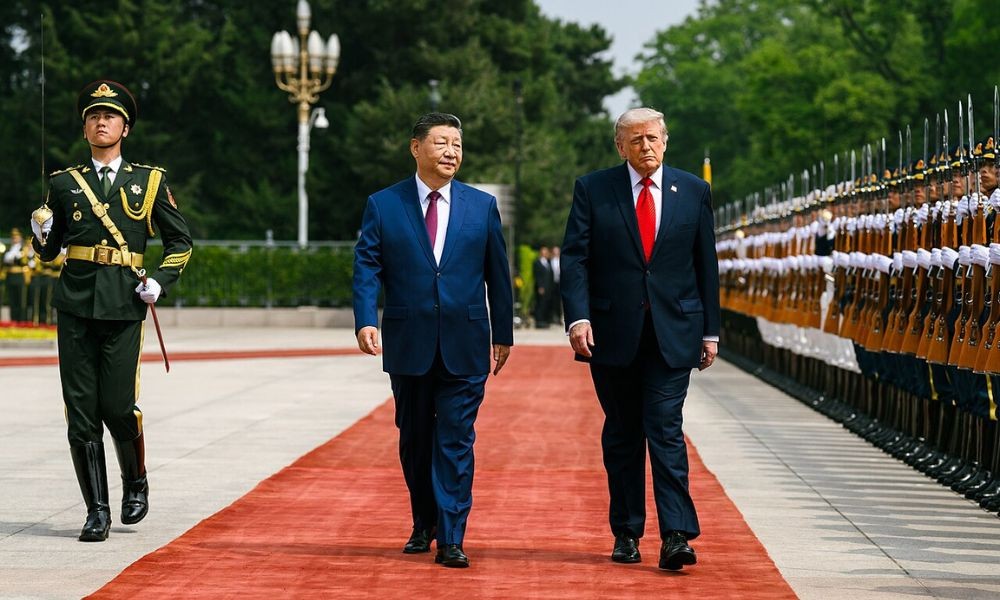
President Donald Trump is set to host his Chinese counterpart Xi Jinping at the White House on Thursday for a closely watched meeting that has implications for U.S. trade and markets.
Trump’s meeting with Xi follows a summit in Beijing earlier this year that was seen as an opportunity for the countries to reset their relationship after years of trade tensions. But sources of friction linger.
More specifically, advisors and their clients should be paying close attention to AI, which is looming large over this week’s meeting. On Sunday U.S. Treasury Secretary Scott Bessent met with Chinese Vice President He Lifeng ahead of this week’s summit between Trump and Xi.
“We just had a very successful engagement with the Chinese on trade and AI,” Bessent told journalists, following the meeting, which took place at the headquarters of JP Morgan Chase in Manhattan.
While AI continues its inexorable rise across industries, including wealth management, there are nonetheless fears about the technology’s impact across society.
Bessent, who was flanked by U.S. Trade Representative Jamison Greer, explained that the two countries had discussed setting up a U.S.-China AI dialogue, as well as a notification mechanism to address AI-related incidents that rise “up to a national security level.”
“We think that, just like any cross-border activity, that moving from opaque to more transparency between the number one and the number two AI powers in the world is very important,” Bessent added.
Set against this backdrop, AI stocks are rising Monday, with Palantir Technologies Inc. (Ticker: PLTR) up 2.4%, Alphabet Inc. (Ticker: GOOG) up 2.1%, Arista Networks Inc. (Ticker: ANET) up 2.5%, outpacing the S&P 500 index, which is up 1.4%, while the tech-heavy Nasdaq is up 2.1%. Chipmaker Nvidia Corp. (Ticker: NVDA), which is a key player in the AI industry, is up 2.2%.
The summit could also influence the ETF landscape. Last week, for example, EMQQ Global’s EMXETF launched its China AI ETF (Ticker: AICH), which provides exposure to companies in the Chinese AI landscape.
Critical minerals will be another key feature of this week’s summit. Citing Chinese customs data, The Financial Times reported Monday that shipments of rare earth magnets from China to the U.S. fell last month. The magnets, which are important for U.S. manufacturing in industries such as tech, are expected to be a source of tension between Trump and Xi this week, according to the Financial Times.
The summit could influence broader market and investor sentiment, according to Fadi Al Kurdi, founder and CEO of FFA Kings, which provides foreign exchange analysis. A constructive outcome potentially supports risk appetite, he said, in a note Monday.
These sentiments were echoed by ING FX strategist Franco Pesole. “While this shouldn’t be a major market event, positive trade headlines could provide some support to the dollar,” he said, in a note released last week.
For advisors, the near-term signal to watch is less about the summit's headlines than what follows it. A softer tone between Washington and Beijing on AI and trade could extend the rally in AI-adjacent names like Palantir, Alphabet, and Nvidia – but could also mean client portfolios with concentrated AI exposure carry more event risk heading into Thursday, not less.
Advisors with clients invested in China-focused AI plays should be prepared to explain how a shift in tone – constructive or contentious – could move those holdings in either direction. And with critical minerals emerging as a friction point, advisors overseeing exposure to U.S. manufacturing and industrials should watch for supply-chain-related volatility regardless of how the AI conversation lands.

Texas securities regulators initially accused Lasater RE Fund of fraud in June but later dropped those claims.

Cornerstone Advisors and Clear Pointe Wealth Management mark an unusual double-team addition for LPL as recruiting run extends in Utah.

Investors were promised guaranteed returns from mobile homes that never existed

The Osaic-acquired broker-dealer failed to catch reps steering 295 clients into costly early UIT sales, regulator finds.

Rick Hu of Midas Wealth breaks down the fee-based planning shift that transformed his advisory practice and reshaped client relationships
As AI makes financial information more accessible than ever, Lana Hock explains why human judgment, trust, and empathy remain the qualities clients value most in a financial advisor
Northern Trust’s Ken Lassner shows advisors how to convert volatility into after-tax portfolio gains

