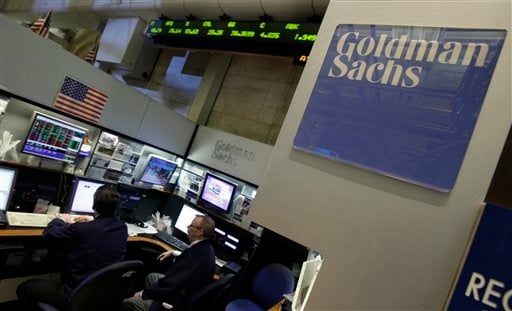
Goldman Sachs Group Inc., which for years saw no need to play a traditional Washington lobbying game, is deploying former lawmakers and crisis specialists as it tries to tamp down the political firestorm threatening its well-honed brand.
The firm's 12-person government affairs office in Washington is aiding what one person involved called a franchise protection strategy in the wake of a Securities and Exchange Commission fraud suit against the firm this month. Advisers include an ex-House Democratic Leader, a chief of staff to President Ronald Reagan, President Bill Clinton's SEC chairman and President Barack Obama's first White House counsel.
The first test of the campaign comes today as Chief Executive Officer Lloyd Blankfein and six other current or former
Goldman Sachs employees testify before a Senate panel investigating the company's role in fueling the subprime loan crisis. The grilling is a turnabout for the firm, which has seen its former partners become Treasury secretaries, top presidential aides and even senators.
“Goldman relied on their top-level connections so they wouldn't have to worry about the public relations and the crisis lobbying,” said Mark Corallo, a former Justice Department spokesman who now provides communications advice to companies. “Seemingly they haven't learned the lesson of politics: In a crisis, it's every man for himself."
The new
Goldman Sachs strategy includes a more open public relations campaign aimed at the public and Congress, as well as a scorched-earth attack on the SEC case.
The bank has seized on the SEC commissioners' 3-2 vote to argue that the agency filed a weak, and perhaps politically timed, lawsuit. The news broke April 16 as the Obama administration was making a big push for legislation overhauling Wall Street regulation.
“You've got a highly contentious series of regulatory reforms, you have a populist electorate that is very angry at the financial community and you have a commission that has been damaged over the years, seeking to restore its credibility as a tough regulator,” said former SEC chairman Arthur Levitt, a
Goldman Sachs adviser. Levitt is a member of the board of Bloomberg LP, the parent of Bloomberg News.
People familiar with
Goldman Sachs's effort say the Washington team has been trying to ensure that lawmakers understand the bank's position. In a rare move, the company recently devoted part of its Web site to a public explanation of its actions in the financial crisis. Its lobbyists invited lawmakers and their aides to listen to the bank's April 20 earnings call, where executives outlined its legal defense.
The firm has been putting more money into Washington. It boosted its lobbying expenditures to $1.2 million during the first three months of 2010 from $670,000 during the same period a year earlier.
Goldman Sachs's political action committee contributed a total of $290,500 to both parties in March.
In prior years,
Goldman Sachs earned the nickname “Government Sachs” because its entrée in Washington often was based on its own alumni, who have included Treasury Secretaries Henry Paulson and Robert Rubin. President George W. Bush's chief of staff Joshua Bolten worked at
Goldman Sachs as did Jon Corzine, who was a senator and then governor of New Jersey.
The investment bank began rebuilding its Washington operation in the middle of 2008. Early this month, with the Senate and SEC investigations heating up,
Goldman Sachs brought in several new consultants with ties to the capital's power brokers.
Leading the communications side is Mark Fabiani, a former special counsel to Clinton who advised the former president on political, media and legal responses to the Whitewater scandal. Another new consultant is Stephen Labaton, who covered the SEC as a reporter for the New York Times.
The firm has turned to Obama's former counsel Greg Craig to mastermind its legal defense for the subprime probe by the Senate Permanent Subcommittee on Investigations. A partner in the Washington office of the Skadden, Arps, Slate, Meagher & Flom law firm, Craig led the legal defense team for Clinton's impeachment trial.
Craig and the other recent hires also face the challenge of helping
Goldman Sachs navigate the Financial Crisis Inquiry Commission, the group set up by Congress to investigate the reasons for the economic collapse
Overseeing the
Goldman Sachs Washington office is Michael Paese, a former top staffer to House Financial Services Committee Chairman Barney Frank. Frank, in a move that underscores some of the bank's challenges, took the unusual step last year of banning Paese from lobbying the panel on the regulatory-overhaul bill, even though he was allowed to under federal law.
Under Paese are Todd Malan, a Republican who was head of a trade association for U.S. subsidiaries of foreign companies, and Kenneth Connolly, who was staff director for the Senate Environment and Public Works Committee.
Other recent hires include: Michael Thompson, a former staff member for Wyoming Republican Senator Mike Enzi; Joyce Brayboy, who worked for Democratic Representative Mel Watt of North Carolina; Eric Edwards, Democrat and former aide to a House Financial Services subcommittee; and Joe Wall, a former aide to Vice President Dick Cheney.
While
Goldman Sachs uses about a dozen outside firms, its most prominent hired guns included former Democratic House Leader Richard Gephardt and Kenneth Duberstein, a Reagan chief of staff.
Gephardt's former chief of staff, Steve Elmendorf, is another one of the bank's primary lobbyists, as are former Democratic Representative Harold Ford Jr. of Tennessee and Richard Roberts, a former SEC commissioner and chief of staff to Richard Shelby, the top Republican on the Senate Banking Committee.
Some Wall Street observers predicted that even with all the new firepower,
Goldman Sachs faces an uphill battle in Washington.
“They are tarnished. I don't think they can regain their luster,” said Charles Geisst, a finance professor at Manhattan College in New York. “I wouldn't want to be the next president to appoint a
Goldman Sachs person to the Fed or wherever.”