

For the past 14 years, we’ve been studying the relationship between leadership behaviors and fiduciary responsibility. The research has been focused on the question: Do exemplary fiduciaries demonstrate the same behaviors as distinguished leaders?
The answer: It appears so.
More work needs to be done to psychometrically validate the research, but preliminary results indicate a strong correlation between genuine leaders and authentic fiduciaries.
We’re basing our studies on groundbreaking peer-reviewed published research in the new field of neuro-leadership. This work was conducted by Dr. Sean Hannah and his research collaborators, Dr. David Waldman, Dr. Pierre Balthazard, Dr. Robert Thatcher and others. (In the interest of full disclosure, Hannah, who is a tenured research professor at Wake Forest University, is also one of the founders of the new Center for Board Certified Fiduciaries.)
We’re learning to harness the power of neuroscience to increase our understanding of what makes an exemplary fiduciary. Such a discernment is vital to the training and development of the more than 17.5 million men and women who serve in an investment fiduciary capacity. Ever hear of a ‘lay fiduciary’? There are 17.5 million of them.
Central to the research in neuro-leadership is the identification of six neurological markers — hot spots in the brain — that distinguish the exemplary leader. These same six markers are now the basis for our studies in neuro-fiduciary.
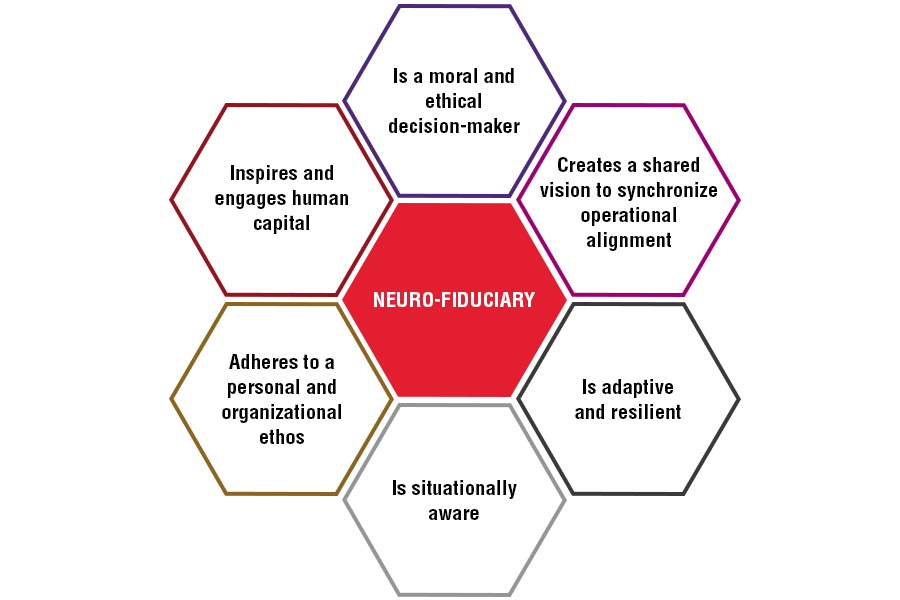
1. Procedural justice: The capacity for ethical leadership, particularly your ability to enact a fair, just and transparent process to resolve moral conflicts or to allocate limited resources.
2. Vision/Inspiration: The capacity for inspirational leadership and your ability to define an engaging vision for the future. This requires a sense of purpose and passion for that purpose.
3. Self-complexity: The capacity to understand one’s own self within changing roles and requirements. This requires an ability to adjust and adapt your thoughts and behaviors to enact more appropriate responses to ill-defined, changing and evolving situations.
4. Situational awareness: The capacity to: (a) perceive changes in one’s environment, (b) interpret changes to determine whether and how changes may impact goals and objectives, and (c) make predictions as to how changes may impact future events.
5. Executive control: The capacity to resolve conflicts between an impulsive desire and adherence to a higher moral order.
6. Social astuteness: Your capacity for: (a) social intelligence, (b) interpersonal influence, (c) networking ability and (d) sincerity.
The pandemic has reinforced the importance of neuro-fiduciary training. Four neurological markers, in particular, were seen to be critical success factors. Advisers who excelled during the crisis demonstrated a greater capacity for vision/inspiration, self-complexity, situational awareness and social astuteness.
The critical role of the fiduciary means that we need to train on much more than rules and regulations. Furthermore, whether advisers is subject to fiduciary status, or not, they will be far more successful if they focus more attention on developing their leadership behaviors.
Don Trone is CEO of the new Center for Board Certified Fiduciaries.

Shorter waits for failed SIE and Series 7 candidates take effect Jan. 19, speeding the path to registration

Raymond James and Cetera also welcomed advisors from UBS and LPL as competition for experienced teams stays fierce

Jim Walesa worked in the securities industry for 39 years before leaving in 2021.

As the market turned from pricing in cuts to betting on hikes this year, the developing reality of a K-shaped economy has had real implications for households and investors alike.

Alleged cash payments, stolen client data, and a court that jumped the gun
Knighthead Life entered the market with a competitive MYGA. A strong launch earned advisor confidence and paved the way for FIAs.
As AI makes financial information more accessible than ever, Lana Hock explains why human judgment, trust, and empathy remain the qualities clients value most in a financial advisor

