
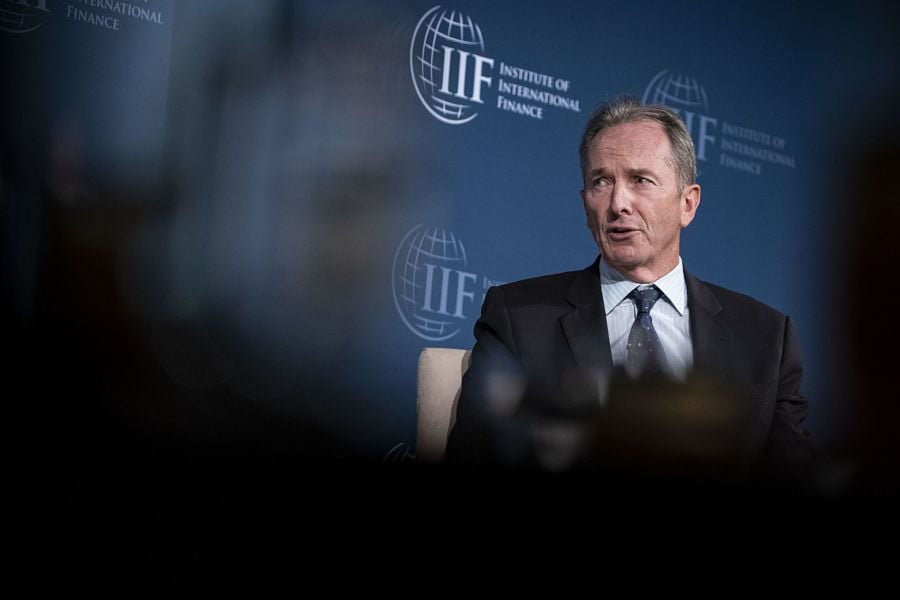
A tense election highlighted by political fractures and social unrest combined with the COVID-19 pandemic that could last well into next year and an economy that’s struggling in many areas should make investors cautious, Morgan Stanley chief executive James Gorman said Monday.
The country is in “a lot of turmoil and uncertainty,” Gorman said during the virtual Securities Industry and Financial Markets Association annual conference. “The prudent investor doesn’t try and get greedy.”
Investors and Morgan Stanley are choosing a “workspace close to shore,” Gorman said. “We’re managing our risks, I think, prudently. Some might be more aggressive. I don’t care. If that means we lose some revenue to them, we would rather be secure.”
He noted the stock market is at record highs and interest rates are at record lows. Technology is growing rapidly while other sectors, such as tourism and hospitality, are faltering, producing a situation in which “there are extremely healthy pockets and there are much unloved pockets of the markets,” Gorman said.
“In this environment, I think, again, the catch word is uncertainty, and in periods of uncertainty, you should be a little cautious,” Gorman said. “That’s certainly how we’re running Morgan Stanley.”
He said wealth management clients are “much more sober through this. I’ve been kind of surprised at how little variation there has been in their activity. People with serious money have been quite prudent through this; they haven’t been swinging for the fences at all.”
Morgan Stanley recently expanded its position in the retail wealth management business by closing its acquisition of ETrade. The deal has given Morgan Stanley a digital platform to complement its full-service advice offering.
Scooping up ETrade gives Morgan Stanley customers greater latitude in choosing how they want investment advice delivered, Gorman said. “If you don’t give them that choice, they will take their money elsewhere,” he said.
Morgan Stanley also is purchasing Eaton Vance, which will augment the asset management side of its business. The firm will generate about half of its revenues on the institutional investment side and about half from asset and retail wealth management, Gorman said.
The firm is seeking “a combination of speed and growth with ballast and steadiness,” Gorman said.
The Wall Street leader touted socially sustainable investing, which has been under regulatory scrutiny. He said there will continue to be strong demand for investing based on environmental, social and governance factors.
“ESG investing is not a fad,” Gorman said. “People are concerned and they want to invest where their heart tells them to invest.”
He also addressed diversity in the financial industry, saying that much work still needs to be done. “We are not where we need to be,” Gorman said. “We’ve done better from a low base.”
Morgan Stanley is establishing an institute on diversity and inclusion to analyze the firm’s efforts in the area, Gorman said. It will be similar to an institute on sustainability it created in 2014.
“We want to move the needle,” said Gorman, who will chair the diversity institute. “We are going to make a difference."

Why “one big pool of money” needs predictability—and a plan.

Advisor recruiting climbed to its strongest pace in nearly two years, while CEO Richard Steinmeier said the firm has "cleared the decks" for bigger institutional deals.

The combinations involving MirrorWeb and AdvisorRankings illustrate how AI is reshaping both wealth firm operations and wealthtech platforms' business models.

New 5-in-1 onboarding tool aims to cut subscription paperwork as advisor demand for private markets accelerates

Connecting unique offerings with a specific client niche is a sure path to advisor satisfaction and success – but it all has to start with an intentional strategy.
Northern Trust’s Ken Lassner shows advisors how to convert volatility into after-tax portfolio gains
Dan Biagini of American Equity says the steady decline of pensions, longer lifespans and a reset in interest rates are rewriting how advisors build retirement income

